How Can You Verify Overseas Farm Machinery Parts Lead Times Before Buying?

Key Takeaways
- The Kyiv Independent Hit by Suspected Russian CyberattackIT & Security Director
- What is editorial exposure and how does it differ from paid advertising?IT & Security Director
- Apple Warns Users in 99 Countries of Spyware; German Lawmakers' Devices SuspectedIT & Security Director
- How to write technical content for exporters selling machinery abroadChief Civil Engineer
- BW ESS Brings Hams Hall, Europe's Largest Operating Battery Storage Project, OnlineAutomotive Tech Analyst
- How to size electric motors for pumpsChief Civil Engineer
- Trump Administration Pledges $15 Billion in Farm Aid Ahead of Midterm ElectionsAgri-Tech Strategist
- When does automated food processing technology pay for itself?Agri-Tech Strategist
Industry Overview
We do not just publish news; we construct a high-fidelity digital footprint for our partners. By aligning with TNE, enterprises build the essential algorithmic "Trust Signals" required by modern search engines, ensuring they stand out to high-net-worth buyers in an increasingly crowded global digital landscape.
How Can You Verify Overseas Farm Machinery Parts Lead Times Before Buying?
A delayed replacement bearing or hydraulic pump can leave farm equipment idle during a critical harvest window. If you are asking, “How can I verify overseas farm machinery spare-part lead times before ordering?” start by separating supplier promises from documented milestones. Confirm stock for the exact part number, investigate any production dependencies, and check freight estimates against customs and final delivery requirements.
The real question is not whether a supplier can “ship quickly.” It is whether the correct, usable component can reach your maintenance team before the machine needs to return to work. That requires checking the entire delivery chain—not just the date printed on a quotation.
Define which date the supplier is actually promising
“Lead time: ten days” is incomplete. It may mean ten working days after payment, after drawing approval, or after a factory receives material. It may end when the part leaves production rather than when a carrier collects it. None of those dates necessarily tells you when the component will arrive at the farm.
Ask the supplier to distinguish stock availability, ready-for-collection date, expected departure, destination arrival, and delivery to the named receiving address. Specify calendar or working days and the event that starts the clock. Holidays, payment clearance, and technical approval can otherwise create gaps before the quoted countdown even begins.
Build the timeline backwards from the required operating date. Allow time after delivery for receiving inspection, fitting, adjustment, and testing where necessary. A hydraulic pump arriving on the morning harvesting resumes may already be too late.
Verify the part before verifying its availability
An accurate delivery estimate for the wrong component has no procurement value. Agricultural equipment can have serial-number breaks, regional specifications, and revised assemblies that look similar in a catalogue. Begin with the machine model, serial number, original part number, required quantity, and any superseded references.
For interchangeable parts, obtain written confirmation of the characteristics that determine fit and function. Depending on the component, these could include shaft dimensions, spline configuration, mounting arrangement, hydraulic displacement, seal material, bearing clearance, connector type, or software compatibility. Photographs help identify differences, but they do not replace drawings or manufacturer compatibility information.
Make the quoted lead time conditional on that agreed specification. If a supplier offers a substitute, ask whether it is physically available or whether the substitute itself needs sourcing. “Equivalent available” can hide another round of technical approval and purchasing.
Ask for evidence that matches the stock claim
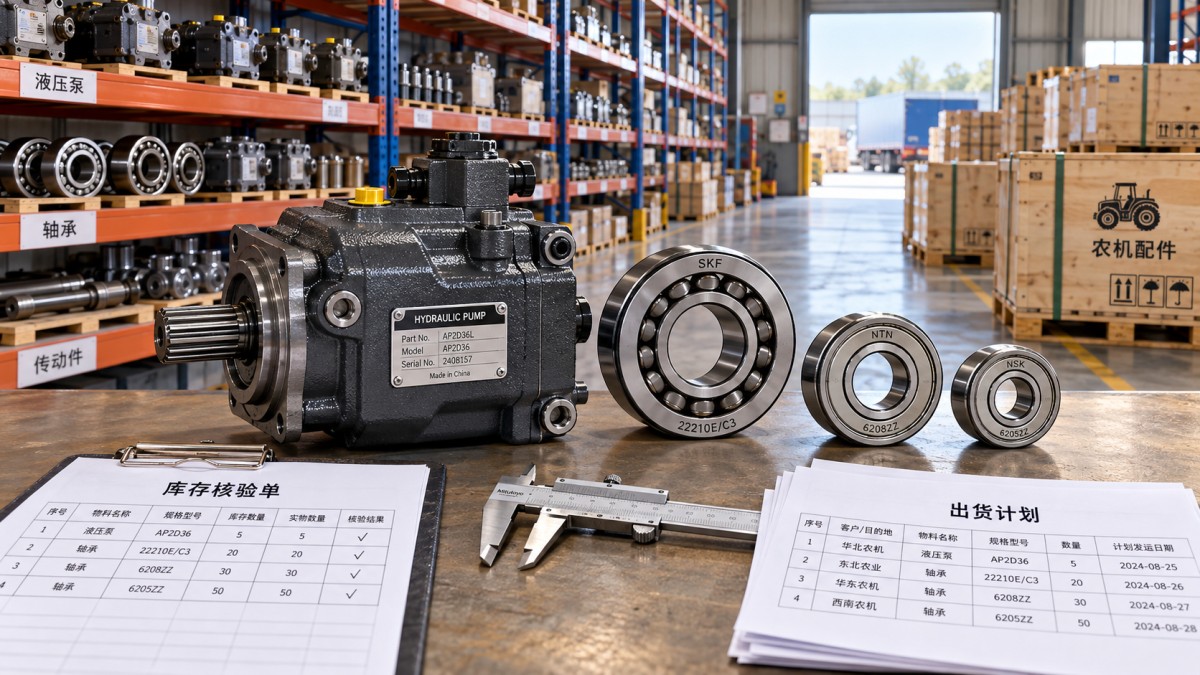
“In stock” may refer to inventory at the seller’s warehouse, a distributor’s location, or an upstream factory. Those situations have different collection and allocation risks. Establish who physically holds the parts, where they are located, and whether the quantity is free to sell rather than already committed.
For a critical order, request a live video check or independent inspection proportionate to the purchase risk. A photograph alone can be old or show another buyer’s goods. Ask for the packaging labels and part markings to be shown together, with an order-specific reference where practical.
Then establish the reservation terms: what secures allocation, how long the reservation lasts, and whether the supplier will confirm it in writing. Stock evidence without allocation evidence is only a snapshot.
For manufactured parts, find the dependency most likely to slip
A production estimate is credible only when its assumptions are visible. Ask which operations are complete, which inputs are available, and which steps depend on outside companies. A machined housing may still need heat treatment or coating. A pump assembly may be waiting for seals or a purchased control component.
You do not need the factory’s entire planning system. You need an order-specific sequence showing material readiness, the production slot, subcontracted operations, assembly, required inspection or testing, and packing. Ask which milestone currently determines the completion date and whether its capacity has been confirmed.
Also clarify what “finished” means. If acceptance requires a dimensional report or agreed functional test, the dispatch date must allow for that work and for resolving any nonconformity. Expediting by skipping agreed checks can exchange a delivery delay for a failure after installation.
Validate the journey independently of the sales quotation
Send the proposed shipment details to your freight forwarder before paying: collection address, destination, cargo description, package count, gross weight, dimensions, value, and expected ready date. Without those details, a freight estimate may describe a general service rather than a workable movement for your order.
Ask the forwarder to separate collection, export handling, main transport, import clearance, and final delivery. Airport-to-airport transit is not door-to-farm lead time. Rural delivery coverage, terminal opening hours, missed cutoffs, and onward connections may matter as much as the main transport leg.
Confirm the Incoterms® rule, version, and named place in the quotation. These establish important responsibilities and risk-transfer points, but do not by themselves guarantee a delivery date. Under an EXW arrangement, for example, the buyer needs to resolve collection and export arrangements rather than assume the seller’s dispatch estimate covers them.
Before collection, have the appropriate broker review the proposed customs classification and documentation requirements. Commercial invoices, packing lists, origin information, and any applicable permits or declarations should describe the actual goods consistently. Requirements depend on the product and destination; do not assume that all machinery spares receive identical treatment.
Flag used components, residual fluids, batteries, and wooden packaging where relevant. These can affect carrier acceptance or import requirements. A label saying “tractor parts” may not provide enough information for either the carrier or customs broker.
Compare arrival confidence, not just quoted speed
A short quotation supported by vague assumptions can be less useful than a longer schedule backed by allocated stock and a checked transport plan. Compare suppliers against the same endpoint: the correct part delivered to your receiving location, with the documents needed for clearance and acceptance.
Request an expected arrival date and a credible delayed scenario. The latter should reflect identifiable exposure—an unconfirmed production slot, a weekly departure, or a missing document—not an arbitrary buffer. Avoid adding every activity sequentially when some can run in parallel, but do not overlap tasks that genuinely depend on each other.
Previous shipment records can support a discussion about performance. If offered, ask whether they concern comparable goods, routes, transport modes, and seasons. A tracking record for a small courier parcel says little about moving a crated gearbox by consolidated freight.
For harvest-critical equipment, consider splitting the requirement: send the machine-stopping component by a faster service while less urgent spares follow separately. Check the additional handling and clearance costs before deciding. Faster transport is useful only if the goods are ready to move.
Turn the verified timeline into an order commitment
The purchase order should preserve what you verified, rather than revert to a generic lead-time statement. Record the agreed part specification, quantity, allocation status, timing trigger, ready date, delivery responsibilities, required documents, and acceptance requirements. Identify who must report a missed milestone and when.
Where commercially feasible, link payment stages to observable events rather than unsupported progress claims. Inspection evidence, release documentation, and carrier collection confirmation serve different purposes. A shipping label or booking reference alone does not establish that the carrier has received the goods.
Agree on exception handling before funds move: whether partial shipments are acceptable, whether substitutions require approval, and what happens if the ready date slips. Cancellation rights, refunds, or other remedies should be written clearly and reviewed for the relevant contract and jurisdiction. They are not automatic guarantees of recovery.
This distinction between a claim and its supporting evidence is central to TradeNexus Edge’s approach to B2B supply-chain intelligence. For agricultural procurement, market context can help identify sourcing risks, but an individual order still needs its own technical, inventory, and logistics checks.
Before authorizing payment, ask one final question: which remaining assumption could still prevent this part from reaching the workshop on time? If the answer is unresolved compatibility, unallocated stock, or an unchecked freight route, the lead time is not yet verified. Resolve that dependency—or choose a sourcing plan that can tolerate it.
Deep Dive
Related Intelligence
 Aftermarket PartsWhat Strategic Link Gaps Are Slowing Down Aftermarket Parts Distribution in Agri-Drones Service Networks?Analyst:Automotive Tech Analyst
 Aftermarket PartsCan aftermarket auto parts meet OEM durability standards without voiding vehicle warranties in 2026?Analyst:Automotive Tech Analyst
 Aftermarket PartsHow do aftermarket auto parts impact fleet maintenance costs for construction equipment operators?Analyst:Automotive Tech Analyst