How Can Buyers Verify Aftermarket Suspension Bushing Rubber Specs?
Key Takeaways
- The Kyiv Independent Hit by Suspected Russian CyberattackIT & Security Director
- What is editorial exposure and how does it differ from paid advertising?IT & Security Director
- Apple Warns Users in 99 Countries of Spyware; German Lawmakers' Devices SuspectedIT & Security Director
- How to write technical content for exporters selling machinery abroadChief Civil Engineer
- BW ESS Brings Hams Hall, Europe's Largest Operating Battery Storage Project, OnlineAutomotive Tech Analyst
- How to size electric motors for pumpsChief Civil Engineer
- Trump Administration Pledges $15 Billion in Farm Aid Ahead of Midterm ElectionsAgri-Tech Strategist
- When does automated food processing technology pay for itself?Agri-Tech Strategist
Industry Overview
We do not just publish news; we construct a high-fidelity digital footprint for our partners. By aligning with TNE, enterprises build the essential algorithmic "Trust Signals" required by modern search engines, ensuring they stand out to high-net-worth buyers in an increasingly crowded global digital landscape.
A suspension bushing can fit perfectly and still behave incorrectly on the road. Rubber that is too stiff may transmit vibration into the cabin; a compound with inadequate fatigue resistance may crack despite passing a basic hardness check. For buyers asking, “How do I verify the rubber specification of aftermarket suspension bushings?” the answer starts with traceable evidence—not a catalog description.
Verification means connecting an agreed material specification to relevant laboratory results, production records, and finished-part performance. Dimensions matter, but they cannot establish whether a bushing will deliver the required compliance, durability, or resistance to its operating environment.
What should a suspension bushing rubber specification actually include?
A usable specification describes both the rubber compound and the conditions under which its properties are measured. “Automotive-grade rubber” and “OEM quality” are not measurable acceptance criteria.
Before approving samples, request a controlled specification or drawing that identifies:
- Elastomer family and compound identification: for example, a natural-rubber-based compound, together with the supplier’s unique compound code and revision.
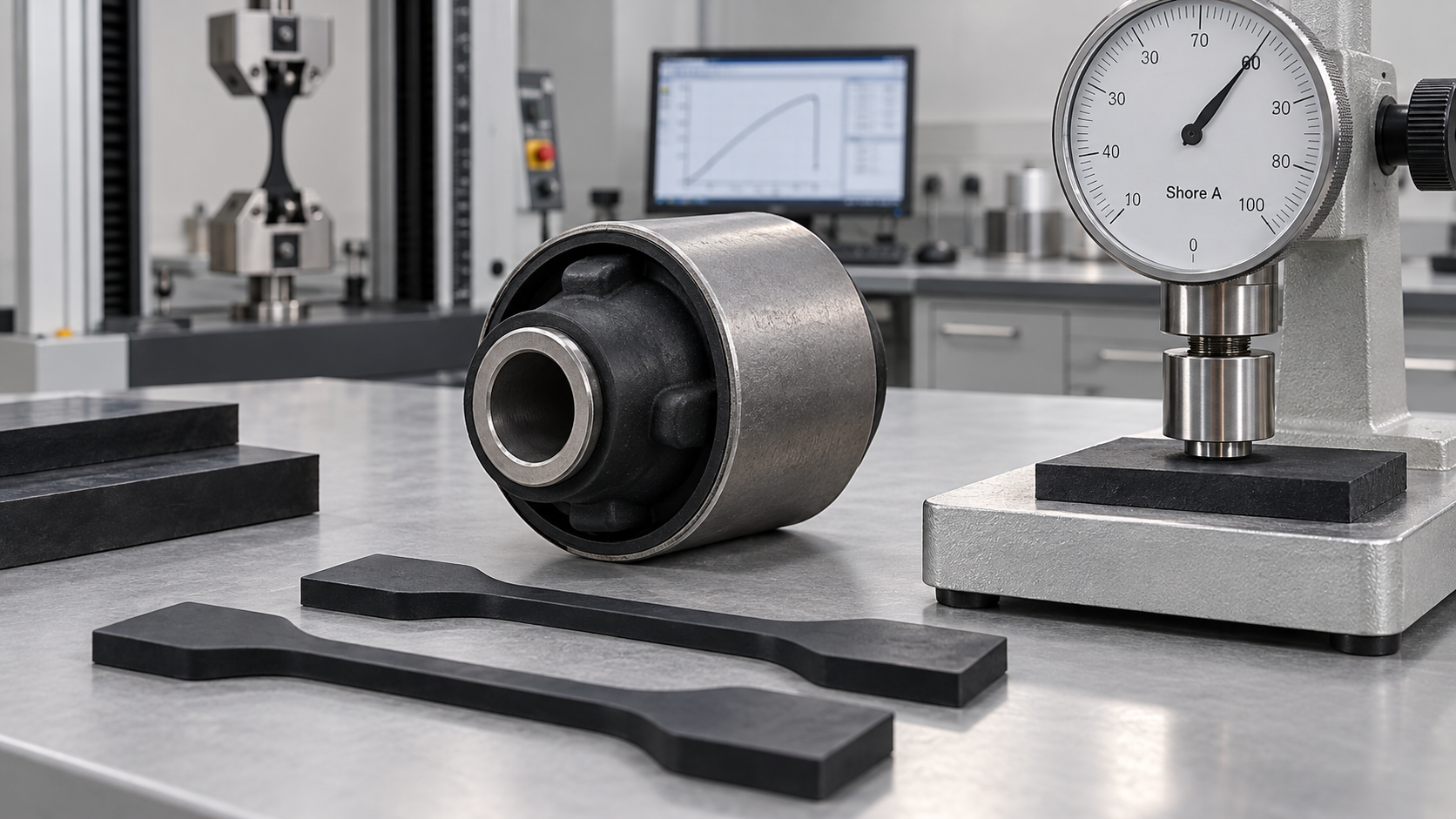
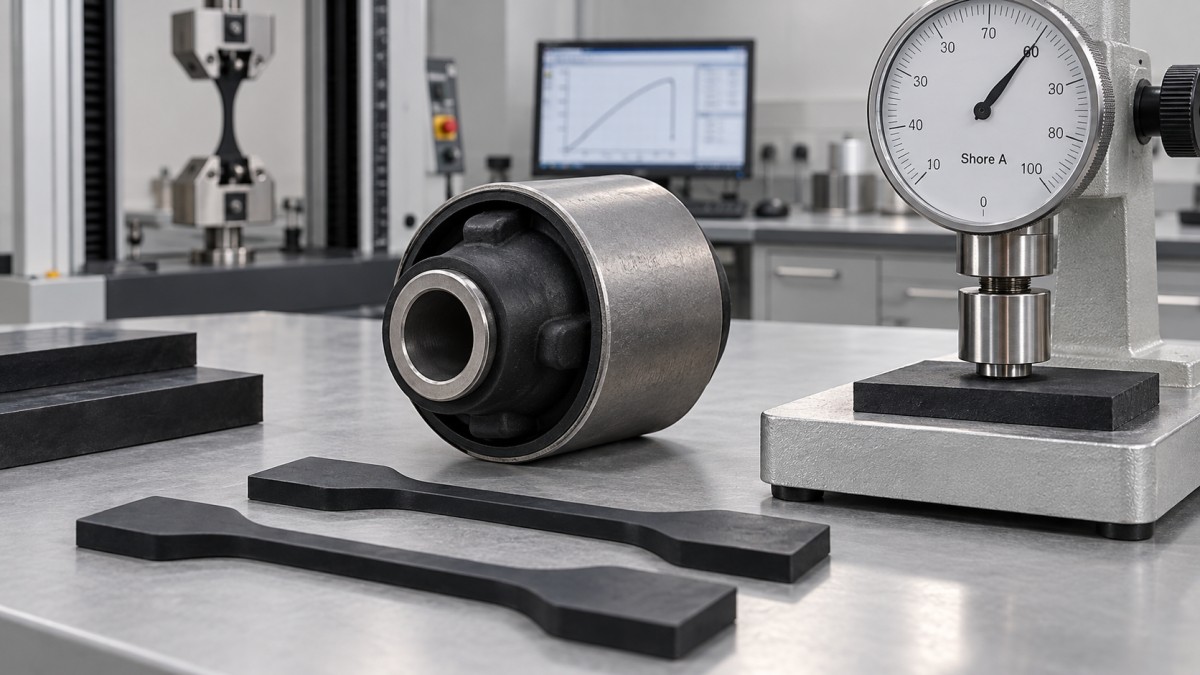
- Hardness: the required Shore A value or range, test method, specimen requirements, and conditioning.
- Mechanical properties: tensile strength, elongation at break, and any specified stress-at-elongation requirements.
- Environmental resistance: heat aging, ozone exposure, low-temperature behavior, and fluid exposure where relevant.
- Permanent deformation limits: compression set under defined time, temperature, and deflection conditions.
- Assembly requirements: rubber-to-metal adhesion, stiffness characteristics, and fatigue performance appropriate to the bushing design.
Each requirement needs an acceptance limit and a test procedure. A result without its conditions is difficult to compare and easy to misinterpret.
How can buyers establish requirements without access to the OEM rubber formula?
The exact original formulation is often proprietary. Fortunately, buyers do not need the complete recipe to establish meaningful performance requirements.
Start with the vehicle application, bushing location, load directions, operating temperatures, likely contaminants, and intended service duty. A control-arm bushing and an anti-roll-bar mounting bushing may require different behavior even when their rubber looks similar.
Where legitimate reference parts are available, comparative testing can establish a baseline for hardness, stiffness, material characteristics, and durability. Record the reference part’s source, condition, and identification. An aged or used part is a poor baseline for new-rubber properties because service exposure can change hardness and elasticity.
Benchmarking supports an engineering comparison; it does not prove OEM equivalence. If original acceptance limits are unavailable, document the agreed aftermarket requirements and the rationale behind them rather than presenting inferred targets as official specifications.
Which supplier documents provide useful evidence?
Ask for documentation before negotiating around sample appearance or unit price. The important distinction is between a general supplier capability and evidence linked to the material you will actually receive.
A certificate of conformity may simply declare compliance without showing measurements. Quality-management certifications, including IATF 16949 where applicable, provide context about supplier systems; they do not certify a particular bushing’s rubber specification.
Is Shore A hardness enough to verify aftermarket bushing rubber?
No. Hardness is useful for screening, but two compounds with the same Shore A reading can differ substantially in damping, fatigue resistance, tensile behavior, and temperature response.
ASTM D2240 or ISO 48-4 can provide a basis for durometer testing. However, a handheld reading on a curved, thin rubber section close to a metal sleeve may be influenced by geometry and substrate support. It should not automatically be treated as equivalent to a compliant laboratory specimen result.
Ask whether hardness was measured on a molded test plaque, a suitable specimen cut from the part, or the finished assembly. Confirm the conditioning temperature, specimen thickness, contact location, and reading time. Use the same agreed method when comparing suppliers.
If the supplier measures one way and your receiving team measures another, an apparent material disagreement may actually be a measurement disagreement.
Which laboratory tests should buyers prioritize?
The right test package follows the application’s risks. The methods below are commonly relevant, but none supplies a universal pass/fail limit for every suspension bushing.
Tensile strength and elongation
ASTM D412 or ISO 37 can assess tensile properties using defined specimens. Request both tensile strength and elongation at break; where specified, stress at a defined elongation adds useful information about compound behavior.
Confirm how the specimens were prepared. Separately molded laboratory sheets may not experience the same cure history as a thick finished bushing. Plaque results are valuable for compound control, but they do not replace assembly validation.
Heat aging and compression set
Heat-aging evaluation, using methods such as ASTM D573, checks how properties change after controlled exposure. Compare retained properties or changes against agreed limits, not just the unaged values.
Compression-set testing under ASTM D395 or ISO 815-1 assesses permanent deformation after specified compression and recovery. Time, temperature, compression method, and recovery conditions must accompany the result. A favorable compression-set value alone does not predict multiaxial suspension fatigue life.
Ozone and fluid resistance
ASTM D1149 or ISO 1431-1 can support ozone-resistance assessment under defined exposure and strain conditions. For fluid exposure, ASTM D471 or ISO 1817 can help evaluate changes in volume, mass, hardness, or mechanical properties.
Specify the relevant fluid and exposure conditions. “Oil resistant” is too broad to function as a purchasing requirement.
Rubber-to-metal adhesion
For bonded bushings, the bond is part of the specification. Methods within ASTM D429 may be appropriate for evaluating adhesion, depending on specimen and assembly configuration.
Request the failure location as well as force or strength. Separation at the interface and tearing within the rubber tell different stories. Neither should be judged without the agreed test geometry and acceptance criteria.
Can a laboratory confirm which rubber polymer the supplier used?
Often it can help identify the elastomer family, but identifying a polymer is not the same as verifying an entire formulation.
Fourier-transform infrared spectroscopy can support polymer identification, while thermogravimetric analysis can provide information about decomposition behavior and broad formulation fractions. Filled, blended, or aged compounds may require complementary techniques and specialist interpretation.
Such testing can investigate a suspected material substitution or establish a comparison fingerprint. It generally cannot reconstruct the exact proprietary recipe, processing history, or service performance from one measurement.
Be cautious about assuming one elastomer is always superior. Natural-rubber-based compounds are widely used where dynamic performance matters. Other elastomers offer different environmental advantages, with corresponding trade-offs. EPDM, for example, generally offers good weathering resistance but is unsuitable for many petroleum-oil exposures. Selection must match the application, not a marketing hierarchy.
Why can rubber pass material tests while the finished bushing fails?
A bushing is an engineered assembly, not simply a piece of rubber. Geometry, void orientation, sleeve dimensions, rubber thickness, cure state, and bonding preparation all influence its response.
A compound can meet tensile and hardness limits while the finished part has incorrect radial stiffness. Likewise, satisfactory test plaques will not reveal every problem caused by contamination at the metal surface or inconsistent production curing.
For initial qualification, request load-deflection testing in the relevant directions: radial, axial, torsional, or a defined combination. Where ride and vibration behavior matter, dynamic stiffness and damping should be evaluated at specified frequencies, amplitudes, temperatures, and preloads.
Durability testing should reproduce the important loading modes and installation conditions as closely as practical. For designs using bonded sleeves, installation position and tightening procedure can affect rubber preload. A cycle count is meaningful only when the loading profile and failure definition are stated.
When is independent testing worth the cost?
Independent verification is especially useful when qualifying a new supplier, investigating inconsistent service life, evaluating a material change, or purchasing parts with significant handling and safety implications.
Choose a laboratory accredited to ISO/IEC 17025 for the relevant methods where available. Accreditation has a defined scope; it does not mean every test a laboratory offers is accredited.
Protect the sample chain as carefully as the test method:
- Collect samples from identifiable production lots rather than relying only on supplier-selected development pieces.
- Record part numbers, lot markings, packaging, collection dates, and sample condition.
- Agree on conditioning, specimen preparation, methods, and acceptance limits before testing.
- Retain comparison samples and link reports to the tested parts and compound batches.
For routine deliveries, a risk-based inspection plan can combine document review, visual and dimensional checks, appropriate hardness screening, and periodic laboratory testing. There is no universal sampling frequency: supplier history, production variability, order volume, and failure consequences should determine it.
What warning signs should stop an approval?
Pause when a supplier provides identical “actual” results across multiple batches without a credible explanation, reports no test conditions, cannot connect a compound code to shipped parts, or substitutes broad claims for measurable limits.
Another concern is a material change described as insignificant because hardness remains unchanged. Polymer source, filler system, cure package, bonding agent, and manufacturing site can affect performance without producing an obvious hardness shift.
Require written notification and an agreed revalidation process for relevant changes. Before approving volume purchases, establish who authorizes deviations, how affected lots are segregated, and what evidence is required for release.
What is the minimum practical verification approach?
Build a documented chain: application requirements, controlled compound specification, batch-linked material results, finished-part validation, and ongoing production checks. Keep acceptance limits and test conditions together so that procurement, engineering, the supplier, and the laboratory are evaluating the same requirement.
If budget is limited, prioritize tests against the most consequential risks rather than ordering an unfocused package. Hardness and identity checks can screen for some discrepancies; they cannot substitute for adhesion or fatigue testing when those are the likely failure modes.
The purchasing question is not simply whether the rubber “looks right.” It is whether the supplier can demonstrate, repeatedly and traceably, that the specified material and finished bushing meet the requirements of the intended application.
Deep Dive
Related Intelligence
 Aftermarket PartsWhat Strategic Link Gaps Are Slowing Down Aftermarket Parts Distribution in Agri-Drones Service Networks?Analyst:Automotive Tech Analyst
 Aftermarket PartsCan aftermarket auto parts meet OEM durability standards without voiding vehicle warranties in 2026?Analyst:Automotive Tech Analyst
 Aftermarket PartsHow do aftermarket auto parts impact fleet maintenance costs for construction equipment operators?Analyst:Automotive Tech Analyst