Could Chemical Exposure Cause Early Fleet Engine Mount Failure?
Key Takeaways
- The Kyiv Independent Hit by Suspected Russian CyberattackIT & Security Director
- What is editorial exposure and how does it differ from paid advertising?IT & Security Director
- Apple Warns Users in 99 Countries of Spyware; German Lawmakers' Devices SuspectedIT & Security Director
- How to write technical content for exporters selling machinery abroadChief Civil Engineer
- BW ESS Brings Hams Hall, Europe's Largest Operating Battery Storage Project, OnlineAutomotive Tech Analyst
- How to size electric motors for pumpsChief Civil Engineer
- Trump Administration Pledges $15 Billion in Farm Aid Ahead of Midterm ElectionsAgri-Tech Strategist
- When does automated food processing technology pay for itself?Agri-Tech Strategist
Industry Overview
We do not just publish news; we construct a high-fidelity digital footprint for our partners. By aligning with TNE, enterprises build the essential algorithmic "Trust Signals" required by modern search engines, ensuring they stand out to high-net-worth buyers in an increasingly crowded global digital landscape.
Yes—chemical exposure can cause engine mounts to fail early when leaking fluids, cleaning products, or other contaminants attack the mount’s rubber compound or rubber-to-metal bond. Heat, repeated wetting, and engine movement can accelerate the damage. However, an oily mount is not proof of chemical failure: contamination may be incidental, and a hydraulic mount may be wet because it has already leaked internally.
The strongest evidence is a consistent connection between the exposure source, the damaged area, and an abnormal change in the material. Before replacing another set of mounts, establish whether the problem follows a fluid leak, a cleaning practice, a particular replacement batch, or excessive mechanical loading. Those patterns lead to different corrective actions.
How do chemicals damage an engine mount?
An engine mount must carry powertrain weight while controlling movement and isolating vibration. Its rubber is therefore a working spring, not simply a protective cushion. Chemical exposure can change how that spring behaves before the mount develops an obvious tear.
Depending on the compound and chemical involved, exposure can produce:
- Swelling and softening: A fluid enters the rubber and changes its dimensions and stiffness. The mount may sag, allow excessive engine movement, or lose clearance around surrounding components.
- Hardening or embrittlement: Chemical interaction, extraction of compound ingredients, or combined chemical and thermal aging can reduce flexibility and make cracking easier.
- Loss of strength: Rubber that still looks broadly intact may become less resistant to repeated stretching and tearing.
- Bond deterioration: Exposure can weaken the rubber-to-metal interface or promote corrosion around it, contributing to separation.
Mechanical loading then acts on the weakened material. A softened mount may deflect farther during acceleration; a hardened mount may concentrate strain around existing cracks. Chemical attack and fatigue are therefore not competing explanations. Chemical degradation can shorten the time needed for normal operating loads to produce failure.
Exposure severity depends on more than the chemical name. Concentration, temperature, contact time, repeated application, and whether fluid drains away or remains trapped all matter. A brief splash onto a cool surface is not equivalent to a persistent leak onto a hot, loaded mount.
Which fluids and chemicals deserve investigation?
Start with substances that can actually reach the failed mount. A compatibility concern elsewhere in the vehicle is less useful than a visible trail from a nearby leak or a cleaning nozzle directed at the same location.
Do not assume that all “rubber-safe” products are suitable for every engine mount. That description may refer to a limited set of materials or short contact periods. A safety data sheet helps identify hazards and some ingredients, but it is not a component compatibility approval.
Likewise, dilution does not make every cleaner harmless. Incorrect mixing, drying before rinsing, and pooling in recesses can create exposure conditions very different from the intended cleaning procedure.
What damage patterns suggest chemical exposure rather than ordinary wear?
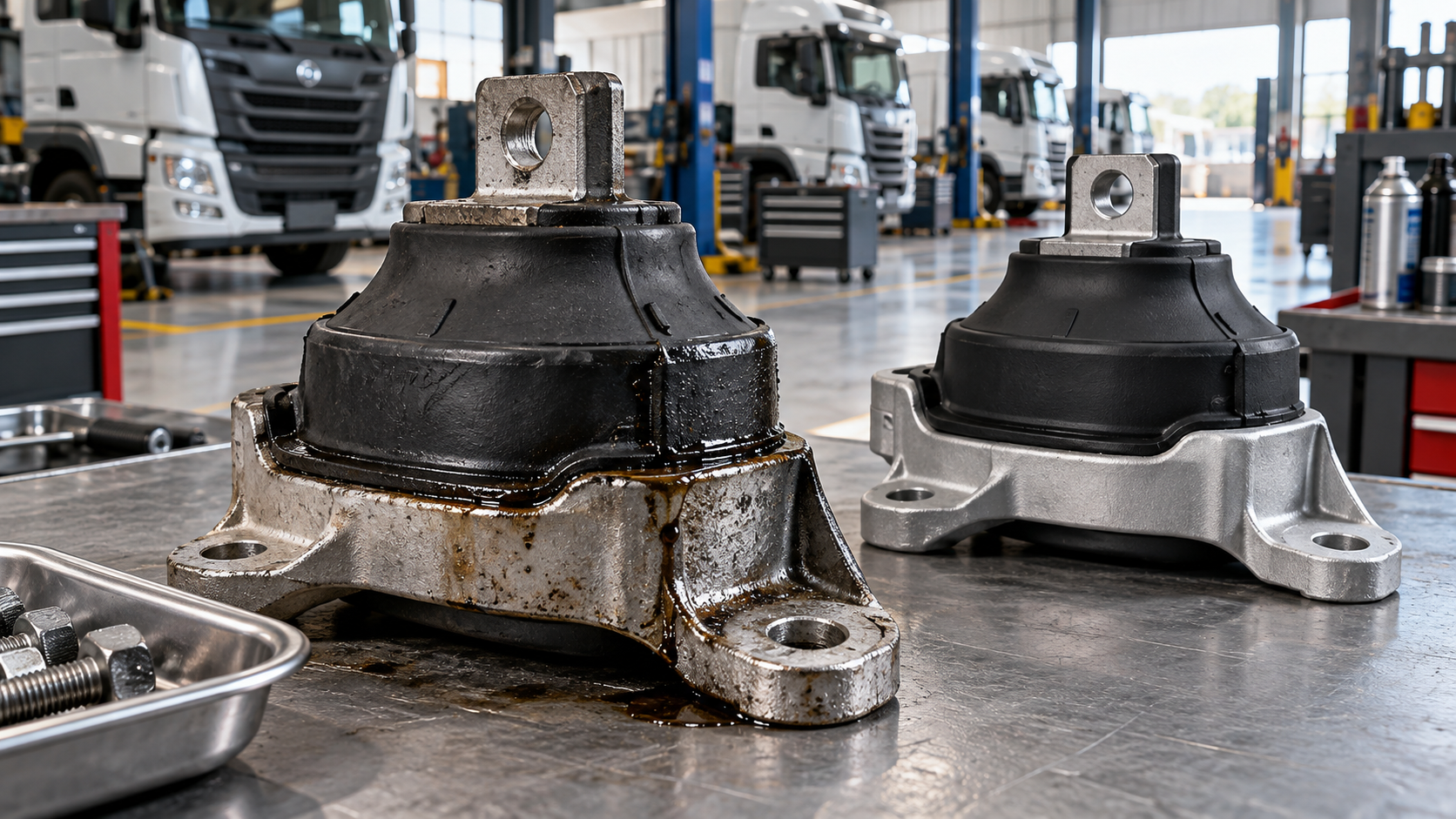
Chemical involvement becomes more credible when deterioration is concentrated on the exposed side, follows a drip path, or appears beneath an area where fluid accumulates. Swelling, unusual tackiness, surface smearing, or a clear texture difference between exposed and sheltered rubber strengthens the case.
Compare the failed part with an unused part of the same specification where possible. Adjacent mounts may have different compounds, geometry, and stiffness, so they are not always valid reference samples. Even an unused comparison requires care: a supplier may have changed the design or formulation without an obvious visual difference.
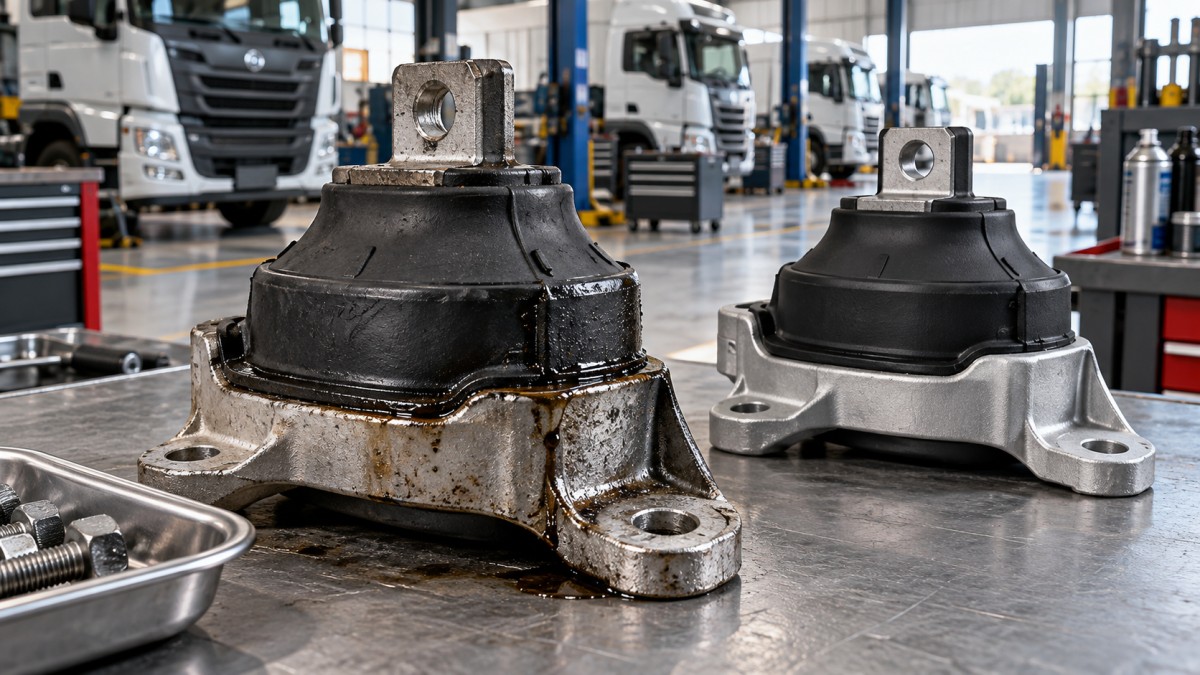
Cracks alone are weak evidence of chemical attack. Heat, ozone, age, cyclic loading, and installation stress can also cause cracking. Similarly, a clean tear or separation at the metal interface does not independently establish whether the initiating problem was chemical degradation, poor bonding, corrosion, or overload.
Useful observations include the location of the first visible damage, whether rubber has changed shape, the condition of sheltered surfaces, and the distribution of corrosion. Record these before cleaning. Washing a failed part can remove both contamination evidence and the spatial pattern needed to interpret it.
Could a wet hydraulic mount be leaking its own fluid?
Yes. A hydraulic engine mount contains fluid within an internal damping system. Wetness around its seams or damaged rubber may come from the mount itself rather than an external engine or transmission leak.
This distinction changes the diagnosis. Internal leakage demonstrates loss of containment, but does not establish what initiated it. The cause could involve fatigue, excessive movement, impact, a manufacturing defect, or external deterioration. Once fluid has spread across the assembly, appearance alone may not distinguish those possibilities.
Trace the highest fresh wet point and inspect components above and around the mount. Record nearby leak sources before removing the part. Fluid color and odor can provide clues, but mixing, dirt, and aging make them unreliable as sole identifiers. If the source remains unclear and failures are costly or repeated, laboratory identification may be justified.
Also confirm the mount design. A solid rubber mount, hydraulic mount, and electronically controlled mount can produce similar vibration complaints for different reasons. Vibration is a symptom, not a material diagnosis.
How can a fleet establish whether exposure is causing the failures?
The practical objective is to build a defensible causal chain: a credible exposure source, contact with a susceptible component, a matching damage pattern, and a failure history that supports the explanation.
Preserve removed mounts with their vehicle identification, installation date, mileage or operating hours, part number, supplier batch information where available, and fitted position. Photograph the component in place, including nearby hoses, shields, fasteners, and leak paths. Handle and package contaminated parts according to the fluid hazards and the receiving laboratory’s instructions.
Then compare failures using meaningful operating groups:
- Same vehicle configuration, different cleaning practices: Does deterioration cluster around a particular wash process or workshop?
- Same mount specification, different leak histories: Do persistently wet mounts fail differently from dry mounts?
- Same exposure, different replacement sources: Is the pattern associated with a particular part revision or supply batch?
- Same route or duty cycle, different mount positions: Does damage follow chemical contact or the most heavily loaded location?
Use installation mileage or hours as the starting point, not total vehicle mileage alone. Include nonfailed vehicles in the comparison; a list containing only failures cannot show whether an exposure is genuinely associated with shorter service life. Calendar age also matters when low-use vehicles spend long periods contaminated.
A controlled maintenance change can provide useful evidence. Correct a confirmed leak or amend an unsuitable cleaning practice, then monitor comparable vehicles with consistent replacement specifications. If the parts supplier, installation method, duty cycle, and wash chemistry all change together, any improvement will be harder to explain.
When is laboratory testing worthwhile?
Testing becomes valuable when failures recur across several vehicles, downtime is substantial, or responsibility is disputed between the component supplier and maintenance operation. A single isolated failure may not justify extensive analysis unless it presents a significant safety concern.
A materials laboratory can assess changes in hardness, dimensions, mechanical properties, fracture appearance, and the rubber-to-metal interface. Chemical analysis may help identify the elastomer family or contamination. Interpretation is stronger when the laboratory receives an unused reference part, the suspected service fluid, and a documented exposure history.
ASTM D471 and ISO 1817 provide established methods for evaluating how liquids affect rubber. They can support a comparative test program, but they do not by themselves certify that an engine mount is suitable for a particular vehicle. Test fluid, temperature, duration, and measured properties must reflect the question being investigated.
Immersion testing also has limits. It may rank material susceptibility without reproducing intermittent splashing, evaporation, heat cycles, or a loaded bonded assembly. A change in rubber volume is relevant, but mount performance also depends on stiffness, geometry, bonding, and dynamic behavior. Request an interpretation of component implications rather than a simple “pass” based on one measurement.
Would switching to an oil-resistant material solve the problem?
Not necessarily. Many engine-mount designs use natural-rubber-based compounds because their fatigue and vibration-isolation properties suit the application. Natural rubber generally has limited resistance to petroleum oils, but that does not make an arbitrary oil-resistant substitute a suitable mount material.
Nitrile rubber can offer better resistance to many petroleum fluids, while EPDM is generally unsuitable for petroleum-oil exposure despite useful resistance to water-based environments and weathering. These broad material tendencies are only screening information. Compound formulation and the specific exposure remain decisive.
A mount must also provide the correct load capacity, directional stiffness, damping, temperature performance, and durability. A chemically resistant but incorrectly tuned replacement can transmit more vibration or place additional loads on brackets, exhaust connections, and other mounts. Polyurethane is not automatically a universal chemical-resistant upgrade either; formulation and operating conditions matter.
For replacement sourcing, request application-specific fitment and performance evidence, traceable part identification, and compatibility information tied to the relevant fluid and test conditions. A statement such as “heavy-duty rubber” provides little technical assurance. Changing the material is a design decision, not merely a purchasing substitution.
What should change before the next replacement goes into service?
Correct the exposure source before treating the replacement mount as the solution. Repair leaks, restore missing shields, and remove trapped contamination using a procedure approved for the affected components. Avoid improvised protective wraps or coatings: they can retain fluid and heat, conceal damage, or introduce another incompatible chemical.
Review cleaning instructions against the actual products and equipment used. Verify dilution, dwell time, rinsing, and restrictions on direct high-pressure application. A pressure jet can damage an assembly mechanically even when the cleaner itself is compatible, so chemistry and application method need separate attention.
At installation, check the rest of the mounting system, bracket alignment, specified fasteners, and the manufacturer’s tightening and positioning procedure. A deteriorated companion mount, incorrect preload, or excessive powertrain movement can rapidly damage a new component. Engine misfire or rough running should also be investigated rather than attributed automatically to mount failure.
Severe separation, abnormal engine movement, or contact with surrounding components requires prompt assessment under the vehicle manufacturer’s service guidance. Do not continue operating solely to collect more evidence.
Chemical exposure should be treated as the leading explanation when contact history, material changes, and failure distribution agree—not simply because a failed mount is dirty. The most useful outcome is a corrective action that survives comparison: the exposure is removed, the correct mount is installed properly, and subsequent inspections show that the same deterioration pattern has stopped recurring.
Deep Dive
Related Intelligence
 Aftermarket PartsWhat Strategic Link Gaps Are Slowing Down Aftermarket Parts Distribution in Agri-Drones Service Networks?Analyst:Automotive Tech Analyst
 Aftermarket PartsCan aftermarket auto parts meet OEM durability standards without voiding vehicle warranties in 2026?Analyst:Automotive Tech Analyst
 Aftermarket PartsHow do aftermarket auto parts impact fleet maintenance costs for construction equipment operators?Analyst:Automotive Tech Analyst