Why Does Replacement Hydroponic Tubing Turn Brittle After Nutrient Dosing?
Key Takeaways
- The Kyiv Independent Hit by Suspected Russian CyberattackIT & Security Director
- What is editorial exposure and how does it differ from paid advertising?IT & Security Director
- Apple Warns Users in 99 Countries of Spyware; German Lawmakers' Devices SuspectedIT & Security Director
- How to write technical content for exporters selling machinery abroadChief Civil Engineer
- BW ESS Brings Hams Hall, Europe's Largest Operating Battery Storage Project, OnlineAutomotive Tech Analyst
- How to size electric motors for pumpsChief Civil Engineer
- Trump Administration Pledges $15 Billion in Farm Aid Ahead of Midterm ElectionsAgri-Tech Strategist
- When does automated food processing technology pay for itself?Agri-Tech Strategist
Industry Overview
We do not just publish news; we construct a high-fidelity digital footprint for our partners. By aligning with TNE, enterprises build the essential algorithmic "Trust Signals" required by modern search engines, ensuring they stand out to high-net-worth buyers in an increasingly crowded global digital landscape.
Why Does Replacement Hydroponic Tubing Turn Brittle After Nutrient Dosing?
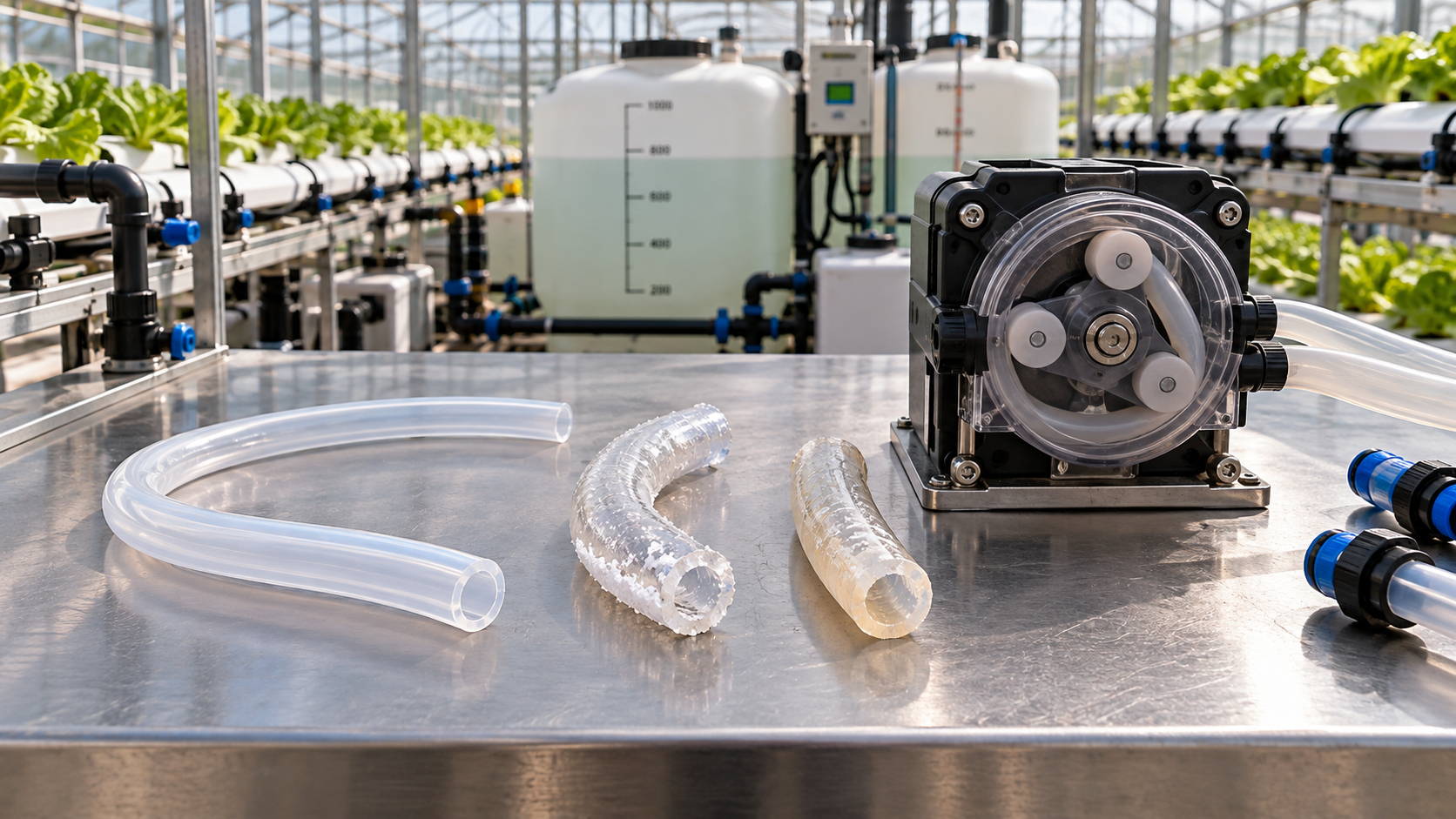
Why does replacement hydroponic tubing turn brittle after nutrient dosing? The timing can point to chemical incompatibility, but nutrient concentrates are not always the sole cause. Tubing formulation, oxidizing sanitizers, heat, UV exposure, and repeated flexing can all contribute to premature failure. For growers and procurement teams, identifying the actual trigger is essential to preventing leaks, disrupted irrigation, and repeated replacement costs.
The most useful starting point is not the nutrient brand. It is the location of the damage: inside the dosing pump, along the concentrate feed line, beside the injection fitting, or throughout the irrigation circuit. Those locations experience very different chemical and mechanical conditions, even when they belong to the same system.
Brittleness is a symptom, not a material diagnosis
A tube that feels harder than its predecessor has not necessarily suffered chemical degradation. The replacement may have a different hardness, wall thickness, or polymer formulation. A deposit of dried nutrient salts can also make a flexible line seem rigid. Genuine embrittlement means the material has lost its ability to deform without cracking.
Several processes can produce that result. Plasticized PVC can stiffen when plasticizer is extracted or migrates out. Oxidation can damage some polymers, reducing their flexibility. Repeated compression can initiate fatigue cracks even when the material remains chemically compatible. Chemical exposure and mechanical stress can also act together, making a marginal installation fail sooner.
Conversely, some incompatible tubing first becomes swollen, soft, or tacky rather than brittle. If it later hardens after drying, the final appearance may conceal the earlier damage. Record the condition immediately after removal, not only after a failed section has sat on a maintenance bench.
The dosing point sees more than the reservoir does
Reservoir pH and electrical conductivity describe the mixed nutrient solution. They do not establish whether a tube can withstand concentrated fertilizer, pH-adjustment chemicals, or cleaning agents. A feed line can hold stock solution between dosing events, creating prolonged exposure even when the pump runs only briefly.
Near an injection point, inadequate mixing may expose a short section to a concentrated stream before dilution occurs. A leaking check valve can also allow unexpected backflow into the dosing line. These conditions deserve investigation when damage is localized near the connection rather than distributed along the entire tube.
The complete chemical history matters. Hydrogen peroxide, peracetic acid formulations, and hypochlorite-based sanitizers introduce oxidizing exposure that a nutrient-only compatibility check misses. Acid or alkaline cleaning steps may add another stress. Compatibility depends on the actual product, concentration, temperature, and contact time—not simply whether the label says “hydroponic.”
Keep nutrient, acid, and sanitizer handling separate according to supplier instructions. Never mix chemicals to reproduce a suspected failure; acids and hypochlorite products, in particular, can release hazardous chlorine gas.
Read the failure pattern before changing materials
Before discarding the failed tube, photograph it in position and mark the direction of flow. Preserve an unused piece from the same batch if available. Comparing exposed and unexposed material can help distinguish an unsuitable replacement from damage caused by operation.
The following patterns are useful clues, although none proves a cause on its own:
- Cracks restricted to the peristaltic pump track: investigate compression fatigue, incorrect tubing dimensions, roller adjustment, and pump speed alongside chemical exposure.
- Splits at barbs or tight bends: check fitting size, insertion damage, excessive stretch, unsupported weight, and the supplier’s minimum bend radius.
- Damage concentrated on an exposed outer surface: investigate sunlight, nearby heat sources, and external chemical splashes.
- Hardening throughout a concentrate line: examine formulation compatibility, prolonged stock-solution contact, and cleaning history.
- A rigid section containing visible deposits: distinguish internal scale or crystallized fertilizer from a change in the tube wall itself.
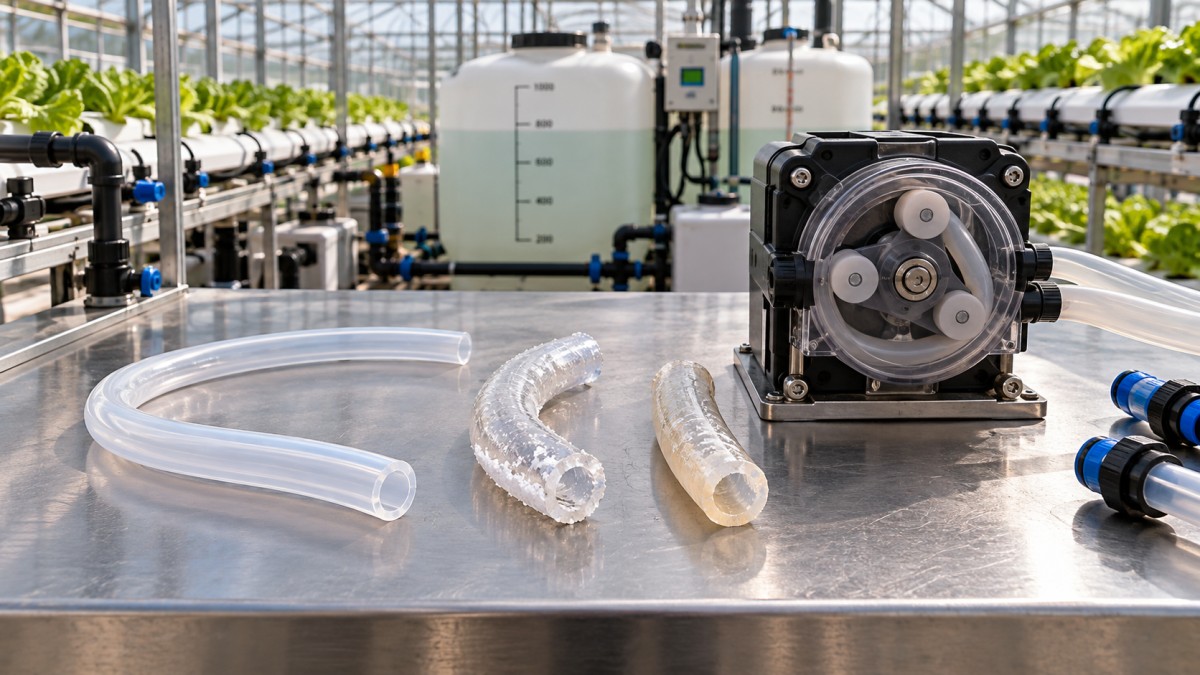
Do not pressure-test a visibly cracked section in service. Isolate and depressurize the affected equipment using the site’s safety procedure. If deposits require investigation, use an approved cleaning method on a removed sample; improvised solvent cleaning can alter the polymer and obscure the evidence.
Why an apparently identical replacement can fail
“Clear flexible tubing” is not a material specification. Even a description such as “PVC tubing” leaves substantial room for differences in plasticizers, stabilizers, hardness, and processing. Two products with the same internal diameter may behave differently under the same chemical exposure.
Dimensions are especially important in peristaltic pumps. Internal diameter affects displacement, while wall thickness and elasticity influence occlusion, recovery, and fatigue. Tubing selected only because it fits over the connector can be unsuitable for the pump head. Excessive compression may accelerate wear; inadequate compression can reduce delivery or allow backflow.
Storage can complicate the comparison. Replacement stock may have experienced prolonged heat or sunlight before installation. Where early failures follow a supplier or batch change, retain packaging and lot information rather than assuming the nutrient recipe changed the material.
A food-contact declaration does not establish resistance to concentrated dosing chemicals. Nor does a broad description such as “chemical resistant” prove suitability for repeated pump compression. These claims answer different questions and should be evaluated separately.
Choose tubing by service location, not by a universal material ranking
There is no single tubing material that is automatically correct for every hydroponic dosing system. The concentrate supply line, pump-head segment, and downstream irrigation line may need different materials. Trying to standardize all three on one inexpensive tube can create avoidable compromises.
Flexible PVC may suit some water and diluted-nutrient duties, but its formulation and compatibility with concentrates or cleaners require confirmation. Polyethylene can be useful for distribution or chemical-feed applications where its grade is compatible, although it is not normally a substitute for an elastomeric peristaltic pump tube.
Silicone and purpose-designed thermoplastic elastomer pump tubing offer flexibility, but chemical resistance, permeability, and compression life vary by formulation. Silicone should not be treated as universally compatible merely because it is flexible and widely available.
Fluoropolymer tubing can offer broad chemical resistance in appropriate static transfer duties. Its stiffness, fitting requirements, pressure limits, and suitability for the specific pump still need checking. Broad chemical resistance does not make a material interchangeable with pump-head tubing.
Ask suppliers to assess the exact grade against the actual chemical formulation and operating temperature. A compatibility chart based on room-temperature immersion in a single reagent is useful screening evidence, not a guarantee of service life under pressure and repeated flexing.
Build a qualification test around the real duty cycle
A replacement trial should answer two separate questions: does the material tolerate the chemistry, and does the assembled system continue to dose reliably? A static soak can help screen candidates, but it cannot establish peristaltic fatigue life or fitting security.
Prepare a short operating record before requesting alternatives:
- Exact nutrient, pH-adjuster, and sanitizer products, including working concentrations.
- Normal and maximum fluid temperatures, plus external heat and sunlight exposure.
- Operating pressure, suction conditions, dosing frequency, and idle contact time.
- Pump model, approved tubing dimensions, fittings, and cleaning sequence.
- Time to first visible damage and any change in delivered volume.
For initial screening, compare unused control samples with separately exposed samples under safely controlled, representative conditions. Inspect flexibility, surface condition, swelling, cracking, and dimensional change. Laboratory measurements of mass, hardness, or tensile properties can strengthen the assessment where the cost of failure justifies them.
Then qualify the candidate in an isolated test loop using the intended pump and fittings. Check leakage and actual delivery over repeated cycles, including realistic idle periods and approved cleaning exposure. Do not infer reliable dosing from appearance alone: a tube may remain intact while changes in elastic recovery alter pump output.
Agree on acceptance criteria before the trial. These should include dosing accuracy, acceptable physical changes, connection integrity, and inspection intervals. A short successful test supports further evaluation; it does not establish an indefinite replacement interval.
Make the next purchase traceable
For procurement, the practical outcome is a controlled specification rather than another generic reorder. Record the manufacturer, exact grade, dimensions and tolerances, pump compatibility, chemical assessment, and batch identification. Require approval before substitutions, including changes sold under the same broad polymer description.
This is where materials knowledge and agricultural operations meet—a connection central to TradeNexus Edge’s coverage of Advanced Materials & Chemicals and Agri-Tech & Food Systems. A sourcing decision becomes more defensible when supplier claims are tied to operating conditions and test evidence, rather than catalog language alone.
If replacement tubing repeatedly turns brittle after dosing, replacing it more often may contain the immediate risk but will not explain the failure. Locate the damage, reconstruct every chemical exposure, verify the replacement specification, and test the candidate in its actual duty. Where dosing accuracy is critical, recalibrate after installation and use inspection findings to set a preventive replacement interval.
Deep Dive
Related Intelligence
 Precision FarmingHow Global Commerce Data Helps Precision Farming Equipment Managers Forecast Spare Part Demand AccuratelyAnalyst:Agri-Tech Strategist
 Precision FarmingHow much does deploying automated farming solutions manufacturer hardware increase labor efficiency on layer farms?Analyst:Agri-Tech Strategist
 Precision FarmingWhy automated farming solutions manufacturers prioritize modular design over full-stack integrationAnalyst:Agri-Tech Strategist