What to Check When Farm Drone Seals Swell After Changing Formulations
Key Takeaways
- The Kyiv Independent Hit by Suspected Russian CyberattackIT & Security Director
- What is editorial exposure and how does it differ from paid advertising?IT & Security Director
- Apple Warns Users in 99 Countries of Spyware; German Lawmakers' Devices SuspectedIT & Security Director
- How to write technical content for exporters selling machinery abroadChief Civil Engineer
- BW ESS Brings Hams Hall, Europe's Largest Operating Battery Storage Project, OnlineAutomotive Tech Analyst
- How to size electric motors for pumpsChief Civil Engineer
- Trump Administration Pledges $15 Billion in Farm Aid Ahead of Midterm ElectionsAgri-Tech Strategist
- When does automated food processing technology pay for itself?Agri-Tech Strategist
Industry Overview
We do not just publish news; we construct a high-fidelity digital footprint for our partners. By aligning with TNE, enterprises build the essential algorithmic "Trust Signals" required by modern search engines, ensuring they stand out to high-net-worth buyers in an increasingly crowded global digital landscape.
When agricultural drone spray seals swell after a formulation change, start by checking chemical compatibility across the entire liquid circuit. A change in solvent, surfactant, oil carrier, or cleaning agent can affect seals even when the active ingredient remains the same. Replacing a swollen O-ring with another of the same specification may restore operation briefly while leaving the cause unresolved.
The timing makes the new formulation a strong suspect, but it does not prove the spray mixture alone caused the damage. Concentrated product during filling, residues from the previous load, longer overnight exposure, or a different flushing procedure may explain why a previously reliable seal has failed. Before returning the drone to service, establish what contacted the seal, identify its exact material, and check whether the damage extends beyond the visibly affected component.
First, establish whether the seal has swollen or failed another way
Stop spraying if the system leaks, loses pressure, or delivers inconsistent flow. Follow the drone manufacturer’s shutdown and pressure-release procedure before opening the liquid circuit, and use the handling precautions specified for the chemicals involved. A leaking pump or valve can affect application accuracy as well as expose nearby equipment and personnel to spray liquid.
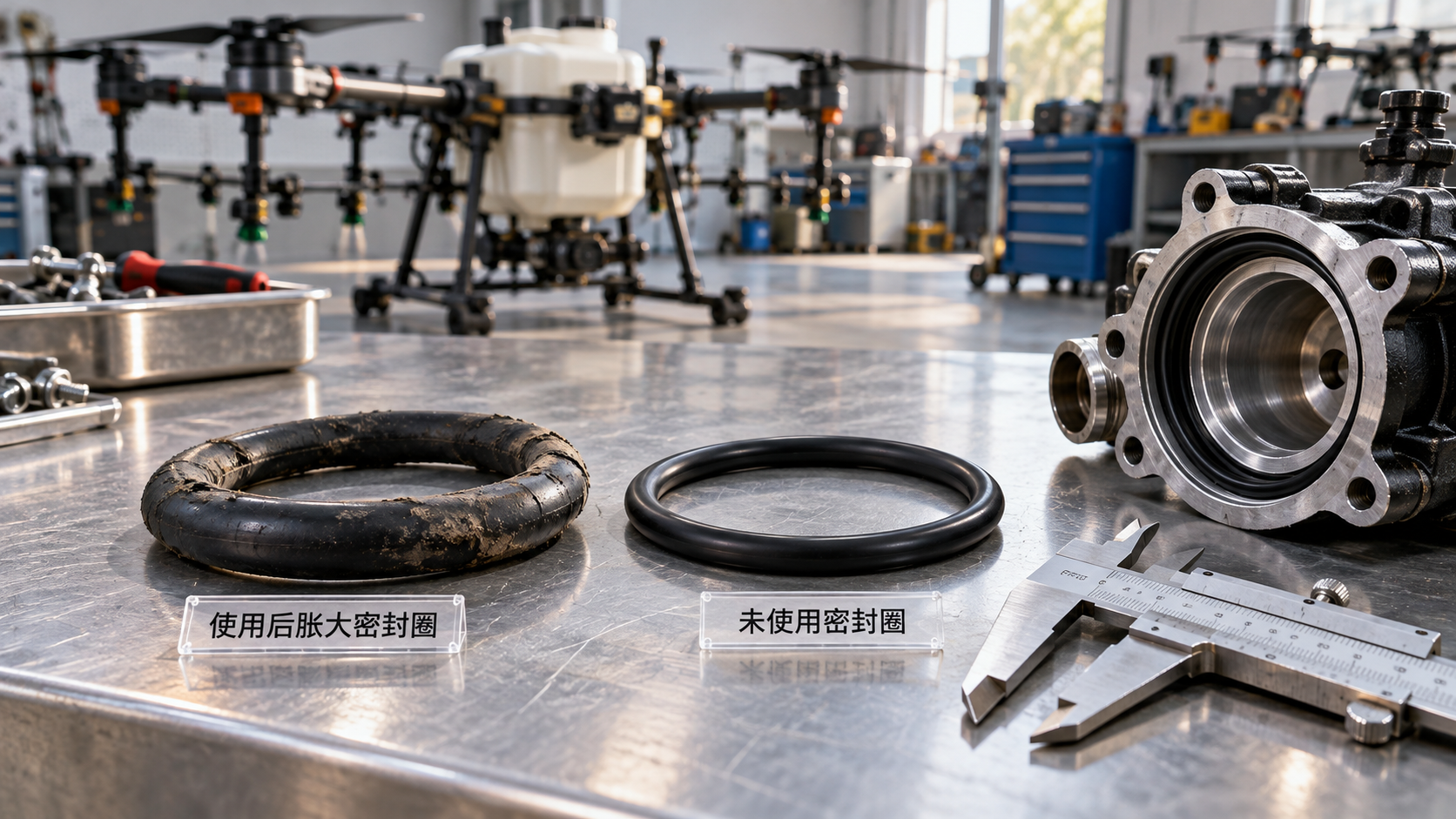
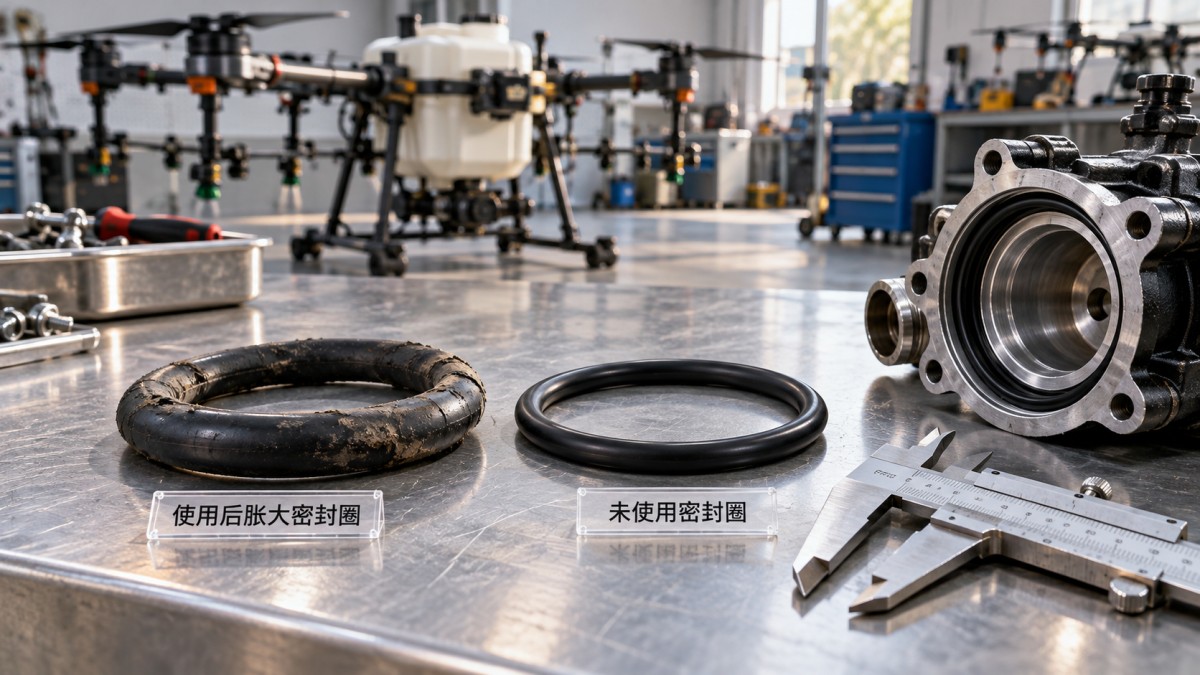
Inspect the removed seal alongside an unused replacement of the same part number. Chemical swelling may appear as increased cross-section, a larger diameter, softening, tackiness, or a seal that no longer fits its groove. A swollen seal can also suffer mechanical damage because it is squeezed into a space that no longer accommodates it.
Other failure patterns need different explanations. A flattened cross-section may indicate compression set. A cut on one side may point to installation damage or a sharp edge. Extruded material can indicate excessive clearance or pressure, although chemical softening can make extrusion easier. Hardness changes and cracking also warrant a compatibility review, even without obvious enlargement.
Record the condition before cleaning or discarding the part. Photograph it beside an unused seal, identify its location, and note whether it was wet, recently flushed, or already dry. Dimensions can change after removal as absorbed liquid leaves the elastomer, so measurements taken at different times are not directly comparable.
Reconstruct what changed between the last successful load and the failure
Compare the previous working mixture with the first mixture associated with swelling. Product names alone are insufficient: products containing the same active ingredient may use different carriers and additives, and their effects on elastomers can differ.
Build a short exposure record from mixing notes, product labels, safety data sheets, and maintenance records. Include:
- The exact product and formulation designation, plus batch details where available.
- Every tank-mix partner, adjuvant, water conditioner, fertilizer, antifoam, and cleaning chemical used.
- The final dilution and whether concentrated product passed through any pump, valve, or fitting during loading.
- The mixing order, agitation method, and any departure from the established procedure.
- How long the liquid remained in the system, including transport, pauses, and overnight storage.
- Changes in water source, operating temperature, flushing, or maintenance.
Give particular attention to solvents, oils, and surfactant packages. An emulsifiable concentrate, oil dispersion, suspension concentrate, and water-based solution can present different compatibility conditions. Formulation categories help direct the investigation, but they cannot establish that a particular seal is suitable.
A safety data sheet is a useful starting point, not a complete compatibility specification. It may not disclose every ingredient or its exact concentration. Ask the formulation supplier whether the finished product, intended tank mixture, and cleaning procedure are compatible with the actual elastomer compound used in the drone.
Also check whether the application concentration increased. A mixture prepared for lower carrier volume may expose the liquid circuit to a different chemical environment from a more dilute application, where that use is permitted. Approval of an application method does not by itself establish compatibility with every pump, hose, and seal installed on the aircraft.
Check concentrated contact during filling
The final tank dilution may conceal a harsher exposure earlier in the process. If concentrate enters a partly filled tank close to an outlet, or is drawn through a transfer connection, a seal may briefly encounter a much stronger mixture. Changing the filling sequence can therefore matter even when the final recipe remains unchanged.
Confirm that mixing and filling follow the product label and equipment instructions. Do not experiment with unapproved mixing orders or improvised dilutions to see whether the problem disappears.
Identify the actual seal compound before choosing a replacement
“Rubber seal” is not a usable material specification. Establish the manufacturer’s part number, elastomer family, compound designation where available, hardness, and dimensions. Check whether the failed part was original equipment or an aftermarket substitute, and whether a maintenance change coincided with the formulation change.
Colour and appearance cannot reliably identify an elastomer. Two black O-rings of identical size may have very different chemical resistance. Even seals within the same polymer family can behave differently because of their formulation and cure system.
Common material families provide useful starting points, with substantial limits:
- EPDM: Often considered for water-based service and certain cleaning environments. Petroleum oils and many hydrocarbon solvents can be problematic, so an oil-containing formulation needs specific review.
- NBR, or nitrile: Often selected for oil resistance, but performance varies with the compound and chemical mixture. Resistance to one oil or solvent does not establish suitability for another.
- FKM: Can offer resistance to many oils and solvents, but some polar solvents, amines, and alkaline conditions can be unsuitable. The specific grade and exposure conditions matter.
- Silicone: Has useful temperature properties in some applications, but solvent resistance and mechanical performance require careful assessment in a spray circuit.
- PTFE-based sealing components: Can provide broad chemical resistance, but their stiffness and sealing behaviour differ from elastomer O-rings. They require an appropriate component design.
A compatibility chart is a screening tool. Check which chemical, concentration, temperature, exposure duration, and material grade the rating covers. A favourable rating for one ingredient cannot establish suitability for a formulated pesticide combined with adjuvants and cleaner residues.
Obtain guidance that connects the exact replacement compound to the intended service. The drone or pump manufacturer must also confirm the mechanical fit. A chemically resistant seal can still fail if its hardness, dimensions, friction, or compression behaviour does not suit the groove and operating conditions.
Use the damage pattern to locate the exposure
Inspect components that share the same liquid path: pump diaphragms or seals, valve seats, filter bowl seals, quick connectors, flow meters, nozzle check valves, and wetted hose linings. The first visible leak may simply be the component least able to tolerate the dimensional change.
If several seals made from the same compound have softened or enlarged, a shared chemical exposure becomes more plausible. If only one component is affected, investigate whether it uses a different material, traps liquid after draining, runs warmer, or experiences greater pressure and movement.
Location can also distinguish filling exposure from operating exposure. Damage near the tank outlet or loading connection may justify closer examination of concentrated contact. Damage in a dead leg or valve cavity may reflect retained liquid. These patterns guide the investigation; they do not establish the cause on their own.
Compare affected and unaffected parts only where their material and service conditions are known. An undamaged seal elsewhere in the drone is weak evidence if it is made from a different compound or spends less time immersed.
Include dwell time, heat, and cleaning in the diagnosis
A seal may tolerate brief contact yet deteriorate when the same mixture remains in the system overnight. Longer exposure allows more opportunity for absorption, while higher temperature can accelerate chemical interaction. Record whether the failure followed longer holding periods, warmer conditions, or repeated cycles without a complete drain.
Cleaning can introduce a separate compatibility problem. A stronger cleaner, an improvised solvent rinse, or a longer soak may damage a seal that tolerates the spray mixture. Cleaner residues can also alter the next exposure. Review the full sequence from filling through flushing, rather than evaluating each liquid in isolation.
Check whether the prescribed cleaning process reaches trapped volumes and whether strainers or valves retain liquid. Follow product-label and equipment requirements for cleaning and disposal; a clear-looking discharge alone does not establish that the circuit is ready for a different formulation.
Turn the findings into a repair and verification plan
Send the equipment or seal supplier a compact evidence package: failed part number, material specification, photographs, exposure timeline, exact mixture, dilution, temperature conditions, and cleaning products. Ask for a recommendation covering both chemical compatibility and the component’s mechanical requirements.
If existing compatibility evidence is insufficient, a qualified supplier or laboratory can assess candidate compounds using representative exposure conditions. Useful observations include changes in volume, mass, hardness, dimensions, and mechanical condition. Acceptance limits should reflect the seal design and equipment requirements; there is no single swelling percentage that makes every seal acceptable.
A loose-seal immersion check can help screen materials, but it cannot reproduce compression, movement, pressure cycling, or every exposure inside an assembled pump. A seal that looks unchanged after a short soak may still perform poorly in service. Any handling of pesticide mixtures for evaluation should follow the applicable product instructions and suitable laboratory controls.
Before returning the drone to spraying, complete the checks that connect the repair to reliable operation:
- Replace damaged components with approved parts and inspect adjacent wetted materials for related deterioration.
- Inspect seal grooves, mating surfaces, and assembly condition so that chemical damage is not compounded by a mechanical defect.
- Complete the prescribed cleaning process and conduct the manufacturer’s leak and functional checks with the specified test fluid.
- Verify pressure stability, valve operation, flow measurement, and nozzle output using the equipment’s service procedure.
- Where service checks pass and compatibility is supported, resume use under a defined inspection plan covering initial operation and subsequent holding or cleaning periods.
A successful water check establishes basic sealing and function. It does not demonstrate resistance to the intended formulation. Likewise, a higher-resistance material does not validate the whole circuit if a hose lining, diaphragm, or valve seat remains vulnerable.
The repair is ready for service when the replacement specification, chemical exposure, and operating procedure agree. Keep that combination in the maintenance record: exact seal part, approved mixture and dilution, filling sequence, permitted holding conditions, and cleaning method. The next formulation change can then be assessed against a known working configuration before another swollen seal becomes the first warning.
Deep Dive
Related Intelligence
 Agri-DronesWhy Digital Landscape Shifts Are Forcing Agri-Drones Buyers to Rethink ROI ModelsAnalyst:Agri-Tech Strategist
 Agri-DronesAgricultural drones delivering lower ROI in fragmented fields—altitude limits or operator training gaps?Analyst:Agri-Tech Strategist
 Agri-DronesAgricultural drones with multispectral cameras — why NDVI outputs vary across firmware versionsAnalyst:Agri-Tech Strategist