Does Pesticide Approval Automatically Permit Agricultural Drone Use?
Key Takeaways
- The Kyiv Independent Hit by Suspected Russian CyberattackIT & Security Director
- What is editorial exposure and how does it differ from paid advertising?IT & Security Director
- Apple Warns Users in 99 Countries of Spyware; German Lawmakers' Devices SuspectedIT & Security Director
- How to write technical content for exporters selling machinery abroadChief Civil Engineer
- BW ESS Brings Hams Hall, Europe's Largest Operating Battery Storage Project, OnlineAutomotive Tech Analyst
- How to size electric motors for pumpsChief Civil Engineer
- Trump Administration Pledges $15 Billion in Farm Aid Ahead of Midterm ElectionsAgri-Tech Strategist
- When does automated food processing technology pay for itself?Agri-Tech Strategist
Industry Overview
We do not just publish news; we construct a high-fidelity digital footprint for our partners. By aligning with TNE, enterprises build the essential algorithmic "Trust Signals" required by modern search engines, ensuring they stand out to high-net-worth buyers in an increasingly crowded global digital landscape.
Does pesticide approval automatically allow application by agricultural drone? No—not by itself. A pesticide’s registration establishes authorized uses under specified conditions. It does not automatically authorize the aircraft, qualify the operator, or confirm that drone application is acceptable for a particular crop and location.
The practical answer depends on the product label, local pesticide rules, and aviation requirements. Those requirements overlap, but they are not interchangeable. A licensed drone pilot can still make an unlawful pesticide application; an authorized pesticide applicator can still conduct an unauthorized flight.
Before buying equipment or scheduling treatment, work through the proposed operation as a complete system: product, crop, application method, aircraft, operator, and field. The weakest link can stop the job.
Separate product authorization from permission to spray
“Approved” is an incomplete description unless you know what was approved and by whom. Approval of an active ingredient is not necessarily authorization of every formulated product containing it. Likewise, registration of a formulation does not establish permission for every delivery method.
For a proposed drone-spraying operation, distinguish three questions:
- Product and use: Is this exact formulation authorized for the crop, target pest, rate, timing, and intended application method?
- Pesticide operation: Does the applicator or business hold the required credentials, and are any aerial-application permits or exemptions needed?
- Flight operation: Are the aircraft, pilot, operating procedures, and airspace permissions appropriate for the proposed mission?
A distributor’s statement that a chemical is “drone compatible” answers none of these questions conclusively. It might describe physical compatibility with a tank or nozzle, rather than legal authorization or demonstrated performance on the intended crop.
Start with the exact product label—not the active ingredient
Obtain the current, locally applicable label for the exact commercial product. Match its registration identifier and formulation to the container being purchased. Products with the same active ingredient can have different concentrations, co-formulants, approved uses, and application restrictions.
Read the crop-specific directions alongside the general application instructions. Look for aerial-use prohibitions, permitted equipment, minimum spray volume, droplet requirements, release height, weather restrictions, buffer zones, and any supplemental labeling. A statement in one section may be narrowed by another.
The awkward cases are labels that mention aerial application without naming drones, or that say nothing explicit about the delivery platform. Do not assume that silence always means permission—or always means prohibition. The legal interpretation depends on the jurisdiction and the wording of the full label.
In the United States, federal pesticide law includes provisions concerning application methods not prohibited by labeling, but those provisions are not a blanket authorization for drone spraying. State requirements and all other applicable label conditions still matter. Where the interpretation is unclear, seek clarification from the relevant pesticide authority rather than relying solely on a sales representative.
A useful inquiry identifies the product registration number, crop, location, aircraft, proposed spray volume, and relevant label passages. “Can this pesticide be used by drone?” is often too broad to produce an operationally useful answer.
Check the jurisdiction before transferring a working model
A program that works legally in one market may not transfer to another. Even within a country, pesticide licensing, environmental restrictions, and application notification requirements can differ.
United States: pesticide compliance and aviation authorization run in parallel
The U.S. Environmental Protection Agency regulates pesticide registration and labeling, while state agencies administer important licensing and enforcement functions. Check both the EPA-approved labeling and the requirements of the state where treatment will occur.
On the aviation side, the Federal Aviation Administration addresses agricultural aircraft operations under Part 137. Drone dispensing operations may require agricultural aircraft operator certification and exemptions or other approvals appropriate to the aircraft and operation. A remote pilot certificate alone should not be treated as a complete agricultural spraying authorization.
Use the EPA’s pesticide-label resources and the FAA’s guidance on dispensing chemicals from drones as starting points, then verify the current requirements for the actual operation.
European Union: product authorization does not remove aerial-spraying restrictions
Article 9 of Directive 2009/128/EC establishes a general prohibition on aerial spraying, with derogations possible under specified conditions. National implementation and competent-authority decisions must therefore be checked before assuming a drone application is permitted.
European aviation rules add a separate constraint: the open category does not permit dropping material. Spraying therefore cannot be treated as an ordinary open-category drone flight. The applicable aviation authorization route must be established independently of pesticide permission.
Elsewhere, use the same discipline: identify the pesticide regulator and aviation authority separately. An equipment supplier’s export experience is useful background, but it is not proof of permission in the destination market.
Test whether the label and the drone can actually work together
Legal eligibility is only the beginning. The aircraft must also deliver the authorized treatment within the label’s operating limits.
Consider a product whose label specifies a minimum carrier volume above the volume used in a supplier’s advertised drone workflow. Reducing the water volume to cover more hectares per load is not automatically acceptable. The pesticide dose per hectare and the total spray volume per hectare are different variables; meeting one does not excuse missing the other.
This can change the equipment economics. More carrier volume means more refills and potentially lower daily capacity. Procurement comparisons should therefore use a compliant operating scenario, not only the aircraft’s headline coverage figure.
Droplet behavior deserves similar scrutiny. Nozzle or atomizer settings, formulation properties, flight speed, release height, and rotor airflow influence deposition and drift. Small droplets are not automatically better, and rotor downwash is not proof that spray will remain inside the treatment area.
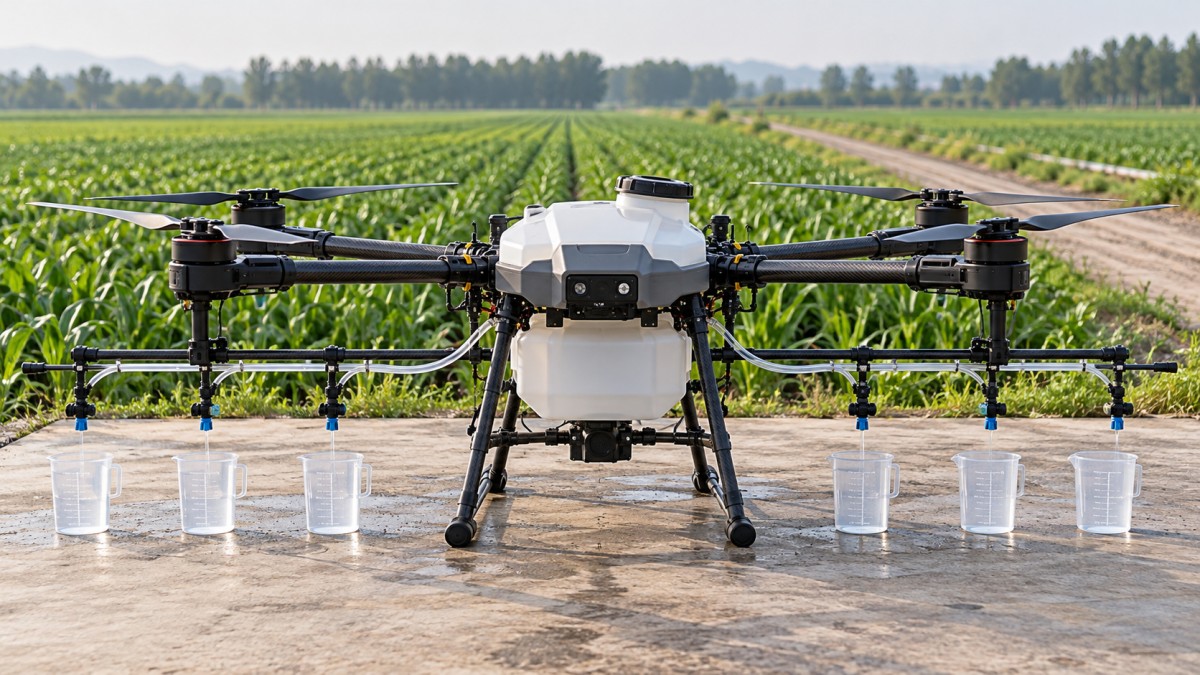
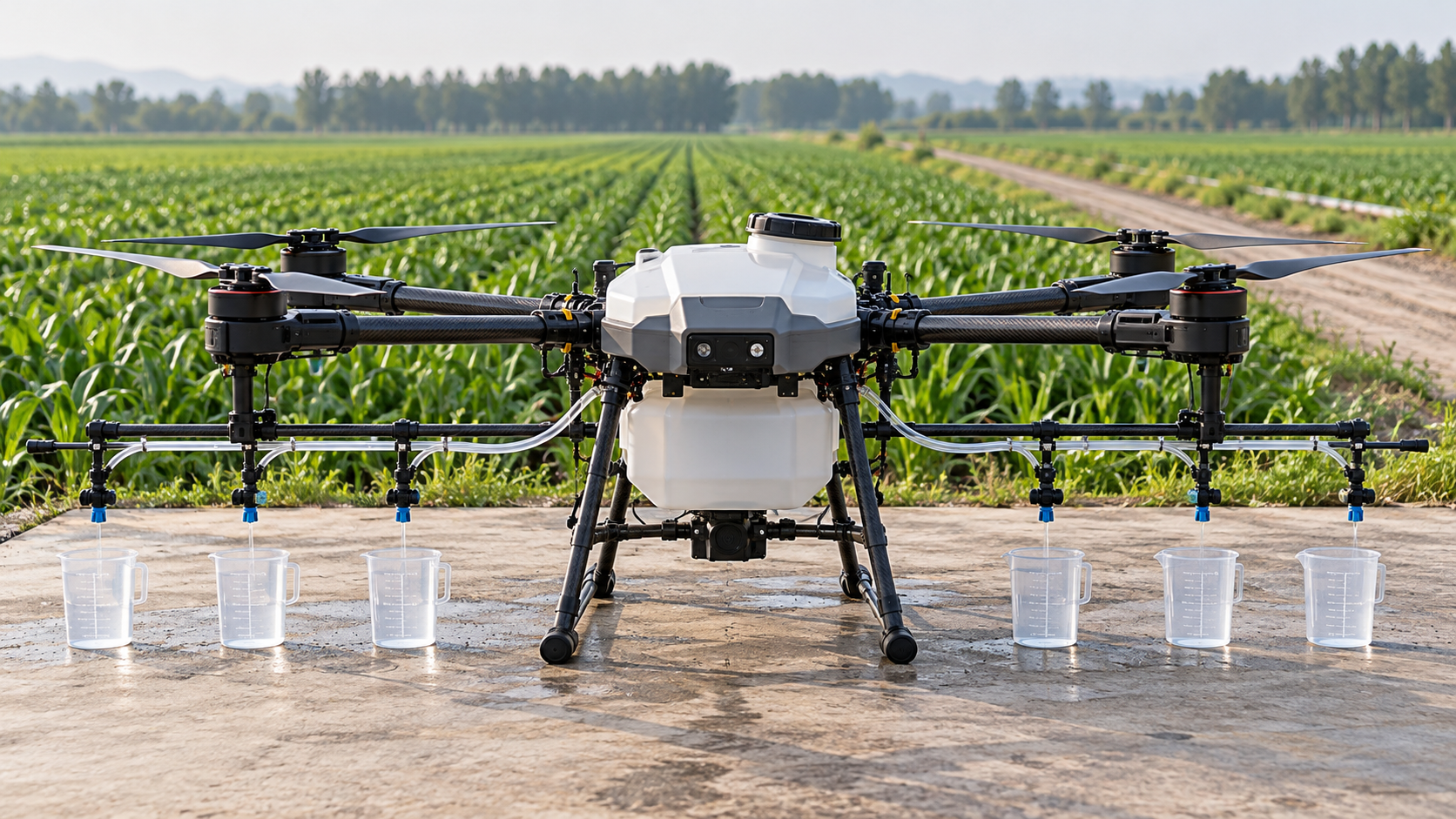
Where appropriate, use water-only calibration and suitable deposition checks to assess flow rate, effective swath, and distribution before pesticide work. Such checks support setup decisions; they do not establish biological efficacy or legal permission. A physically workable spray mixture may still be unsuitable for the intended treatment.
Clear the field, not just the paperwork
A compliant product and authorized operator can still encounter a field that cannot be treated under the planned conditions. Nearby homes, roads, watercourses, sensitive crops, workers, or restricted airspace can materially change the decision.
Before dispatch, translate requirements into a field-specific plan. Mark exclusion areas and required buffers, identify safe loading locations, confirm weather limits, and establish who can stop the operation. Include pesticide-specific worker protection, re-entry, and harvest restrictions where applicable.
Automation does not remove this responsibility. A mapped flight boundary may control the aircraft’s route, but it does not guarantee that droplets stay within the legal treatment boundary. Allowing for drift is a different problem from keeping the drone inside a polygon.
For contractors, the work order should also assign responsibilities clearly. Who checks nearby sensitive sites? Who provides the correct label? Who handles notifications? Ambiguity tends to surface when the crew is already on site and the treatment window is closing.
Build an evidence file before committing capital
For a buyer comparing drone services or equipment, the most useful deliverable is a documented route to lawful operation. Ask for evidence tied to the intended market and use—not a generic presentation showing that spraying drones are commercially available.
- Product evidence: Current label, registration details, relevant supplemental directions, and any required use authorization.
- Operator evidence: Applicable pesticide credentials, aviation permissions, and their scope, limitations, and validity.
- Technical evidence: Calibration records and a proposed setup that can meet the product’s rate, volume, droplet, and application restrictions.
- Commercial evidence: Contract responsibilities, cancellation terms for unsuitable conditions, and insurance wording addressing the proposed spraying activity.
Check that each document applies to the actual contractor, aircraft, territory, and activity. A general insurance certificate, for example, does not by itself establish that pesticide drift or chemical application is covered.
This is where agricultural technology procurement intersects with chemical supply-chain intelligence. For TradeNexus Edge, the useful comparison is not simply between drone specifications; it is between complete operating proposals, including their regulatory dependencies and practical limitations. Equipment that cannot support the intended authorized uses may be the wrong purchase, however capable it looks.
Make the decision for a defined operation
The right question is narrower than “Are agricultural drones allowed?” Ask whether this product can be applied to this crop, with this aircraft and operator, at this location, under the proposed conditions.
If a material point remains unresolved—such as whether aerial directions cover the proposed method, or whether a required permission applies—pause that part of the operation and obtain clarification. Keep the response with the label and operating records.
Pesticide approval is one necessary check, not an automatic green light. Before signing a purchase order or releasing a spraying crew, make sure product authorization, pesticide-use requirements, aviation permission, and the field plan all support the same job.
Deep Dive
Related Intelligence
 Agri-DronesWhy Digital Landscape Shifts Are Forcing Agri-Drones Buyers to Rethink ROI ModelsAnalyst:Agri-Tech Strategist
 Agri-DronesAgricultural drones delivering lower ROI in fragmented fields—altitude limits or operator training gaps?Analyst:Agri-Tech Strategist
 Agri-DronesAgricultural drones with multispectral cameras — why NDVI outputs vary across firmware versionsAnalyst:Agri-Tech Strategist