How Can Buyers Verify a Supplier’s Low-Carbon Fertilizer Claim?
Key Takeaways
- The Kyiv Independent Hit by Suspected Russian CyberattackIT & Security Director
- What is editorial exposure and how does it differ from paid advertising?IT & Security Director
- Apple Warns Users in 99 Countries of Spyware; German Lawmakers' Devices SuspectedIT & Security Director
- How to write technical content for exporters selling machinery abroadChief Civil Engineer
- BW ESS Brings Hams Hall, Europe's Largest Operating Battery Storage Project, OnlineAutomotive Tech Analyst
- How to size electric motors for pumpsChief Civil Engineer
- Trump Administration Pledges $15 Billion in Farm Aid Ahead of Midterm ElectionsAgri-Tech Strategist
- When does automated food processing technology pay for itself?Agri-Tech Strategist
Industry Overview
We do not just publish news; we construct a high-fidelity digital footprint for our partners. By aligning with TNE, enterprises build the essential algorithmic "Trust Signals" required by modern search engines, ensuring they stand out to high-net-worth buyers in an increasingly crowded global digital landscape.
A supplier’s low-carbon fertilizer claim is credible only when the claimed reduction can be traced to a defined product, a transparent carbon-footprint calculation, a relevant comparison baseline, and evidence covering the material supplied. A green label or a large percentage reduction does not establish any of those conditions.
The decisive distinction is between a lower product carbon footprint and a claim supported by offsets or allocated environmental attributes. Each requires different evidence. Before accepting a price premium or reporting an emissions reduction, establish what changed, where the reduction occurred, and whether the supporting documentation applies to the shipment being purchased.
What does “low-carbon fertilizer” actually mean?
The phrase alone does not define a universal emissions threshold. It can describe fertilizer made with lower-emission ammonia, production using renewable electricity, improved control of nitrous oxide emissions, or a product whose reported balance includes carbon credits. These are not equivalent claims.
Ask the supplier to restate the claim in measurable terms: the product and grade, production site, reporting period, footprint value, lifecycle boundary, and comparison reference. “Lower manufacturing emissions than a specified conventional production route” is assessable. “Environmentally friendly fertilizer” is not.
Also separate product performance from corporate performance. A manufacturer’s emissions target, renewable-energy commitment, or sustainability report does not establish the footprint of an individual fertilizer grade. A company can operate facilities with different energy sources and emissions intensities.
Which documents should support the claim?
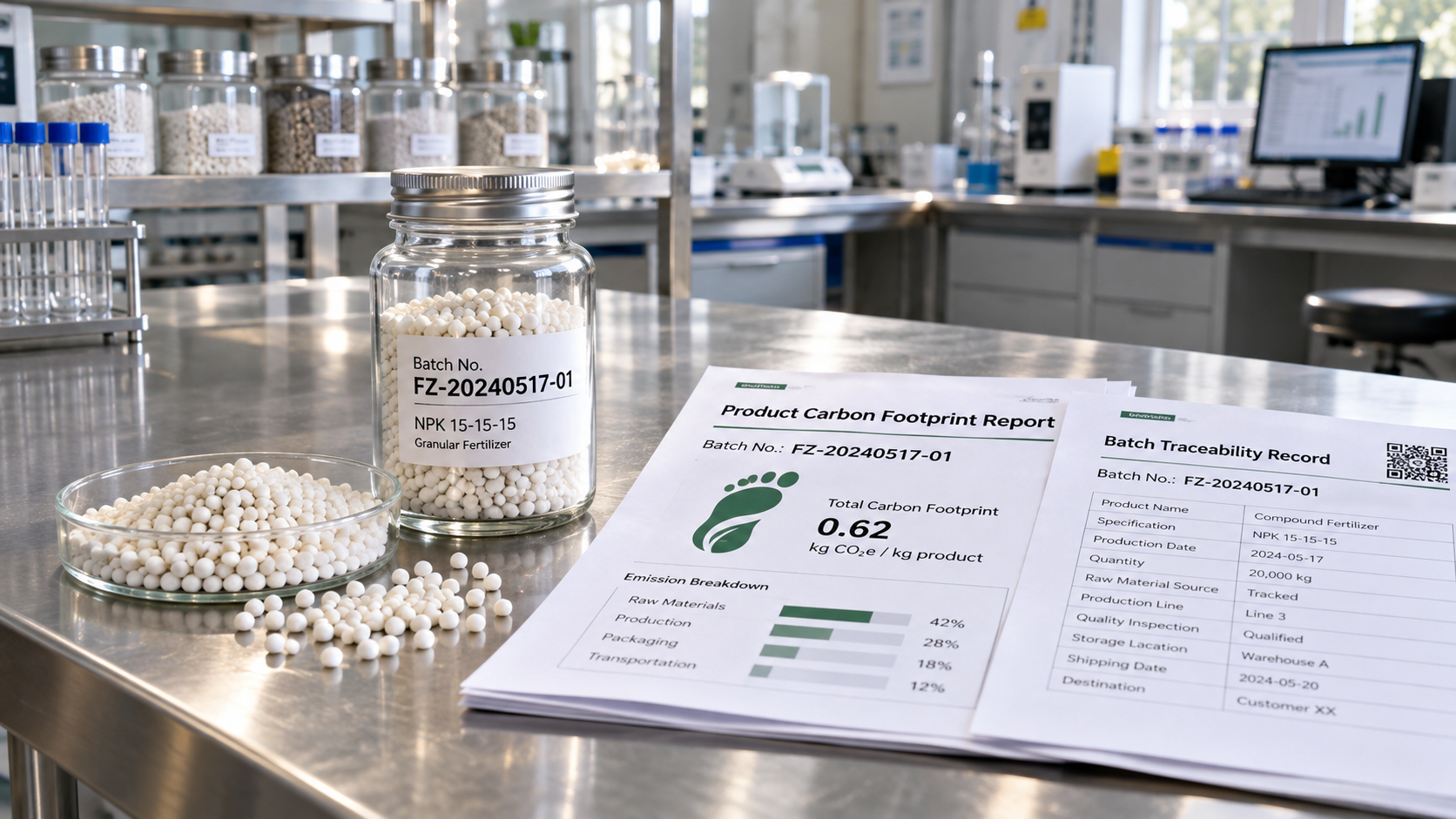
Request an evidence package rather than a certificate image. The documents should connect the advertised claim to both the calculation and the commercial product.
Detailed process data may be commercially confidential. A supplier need not disclose every operating record publicly, but confidentiality should not prevent access to a meaningful verification statement, calculation summary, and evidence of product coverage. Sensitive information can be examined under a confidentiality agreement or by an independent verifier.
Which carbon-footprint standards matter?
ISO 14067 provides requirements and guidelines for quantifying product carbon footprints, drawing on lifecycle-assessment principles in ISO 14040 and ISO 14044. The GHG Protocol Product Life Cycle Accounting and Reporting Standard is another recognized reference. These frameworks help structure a calculation; they do not themselves prove that a product is low-carbon.
Ask which standard, version, and product category rules were applied. Product category rules can determine important choices about boundaries, allocation, and reporting. Two studies referencing the same broad standard may still be unsuitable for direct comparison.
An environmental product declaration, where available, can provide structured, verified lifecycle information. It is not automatically a low-carbon certification, and declarations prepared under incompatible rules should not be ranked solely by their headline numbers.
A company-level environmental-management certificate is different again: it concerns a management system, not proof of a specific product’s emissions reduction.
How can two fertilizer footprints be compared fairly?
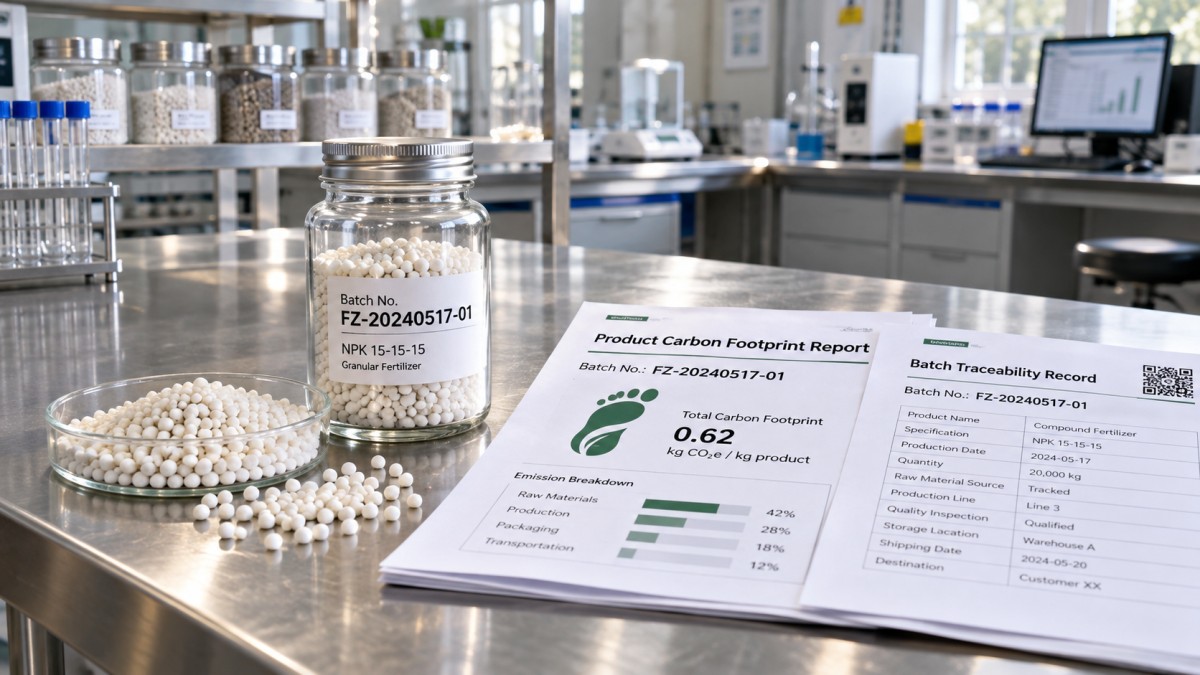
Align the product function, reporting unit, lifecycle boundary, and calculation assumptions before comparing results. A value expressed per tonne of fertilizer cannot be ranked directly against one expressed per tonne of nitrogen.
For nitrogen fertilizers, converting to a nutrient basis can expose misleading comparisons caused by different concentrations. Divide the footprint per tonne of product by the nitrogen mass fraction to obtain the footprint per tonne of nitrogen, provided the underlying boundaries are equivalent. For compound fertilizers, nitrogen alone may not represent the full nutrient function.
Even a nutrient-normalized comparison does not establish agronomic equivalence. Nutrient availability, application rate, placement, and field conditions can affect the quantity needed to achieve a particular crop outcome.
Check whether each assessment includes:
- Feedstock extraction and upstream energy supply.
- Ammonia production and subsequent fertilizer processing.
- Packaging, transport, and storage.
- Field application and associated emissions.
- Any relevant end-of-life treatment.
A cradle-to-gate footprint generally ends at the factory gate. A delivered-product footprint adds specified logistics, while a cradle-to-grave assessment extends through use and end-of-life stages. Excluding field emissions is not inherently misleading if the claim is explicitly limited to production. Presenting that figure as the fertilizer’s total climate impact would be misleading.
Which production details are most important to check?
The evidence should match the claimed source of improvement. For nitrogen fertilizers, ammonia production is an important checkpoint, but it is not the only one.
If renewable hydrogen underpins the claim, examine electricity sourcing, electrolyzer consumption, backup supply, and the rules used to attribute renewable electricity. A renewable-energy contract alone does not reveal the footprint of hydrogen production.
If the route uses fossil feedstocks with carbon capture, request the capture boundary, uncaptured emissions, upstream fuel emissions, transport and storage assumptions, and evidence concerning storage permanence. A capture percentage for one process stream is not the percentage reduction for the complete fertilizer lifecycle.
For nitrate-based fertilizers, nitrous oxide emissions from nitric acid production can materially affect the result. Evidence of abatement equipment is useful, but operating performance, monitoring, downtime, and the reporting period are more informative than installation alone.
For urea, check how the assessment treats carbon incorporated into the product and subsequently released during use. Incorporation of carbon dioxide into urea should not be confused with permanent carbon storage.
Does independent verification guarantee that the claim is valid?
No. Independent verification strengthens confidence only within its stated scope. A verifier may have examined a historical plant average, a calculation model, selected data, or a particular product footprint. None automatically confirms that every shipment carries the advertised attribute.
Read the verification statement itself. Identify the verifier, criteria, covered product and facilities, reporting period, level of assurance where specified, and any limitations or qualifications. If accreditation is claimed, confirm that its scope is relevant to the verification activity.
Pay attention to whether the work assessed operating data or only a proposed production scenario. A verified engineering estimate for a future facility is not evidence of the footprint of current deliveries.
Uncertainty also matters when comparing close results. A small difference between two reported footprints may not support a defensible ranking if data quality, assumptions, or uncertainty differ materially.
How should buyers assess mass-balance and book-and-claim models?
A physically segregated supply chain connects the delivered material to specified production. Mass-balance systems allow eligible and conventional inputs or outputs to mix while tracking attributed quantities under defined rules. Book-and-claim models separate an environmental attribute from the physical supply chain more explicitly.
These approaches can support different claims; they should not be presented as interchangeable. With an allocation-based model, establish what the scheme permits the supplier—and subsequently the customer—to say.
Request the scheme rules, covered facilities, reconciliation period, conversion factors, and controls preventing attributes from being issued or sold more than once. Check how an allocation is recorded against the purchased quantity and how cancellation, retirement, or an equivalent control prevents reuse.
A certificate showing that a manufacturer produced some low-carbon material is insufficient if the same attributes could support multiple sales. Likewise, purchasing an allocated attribute does not automatically establish eligibility for a reduction in every corporate inventory, customer program, or regulatory system. The intended reporting framework must accept the accounting approach.
Do carbon offsets make fertilizer low-carbon?
Offsets do not reduce the emissions physically associated with producing the fertilizer. They finance or represent emissions reductions or removals elsewhere. Keep the product’s gross footprint separate from any compensation claim.
Request the footprint before offsets, the quantity of credits applied, the crediting program and project identification, and evidence of retirement. Credit quality involves additional questions about additionality, permanence, leakage, and double counting.
A product described as “carbon neutral” after compensation may have higher manufacturing emissions than a lower-emission product sold without offsets. Comparing only the final net figure can therefore reverse the apparent ranking.
If the purchasing objective is to reduce supply-chain emissions, evaluate the underlying product footprint first. Whether credits support a separate claim depends on the applicable accounting and claims rules.
What changes when transport and field use are included?
A factory-gate advantage does not establish the size of the advantage at the delivery point. Compare equivalent transport assumptions, including route, mode, distance, and relevant storage or handling. Cross-border sourcing makes this especially important because suppliers may quote different delivery boundaries.
Field use introduces a different set of variables. Nitrous oxide emissions depend on factors including soil conditions, weather, nitrogen rate, timing, and application method. Urea can also release carbon dioxide during use. Lower production emissions do not by themselves demonstrate lower field emissions.
Claims involving inhibitors, controlled-release products, or improved nutrient-use efficiency need evidence appropriate to the claimed outcome and application conditions. Results from one crop, climate, or management system should not be treated as a universal reduction factor.
When field emissions are modeled, ask which emission factors and assumptions were used. Otherwise, a claimed improvement may reflect different modeling choices rather than a better-performing fertilizer.
What should be settled before accepting the claim?
Resolve gaps that could change the purchasing decision: an unclear baseline, unmatched units, an outdated reporting period, missing verification scope, unexplained offsets, or certificates that cannot be linked to supplied quantities. An unusually low figure is a reason to investigate boundaries and allocation—not proof of either innovation or misconduct.
The purchase specification should identify the product grade, eligible production site or sourcing arrangement, footprint boundary, maximum accepted footprint where relevant, calculation method, evidence requirements, and permitted claim wording. It should also address changes in feedstock, electricity sourcing, production location, and allocation method that could affect the result.
Specify whether compliance is demonstrated through a verified plant average, a defined reporting period, or shipment-linked documentation. Retain the supporting records alongside the contract and delivery documents.
A defensible decision does not require perfect information. It requires enough consistent evidence to establish what was measured, what was excluded, why the comparison is valid, and how the claimed attribute reaches the purchased quantity. If those links cannot be demonstrated, the low-carbon claim should remain unaccepted rather than being treated as a verified purchasing benefit.
Deep Dive
Related Intelligence
 Specialty ChemicalsSodium Methoxide Selection: How Chemical Buyers Reduce Specification and Handling RiskAnalyst:Lead Materials Scientist
 Specialty ChemicalsHow Corporate Case Studies Reveal Real-World Challenges in Adopting Specialty Chemicals for Food SafetyAnalyst:Lead Materials Scientist
 Specialty ChemicalsCan Brand Elevation Tactics Reduce Customer Acquisition Cost for Specialty Chemicals in Organic Food Production?Analyst:Lead Materials Scientist