Why Do Fleet LED Headlight Lenses Crack After Chemical Washdowns?
Key Takeaways
- The Kyiv Independent Hit by Suspected Russian CyberattackIT & Security Director
- What is editorial exposure and how does it differ from paid advertising?IT & Security Director
- Apple Warns Users in 99 Countries of Spyware; German Lawmakers' Devices SuspectedIT & Security Director
- How to write technical content for exporters selling machinery abroadChief Civil Engineer
- BW ESS Brings Hams Hall, Europe's Largest Operating Battery Storage Project, OnlineAutomotive Tech Analyst
- How to size electric motors for pumpsChief Civil Engineer
- Trump Administration Pledges $15 Billion in Farm Aid Ahead of Midterm ElectionsAgri-Tech Strategist
- When does automated food processing technology pay for itself?Agri-Tech Strategist
Industry Overview
We do not just publish news; we construct a high-fidelity digital footprint for our partners. By aligning with TNE, enterprises build the essential algorithmic "Trust Signals" required by modern search engines, ensuring they stand out to high-net-worth buyers in an increasingly crowded global digital landscape.
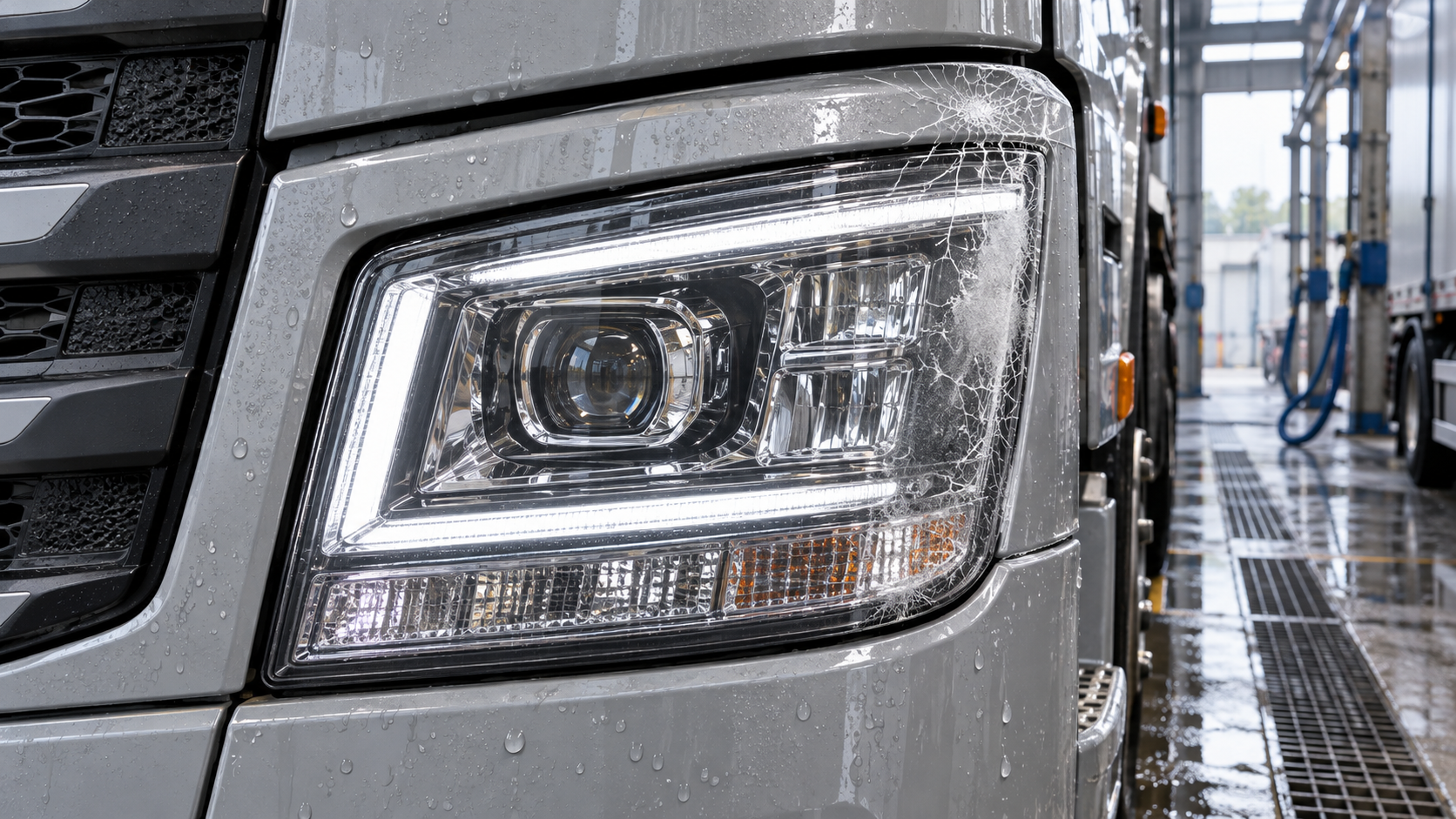
“Why are our fleet's LED headlight lenses cracking after chemical washdowns?” The leading suspect is often environmental stress cracking: a cleaning formulation interacts with a plastic lens already carrying manufacturing, assembly, or service stresses. Detergent concentration, contact time, temperature, and coating condition can all influence the outcome. Replacing the lamp without investigating those conditions can leave the next assembly exposed to exactly the same problem.
That does not make every post-wash crack chemical damage. Stone impacts, mounting loads, coating deterioration, and temperature changes can produce overlapping symptoms. The useful question is not simply whether the wash happened before the failure, but whether the damage pattern and exposure history support a chemical contribution.
Why can a tough headlight lens crack without being hit?
Many modern headlamp outer lenses use hard-coated polycarbonate, although the material and coating should be confirmed for the specific part. Polycarbonate offers high impact resistance, but impact toughness does not guarantee resistance to every cleaner. Under tensile stress, an incompatible chemical can encourage microscopic crazes and eventual cracking at loads the lens would otherwise tolerate.
The stress may already be present. Injection molding can leave residual stresses, while assembly geometry, distorted brackets, prior collision repairs, and temperature cycling can add service loads. Chemical exposure does not have to dissolve the lens visibly to contribute to failure.
This explains an apparently inconsistent fleet pattern: the same wash product may leave some lamps looking normal while others develop fine cracks. Different lamp suppliers, production histories, coating wear, and mounting conditions can change the response. “Only a few vehicles failed” is not enough to rule out the wash process.
What does chemical damage look like compared with impact damage?
Start with clean, dry lenses under oblique light. Fine branching lines, localized haze, or crazing around edges and stressed areas can support a chemical-stress hypothesis. Damage following runoff paths or concentrated around places where liquid collects is another useful clue. None of these observations proves the cause by itself.
An impact often leaves a recognizable strike point, chip, or abrasion associated with the fracture. Mechanical loading may produce damage associated with a distorted housing, mounting area, or previous repair. Coating damage can resemble cracking even when the underlying polycarbonate has not fractured. A magnified examination helps distinguish these conditions; photographs alone may not.
Also establish when the damage became visible. Washing can remove dirt that concealed an existing defect. Conversely, environmentally assisted cracks may develop or extend after the surface has dried. A driver noticing cracks after washing establishes a timeline, not a complete diagnosis.
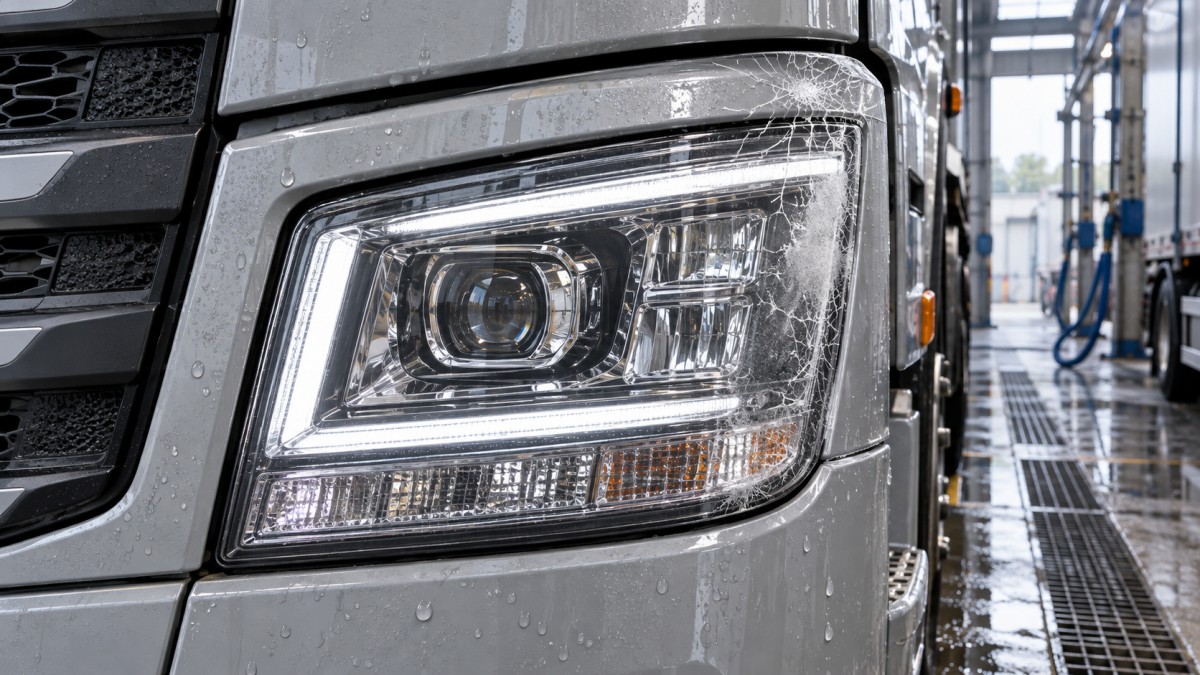
For useful comparison photographs, include the entire lamp, a close-up of the damaged area, and its position relative to an edge, mounting feature, or runoff path. Photograph an unaffected lamp of the same part number under similar lighting.
Which wash chemicals should we investigate?
Investigate the complete wash sequence, not just the detergent listed on the purchase order. Pre-soaks, degreasers, insect removers, wheel cleaners, rinse additives, and manually applied spot treatments can all reach the headlamp. Overspray from a neighboring cleaning operation is easy to miss.
Strongly alkaline products, some solvents, and certain formulated cleaner mixtures warrant particular scrutiny for polycarbonate compatibility. However, a chemical-family label is not a reliable pass-or-fail test. Concentration, temperature, exposure duration, the coating, and the lens's stress state all matter. A generic statement that a product is “plastic-safe” is too broad for this decision.
Nor does neutral pH establish compatibility. pH does not describe solvent content or every interaction between a formulation and a coated plastic. The safety data sheet helps identify hazards and some ingredients, but it is not a finished-headlamp compatibility certificate.
Ask the chemical supplier for written guidance covering the actual lens material and coating, working dilution, application temperature, dwell time, and rinse requirements. Cross-check that guidance with the headlamp or vehicle manufacturer's cleaning instructions. Where the two do not align, resolve the discrepancy before continuing exposure.
Why would cracking begin when the detergent has not changed?
An unchanged product name does not mean unchanged exposure. A dosing fault, different concentrate, adjusted wash program, slower vehicle movement, or hand spraying can alter what reaches the lens. Check the delivered working solution using the chemical supplier's recommended verification method; do not rely solely on the injector setting.
A particularly revealing scenario is a vehicle waiting after pre-soak application. The intended dwell becomes longer, and partial drying can concentrate residues. Repeating the process on sun-heated lenses creates another exposure condition, even though the operator follows the same nominal dilution.
Older lenses may also respond differently. Weathering, abrasion, and previous polishing can compromise the protective hard coat. That does not prove chemical attack, but it changes the surface being exposed. Compare vehicles by lamp age, replacement history, wash route, and cleaning practice rather than grouping the entire fleet together.
Could pressure or temperature be the real cause?
Possibly, and these factors can coexist with chemical attack. High-pressure spraying at close range may damage vulnerable coatings or seals. Rapid temperature changes can add stress. LED lighting does not make an assembly thermally inactive: electronics, sunlight, and surrounding vehicle components still affect its temperature.
Record water temperature, lens surface conditions, nozzle type, distance, and spray direction alongside chemical data. Follow the vehicle or lamp manufacturer's limits rather than adopting a universal pressure or temperature threshold.
What should maintenance teams do before replacing more lamps?
Address roadworthiness first. Cracking, haze, water ingress, or altered light distribution may make continued operation unsuitable. Apply the vehicle manufacturer's guidance and relevant local inspection requirements. A lamp that still illuminates is not necessarily delivering an acceptable beam.
Then preserve evidence before parts and wash records disappear:
- Retain representative failed assemblies, labeling vehicle identification, lamp part number, installation date if known, and first observed damage.
- Record every chemical used in the wash sequence, including product codes, batches where available, working dilutions, and manual treatments.
- Capture dosing checks, dwell conditions, rinse performance, and recent maintenance or program changes.
- Identify unaffected comparison vehicles with similar lamps and service conditions, including vehicles using another wash location.
Suspend the suspected exposure for affected lamp types while checking an approved alternative process. Simply reducing concentration by guesswork can compromise cleaning without establishing compatibility. If the operation requires disinfection or removal of specific contaminants, involve the responsible safety or hygiene team before changing the procedure.
Avoid polishing, solvent wiping, or experimental treatments on retained failed parts. Those actions can remove surface evidence and make supplier assessment less conclusive.
How can suppliers confirm compatibility rather than trade blame?
Give the lamp supplier and chemical supplier the same exposure record. Ask them to evaluate a defined combination: this assembly, this cleaner, this working concentration, and this wash sequence. Separate conversations based on “your plastic” and “your detergent” rarely resolve the interaction.
Testing should account for stress and coating condition. A short immersion test on an unstressed, uncoated plastic sample cannot establish the suitability of a finished headlamp. Conversely, exposing a sample to neat concentrate may demonstrate a hazard without representing normal service. Both tests can answer limited questions, but neither automatically explains fleet failures.
A materials laboratory can help distinguish coating crazing from substrate cracking, examine fracture origins, and design comparative exposure tests. Representative assemblies, realistic repeated wash cycles, appropriate controls, and documented drying and temperature conditions make results more useful. Include foreseeable process deviations without confusing them with normal operating conditions.
This is the materials-and-maintenance interface that TradeNexus Edge (TNE) covers across Advanced Materials & Chemicals and Auto & E-Mobility: sourcing decisions need application-specific evidence, not isolated claims about a resin or cleaning product.
Can the lenses be repaired, and how do we prevent recurrence?
Do not treat a cracked lens as ordinary surface oxidation. Polishing may improve some superficial defects, but it does not restore a fractured substrate or establish optical performance. Unapproved solvents, adhesives, and coatings can introduce further damage. Whether a lens can be serviced separately or requires assembly replacement depends on the lamp design and manufacturer instructions.
Prevention usually means controlling exposure rather than buying a supposedly indestructible lens. Document the approved chemistry and dilution, verify dosing, prevent products drying on lamps, and follow specified rinsing and pressure-washing practices. Include subcontracted wash sites: an internal procedure offers little protection if an outside operator uses an incompatible spot cleaner.
For replacement procurement, request cleaning restrictions and compatibility evidence for the finished assembly, not just the base polymer. An aftermarket lamp should not be assumed equivalent in coating or chemical response because it fits the same vehicle.
After any corrective change, track new damage against lamp part number and wash exposure over repeated cycles. An intact lens after one wash is encouraging, not proof of a permanent fix. Before authorizing another round of replacements, confirm that the conditions capable of damaging those replacements have actually changed.
Deep Dive
Related Intelligence
 Auto ElectronicsHow Automotive Tier-1 Suppliers Validate Polyurethane Resins for Bumper Systems Under -40°C to +85°C CyclingAnalyst:Automotive Tech Analyst
 Auto ElectronicsLED headlights brighten roads — and also expose flaws in headlamp alignment protocolsAnalyst:Automotive Tech Analyst
 Auto ElectronicsCar infotainment units with Android Automotive OS struggle with OTA update rollbacks — and no clear recovery pathAnalyst:Automotive Tech Analyst