Do EV Battery Imports Require Dangerous Goods Shipping Documents?
Key Takeaways
- The Kyiv Independent Hit by Suspected Russian CyberattackIT & Security Director
- What is editorial exposure and how does it differ from paid advertising?IT & Security Director
- Apple Warns Users in 99 Countries of Spyware; German Lawmakers' Devices SuspectedIT & Security Director
- How to write technical content for exporters selling machinery abroadChief Civil Engineer
- BW ESS Brings Hams Hall, Europe's Largest Operating Battery Storage Project, OnlineAutomotive Tech Analyst
- How to size electric motors for pumpsChief Civil Engineer
- Trump Administration Pledges $15 Billion in Farm Aid Ahead of Midterm ElectionsAgri-Tech Strategist
- When does automated food processing technology pay for itself?Agri-Tech Strategist
Industry Overview
We do not just publish news; we construct a high-fidelity digital footprint for our partners. By aligning with TNE, enterprises build the essential algorithmic "Trust Signals" required by modern search engines, ensuring they stand out to high-net-worth buyers in an increasingly crowded global digital landscape.
Do EV Battery Imports Require Dangerous Goods Shipping Documents?
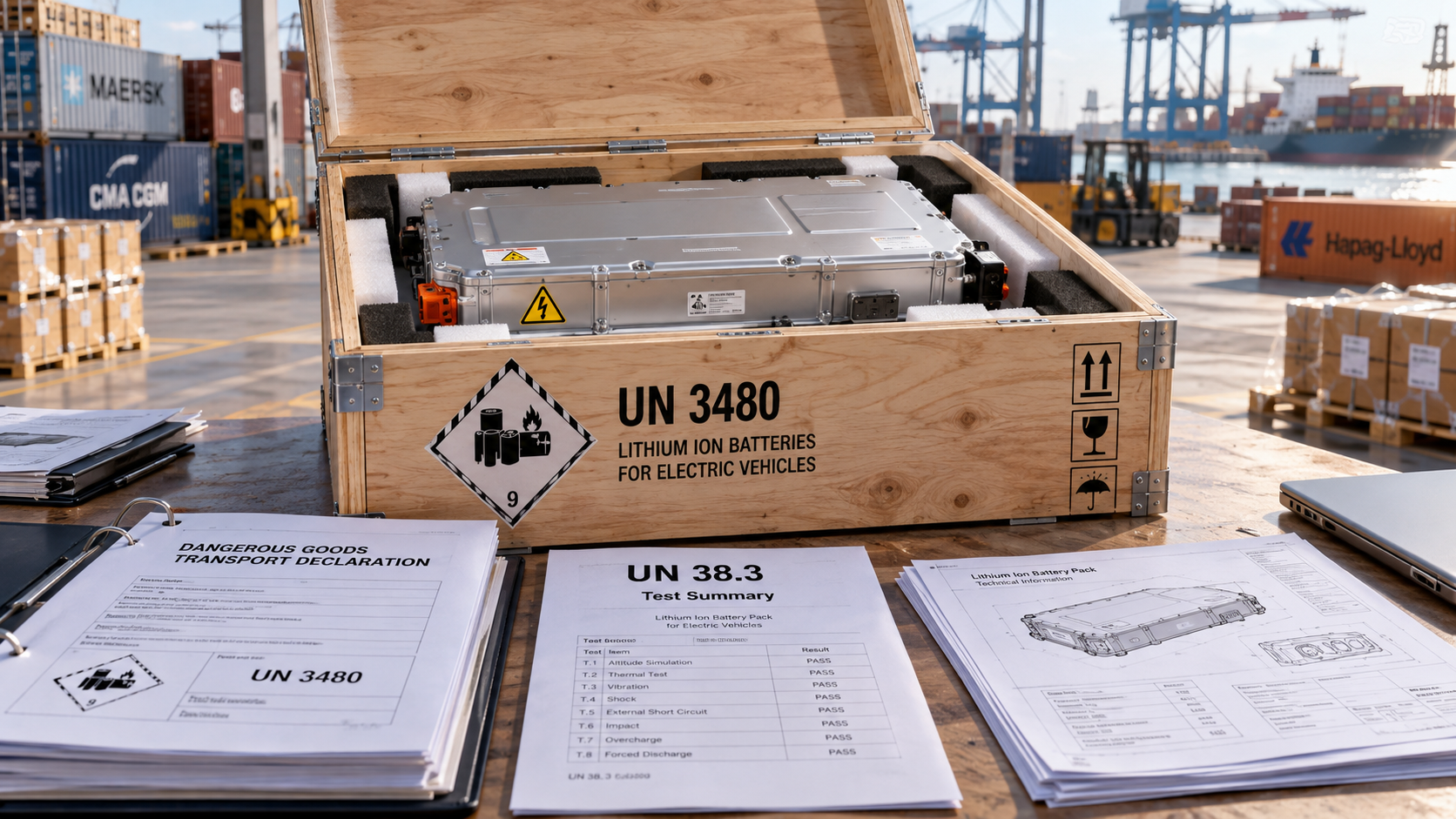
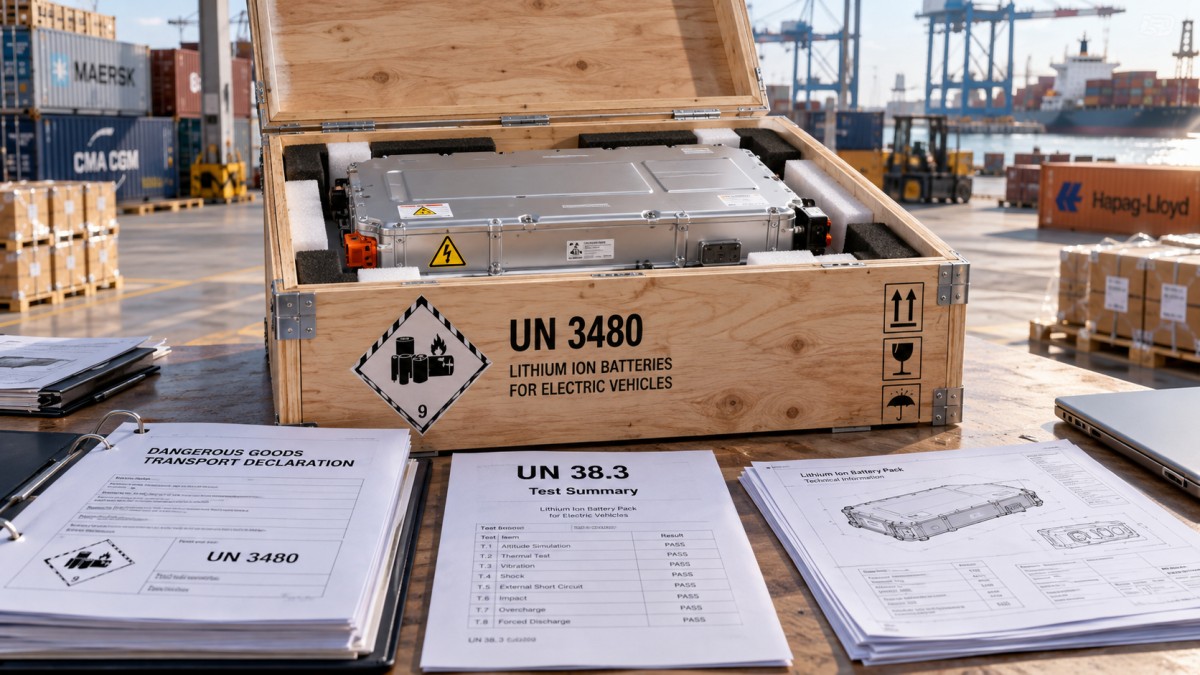
Do EV battery imports need dangerous goods shipping documents? For most commercial shipments of standalone lithium-ion EV batteries, yes. But the exact paperwork depends on the battery’s classification, condition, transport mode, and route. A replacement pack shipped in a crate is not treated the same way as a battery installed in a complete vehicle.
The mistake to avoid is treating “battery documentation” as one interchangeable bundle. A UN 38.3 test summary, a safety data sheet, and a dangerous goods declaration serve different purposes. Having one does not automatically satisfy the requirements for the others.
Before booking freight, establish what is being shipped, which transport rules apply, and who will prepare and sign the declaration. Those decisions should come before the supplier seals the crate—not after the carrier rejects it.
Start with the shipment, not the product name
“EV battery” is a purchasing description, not a complete dangerous goods classification. The same battery technology can fall under different transport entries depending on how it is presented for carriage.
A battery bolted into a transport frame is not automatically “contained in equipment.” Likewise, putting an unrelated component in the crate does not turn a standalone battery shipment into UN 3481. Classification follows the actual configuration and regulatory definitions.
Chemistry matters too. Lithium iron phosphate, commonly called LFP, remains a lithium-ion chemistry for transport purposes. Its safety characteristics do not make a commercial traction pack exempt from dangerous goods rules. Other chemistries require their own assessment.
Which documents do you actually need?
For a typical fully regulated lithium-ion battery shipment, the documentation package has several layers. Keep them separate in your procurement checklist.
The dangerous goods declaration
This communicates the shipment’s regulated transport description and certifies compliance with applicable requirements. Air shipments generally use an IATA Shipper’s Declaration for Dangerous Goods when required. Sea shipments use a dangerous goods transport document complying with the IMDG Code, often incorporated into a multimodal dangerous goods form.
Information typically includes the UN number, proper shipping name, hazard class, package details, and quantity, with additional entries where required. Do not invent a packing group: lithium-ion battery entries do not have an assigned packing group.
The UN 38.3 test summary
Subject to limited regulatory exceptions, lithium battery types must meet the applicable tests in subsection 38.3 of the UN Manual of Tests and Criteria. Manufacturers and subsequent distributors must make the prescribed test summary available. It is not generally a document that must physically accompany every consignment, although carriers and customers may request it before acceptance.
Check that the summary covers the battery type being shipped. A cell-level document should not be assumed to establish compliance for an assembled traction pack. Model references, manufacturer details, and the relationship between the tested design and supplied product need to be traceable.
Supporting records and ordinary import paperwork
A safety data sheet may support handling reviews or satisfy a carrier’s request, but it does not replace the declaration or test summary. Commercial invoices, packing lists, customs entries, and any destination-specific product compliance records remain separate requirements.
For sea freight, a container or vehicle packing certificate may also be required under the applicable IMDG provisions. It can be combined with the dangerous goods transport document, but the packing certification and shipper’s declaration address different responsibilities.
Air freight: confirm eligibility before buying speed
Standalone lithium-ion batteries under UN 3480 are forbidden as cargo on passenger aircraft. Eligible shipments move on cargo aircraft under the applicable requirements. For normal UN 3480 air shipments, state of charge must not exceed 30% of rated capacity; departures from that limit require the applicable approval pathway.
Large EV packs also raise package-weight, handling, and aircraft-loading questions. Do not assume that a forwarder offering general lithium-battery services can accept a complete traction battery. Some shipments require approvals or arrangements beyond an ordinary dangerous goods booking.
For an urgent replacement pack, send the forwarder the battery specifications, weight, dimensions, condition, test summary, and proposed packaging before authorizing dispatch. Ask for written confirmation of acceptance under the actual routing, including any connecting airline.
The governing framework includes the ICAO Technical Instructions, with airlines commonly applying the IATA Dangerous Goods Regulations and operator variations. Use the current edition: requirements for batteries packed with or contained in equipment can differ from standalone batteries and can change between editions.
A declaration cannot make an otherwise prohibited shipment acceptable.
Sea freight: more capacity, but still a controlled shipment
Ocean transport is often more practical for heavy battery packs, but it is not a paperwork shortcut. Fully regulated shipments must meet the applicable IMDG Code requirements for documentation, packaging, marking, labeling, and cargo transport unit placarding.
The shipping line may request a draft declaration, test summary, battery specifications, and packaging information before approving the booking. Its acceptance policy can be more restrictive than the regulatory minimum. Transshipment ports and inland connections can add further constraints.
Do not transfer the air-freight 30% state-of-charge rule to every sea shipment as though it were universal. Establish the applicable sea requirements and then check whether the shipping line imposes its own charge limits or supporting evidence requirements.
Documentation and physical preparation must agree. If the declaration describes individual crates but the final shipment uses an overpack, review the package descriptions, visibility of marks and labels, and any required overpack marking before release.
Used, damaged, and prototype batteries need an earlier decision
A used battery is not automatically a damaged battery. Conversely, a pack that still holds charge is not necessarily suitable for routine transport. Return shipments need a condition assessment, especially after collision damage, water exposure, overheating, swelling, leakage, or a safety-related recall.
Batteries identified as damaged or defective for safety reasons are generally forbidden for air transport. Sea or road movements may be possible under specific provisions, but packaging and approval requirements depend on the hazard presented. A pack liable to dangerous reaction during transport requires specialist assessment—not simply a stronger wooden crate.
Prototype and low-production-run batteries can have specific regulatory pathways. “Engineering sample” is not an exemption by itself. Before ordering transport, establish whether testing requirements have been met or whether an applicable alternative provision and approval are available.
For batteries moving for recycling or disposal, check waste shipment controls separately. Dangerous goods compliance alone does not establish that a cross-border waste movement is lawful.
Build a release check that catches expensive mismatches
A useful pre-shipment review connects the technical file to the booking and the actual cargo. It should answer these questions:
- Identity: Do model numbers on the invoice, packing list, battery labels, and supporting test documentation correspond?
- Classification: Has a competent dangerous goods specialist confirmed the UN entry, transport description, and applicable packing instruction?
- Condition: Is the shipment new, used, returned, damaged, prototype, or waste—and is that status disclosed?
- Preparation: Are terminals protected against short circuit, batteries secured against movement, and packaging suitable for the relevant requirements?
- Acceptance: Has the actual carrier accepted the route, package dimensions, weights, and battery configuration?
- Responsibility: Who prepares, checks, and signs the declaration, and who supplies the final packing information?
That final point deserves a purchase-order clause. A forwarder may prepare documents, but the allocation of legal duties depends on the parties’ actual roles and applicable law. Incoterms allocate commercial obligations; they do not override dangerous goods responsibilities.
Avoid “documents to follow” arrangements for first-time suppliers. Request draft paperwork before cargo collection, then reconcile it against the final packed shipment. Changes in package count, battery model, or route should trigger another review.
Check transport compliance separately from import clearance
Customs release does not prove that a battery was correctly offered for transport. Equally, carrier acceptance does not establish compliance with destination-market battery, environmental, or product rules. Include the port-to-warehouse journey in the review: road or rail legs can introduce their own documentation and operational requirements.
This distinction fits TradeNexus Edge’s focus on practical Auto & E-Mobility supply-chain intelligence: a sourcing decision is incomplete until the product’s technical evidence, freight acceptance, and import requirements align.
For verification, consult the current IATA lithium battery guidance, the IMO dangerous goods resources, and the UNECE dangerous goods resources, alongside national authorities and your carrier’s acceptance team.
For an ordinary standalone EV lithium-ion pack, plan on a fully regulated dangerous goods shipment unless a qualified review establishes otherwise. Before releasing payment or cargo, obtain a consistent classification, traceable test documentation, an agreed declaration process, and written carrier acceptance. A supplier’s promise that “we have shipped batteries before” is not a substitute for those checks.
Deep Dive
Related Intelligence
 Battery TechLithium battery packs for off-grid telecom — why cycle life drops 40% below 15°CAnalyst:Automotive Tech Analyst
 Battery TechEVE Power Officially Becomes Tesla's Fifth Global Battery SupplierAnalyst:Automotive Tech Analyst
 Battery TechLithium battery packs in off-grid HVAC: Are thermal runaway risks being underestimated?Analyst:Automotive Tech Analyst