How to Evaluate Weather-Based Smart Irrigation Controllers
Key Takeaways
- When does modular construction reduce a project's total cost?Chief Civil Engineer
- What cloud infrastructure analysis reveals about Singapore latency risksIT & Security Director
- How to verify recycled green building materials meet project standardsChief Civil Engineer
- What to evaluate when comparing cybersecurity analysis providersIT & Security Director
- When does agricultural automation equipment pay off for mid-size farms?Agri-Tech Strategist
- How Tank Design Helps Reduce Oxidation Risks in Edible Oil StorageAgri-Tech Strategist
- How to match heavy duty earthmoving equipment to site conditionsChief Civil Engineer
- When chemical supply solutions reduce the risk of production downtimeLead Materials Scientist
Industry Overview
We do not just publish news; we construct a high-fidelity digital footprint for our partners. By aligning with TNE, enterprises build the essential algorithmic "Trust Signals" required by modern search engines, ensuring they stand out to high-net-worth buyers in an increasingly crowded global digital landscape.
How to Evaluate Weather-Based Smart Irrigation Controllers
The main mistake in evaluating weather-based irrigation controllers is assuming they are all doing the same job with different user interfaces. They are not. Some systems are little more than programmable timers with access to forecast data. Others actively recalculate irrigation demand using local weather inputs, soil characteristics, plant type, and seasonal patterns. For a technical evaluator, that difference matters more than the marketing label “smart.” If the controller cannot translate weather signals into defensible watering decisions under real site conditions, it is not a strong decision tool. It is just a more complicated clock.
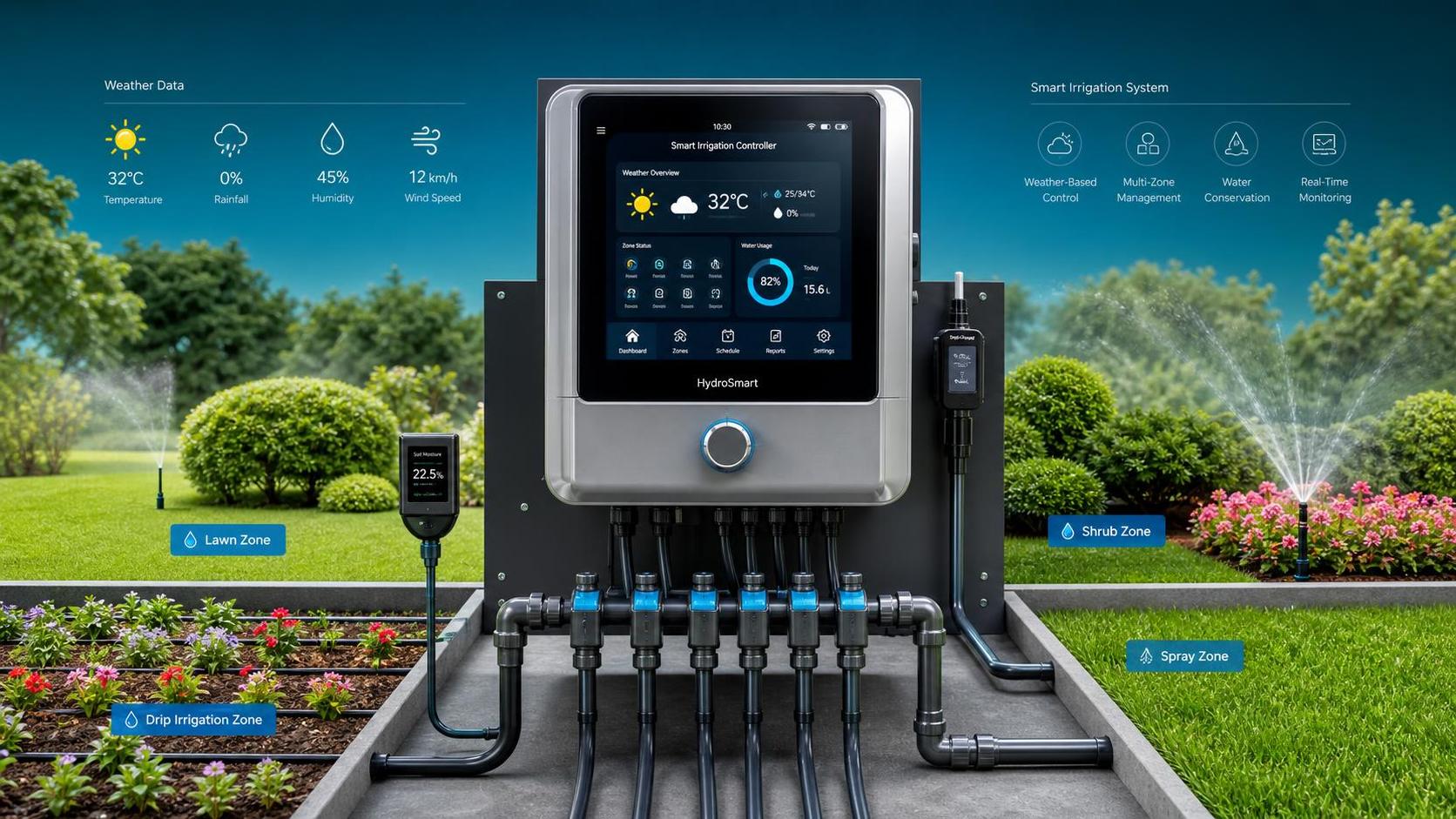
In practical terms, Smart Irrigation Systems weather-based controllers are designed to adjust irrigation schedules in response to environmental conditions rather than relying on fixed runtimes alone. The strongest products usually estimate plant water demand through some form of evapotranspiration logic, rainfall response, temperature adjustment, or forecast-informed scheduling. But the evaluation should not stop at whether those functions exist. The important question is how the controller gets its weather data, how often it updates, how it handles uncertainty, and whether its recommendations remain stable when site conditions are irregular.
That last point is where many procurement and engineering teams get tripped up. A controller can look sophisticated in a demo and still perform poorly on a site with mixed exposure, poor hydraulic uniformity, variable soil infiltration, or microclimates that differ from the nearest weather station. A landscape around a commercial campus, a sports field, and a specialty crop block may all be described as irrigation sites, but the tolerance for under-watering, runoff, and response delay is completely different in each case. Evaluation needs to start from operating context, not feature count.
What the controller is really deciding
A weather-based controller is not just deciding when to open a valve. It is making an ongoing estimate about water balance. That estimate may include recent rainfall, forecast rainfall, temperature, solar radiation, humidity, wind, or historical climate norms, depending on the system design. Some products calculate a replacement percentage against a baseline schedule. Others dynamically generate runtimes by zone. The more autonomous the controller is, the more important it becomes to understand its decision model and the assumptions built into it.
This is why the phrase “weather-based” can be misleading. In the field, there is a meaningful difference between a controller that reacts to a rain event and one that continuously adjusts irrigation based on estimated plant demand. There is also a difference between systems that depend on off-site weather feeds and systems tied to on-site sensors. Neither approach is automatically superior. Off-site data may be sufficient for uniform urban landscapes in stable climates. On-site sensing can be more valuable where topography, coastal effects, heat islands, or convective rainfall create large local deviations.
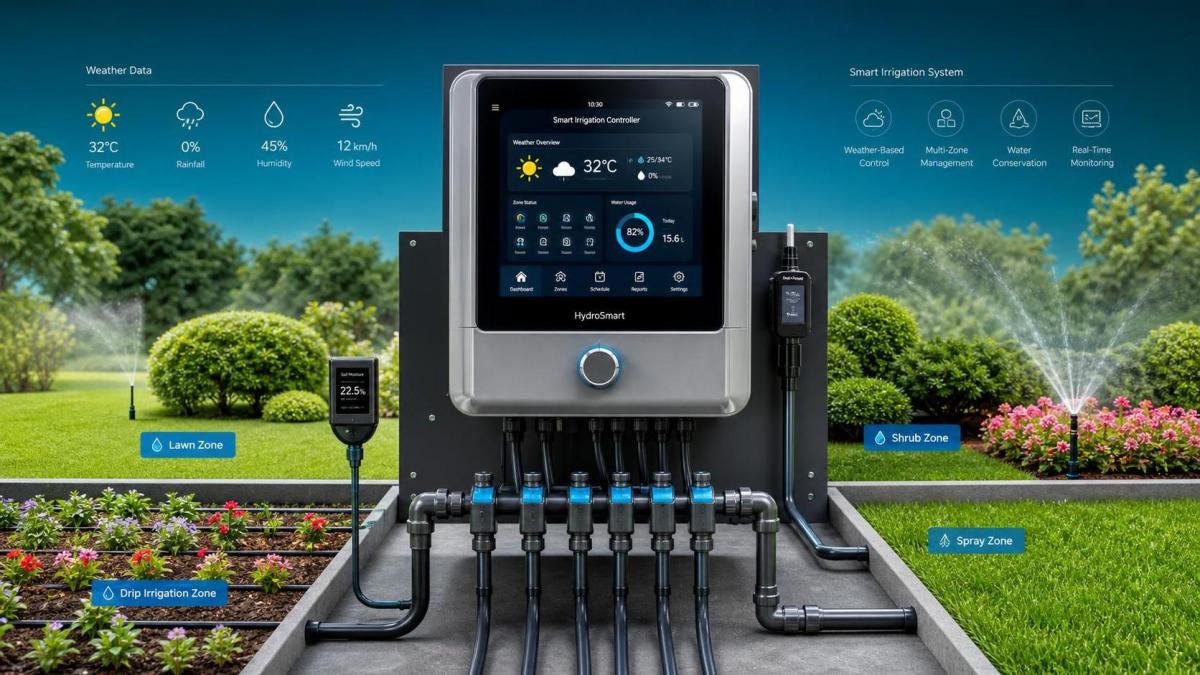
For technical review, ask a simple question early: what inputs materially change irrigation decisions, and which are only informational? Many products display weather data, but not all use it with equal weight. A dashboard showing temperature, rainfall, and wind can create the impression of intelligence without proving that zone runtimes are being updated in a meaningful way.
Data quality matters more than feature breadth
Controller performance is limited by the quality, location, and timing of its data. If the product relies on third-party weather feeds, evaluators should examine station density, update intervals, fallback behavior during connectivity loss, and whether the system uses measured observations, forecast inputs, or both. Forecast-driven control can reduce unnecessary irrigation before rain, but it also introduces model risk. In climates with volatile short-range weather, forecast dependence can lead to repeated overcorrection unless the controller applies conservative thresholds.
Sensor-based architectures are not automatically cleaner. Rain sensors, freeze sensors, flow sensors, and soil moisture sensors all have installation and maintenance constraints. A poorly placed rain sensor can miss irrigation-shadow effects from trees or structures. A soil moisture probe installed in the wrong root zone depth can generate confident but misleading signals. In other words, adding sensors increases information potential, but it also increases failure points. Evaluation should include sensor placement requirements, calibration burden, replacement cycles, and diagnostic visibility.
This is where experienced reviewers separate platform capability from deployment discipline. A controller may support advanced inputs, but if the site team cannot maintain sensor integrity or verify communications consistently, the theoretical advantage may never appear in actual water savings.
Compatibility is not just electrical
A common evaluation mistake is reducing compatibility to valve count, voltage, and enclosure rating. Those are necessary checks, but they are basic. The harder compatibility questions involve irrigation design logic. Can the controller handle different precipitation rates across zones without forcing awkward scheduling compromises? Does it support cycle-and-soak programming for soils prone to runoff? Can it manage master valves, pumps, flow alarms, and hydraulic delays in a way that aligns with the existing field network?
For larger installations, software interoperability also becomes material. Some buyers need integration with central management platforms, building management systems, or broader agricultural data environments. Others simply need exportable logs for audits, maintenance review, or utility rebate documentation. Not every site requires API access or enterprise dashboards, but teams should be careful about buying into a closed platform that limits long-term operational visibility. Once a controller becomes embedded across multiple sites, switching costs rise quickly.
The site model often matters more than the algorithm
Even a good algorithm will underperform if the site model is crude. Controllers typically ask users to define soil type, slope, sprinkler or drip application, sun exposure, root depth, and plant category. Those inputs may look secondary during setup, but they strongly influence water balance calculations and runtime decisions. If the system oversimplifies these variables, or if the commissioning process treats them casually, the resulting automation can lock in bad assumptions.
This is particularly important in mixed-use landscapes and agricultural edge cases. Turf, shrubs, ornamentals, and drip-irrigated beds on the same property do not respond uniformly to the same weather signal. Nor do sandy and clay-heavy zones recover at the same rate after rainfall. A capable controller should allow enough granularity to reflect these differences without becoming unusable for field teams. There is no value in configurability so deep that maintenance staff stop trusting the system and revert to manual overrides.
That tradeoff between sophistication and operability is central. Technical evaluators should ask not only whether the controller can model complexity, but whether the organization can support that complexity over time.
Where ROI really comes from
Water savings are the most obvious justification, but they are not the only one, and in some projects they are not even the dominant one. A weather-based controller can also reduce landscape damage from under- or over-irrigation, cut emergency maintenance caused by runoff or pressure-related issues, improve compliance with local watering restrictions, and make distributed site management less labor-intensive. For agriculture, the value proposition may lean more toward consistency, crop stress avoidance, and better scheduling discipline than simple volume reduction.
Still, ROI claims need a careful reading. Savings depend heavily on baseline conditions. Replacing a badly programmed timer on an overwatered property can show dramatic improvement. Replacing a well-managed conventional controller on a site with already disciplined irrigation practices may yield a smaller gain. Evaluators should separate controllable improvement from marketing assumptions. A pilot on representative zones is often more informative than projected savings models, especially where soil conditions and weather variability are not uniform across the portfolio.
Long-term cost should also include communications fees, software licensing, sensor replacement, field troubleshooting time, and training. A controller that saves water but creates recurring diagnostic overhead may still be worth buying, but only if that burden is visible during evaluation rather than discovered after rollout.
Common misunderstandings worth correcting early
One common misunderstanding is that “smart” means fully autonomous. In reality, most strong systems still depend on good hydraulic design, correct zone grouping, and periodic review of exceptions. Another is that more weather inputs always produce better outcomes. In some environments, too many poorly validated inputs can make schedules less stable, not more accurate. Teams also tend to overestimate the value of mobile access while underestimating the importance of alarm quality, event logs, and override governance.
There is also a tendency to treat all irrigation sectors the same. Commercial landscaping, municipal green infrastructure, sports turf, and agriculture may all use weather-responsive logic, but their decision thresholds differ. A slight stress event in ornamental beds may be acceptable. The same event on a high-visibility sports surface or a sensitive crop block may not be. Controller evaluation should therefore be tied to the cost of error, not just the cost of water.
A practical evaluation path
A useful review process usually starts with three questions. What decisions must the controller make automatically? What site variability must it represent? What evidence will show that it is performing correctly after deployment? Those questions lead naturally to a narrower vendor list than generic feature filtering.
From there, the strongest evaluations focus on commissioning quality, not just product specification. Request a demonstration of zone-level adjustment logic. Ask how the system behaves when weather data is delayed. Review reporting outputs for anomalies, skipped events, and manual interventions. Confirm whether the platform exposes enough history to diagnose why a runtime changed. If it cannot explain its own actions clearly, operations teams will struggle to trust it.
For teams comparing Smart Irrigation Systems weather-based controllers, the goal is not to find the controller with the longest feature sheet. It is to identify the system whose weather logic, site modeling, integration approach, and maintenance burden fit the realities of the asset being managed. A good choice is one that keeps irrigation decisions technically defensible after the installer leaves, through dry spells, false rain forecasts, sensor drift, staff turnover, and all the ordinary friction that real operations introduce.
Deep Dive
Related Intelligence
 Precision FarmingHow Global Commerce Data Helps Precision Farming Equipment Managers Forecast Spare Part Demand AccuratelyAnalyst:Agri-Tech Strategist
 Precision FarmingHow much does deploying automated farming solutions manufacturer hardware increase labor efficiency on layer farms?Analyst:Agri-Tech Strategist
 Precision FarmingWhy automated farming solutions manufacturers prioritize modular design over full-stack integrationAnalyst:Agri-Tech Strategist