How to size a poultry house ventilation system for summer heat
Key Takeaways
- When does modular construction reduce a project's total cost?Chief Civil Engineer
- What cloud infrastructure analysis reveals about Singapore latency risksIT & Security Director
- How to verify recycled green building materials meet project standardsChief Civil Engineer
- What to evaluate when comparing cybersecurity analysis providersIT & Security Director
- When does agricultural automation equipment pay off for mid-size farms?Agri-Tech Strategist
- How Tank Design Helps Reduce Oxidation Risks in Edible Oil StorageAgri-Tech Strategist
- How to match heavy duty earthmoving equipment to site conditionsChief Civil Engineer
- When chemical supply solutions reduce the risk of production downtimeLead Materials Scientist
Industry Overview
We do not just publish news; we construct a high-fidelity digital footprint for our partners. By aligning with TNE, enterprises build the essential algorithmic "Trust Signals" required by modern search engines, ensuring they stand out to high-net-worth buyers in an increasingly crowded global digital landscape.
Start with the design condition, not the fan catalogue
A poultry house ventilation system for summer heat should be sized around the hottest operating condition the flock is likely to face, with allowance for equipment degradation and partial failure. Selecting fans by their nominal airflow rating alone is a common source of underperformance. The published rating may be measured at low static pressure, while a working house must move air through shutters, evaporative cooling pads, inlets, bird occupancy, equipment, and accumulated dust.
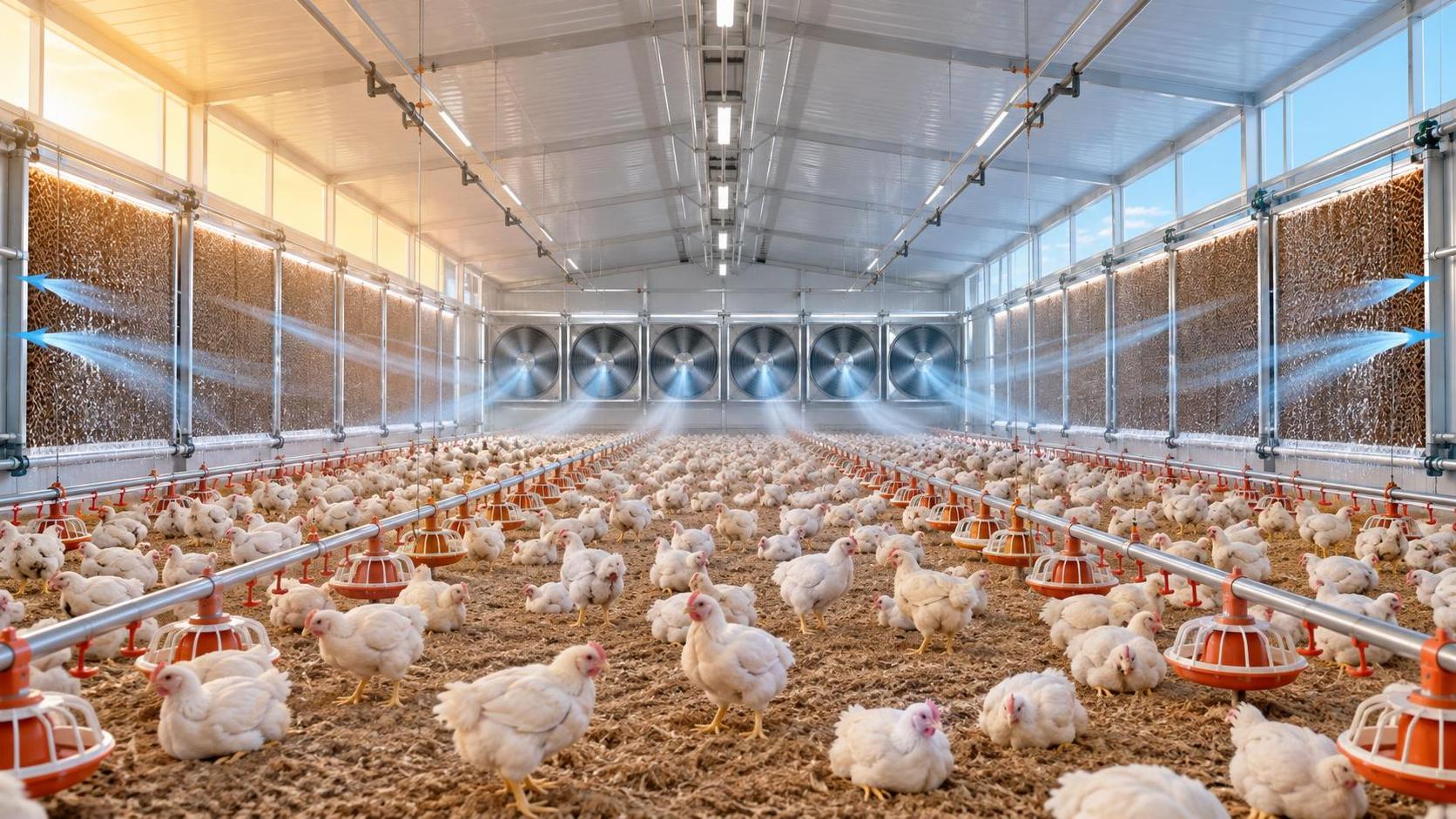
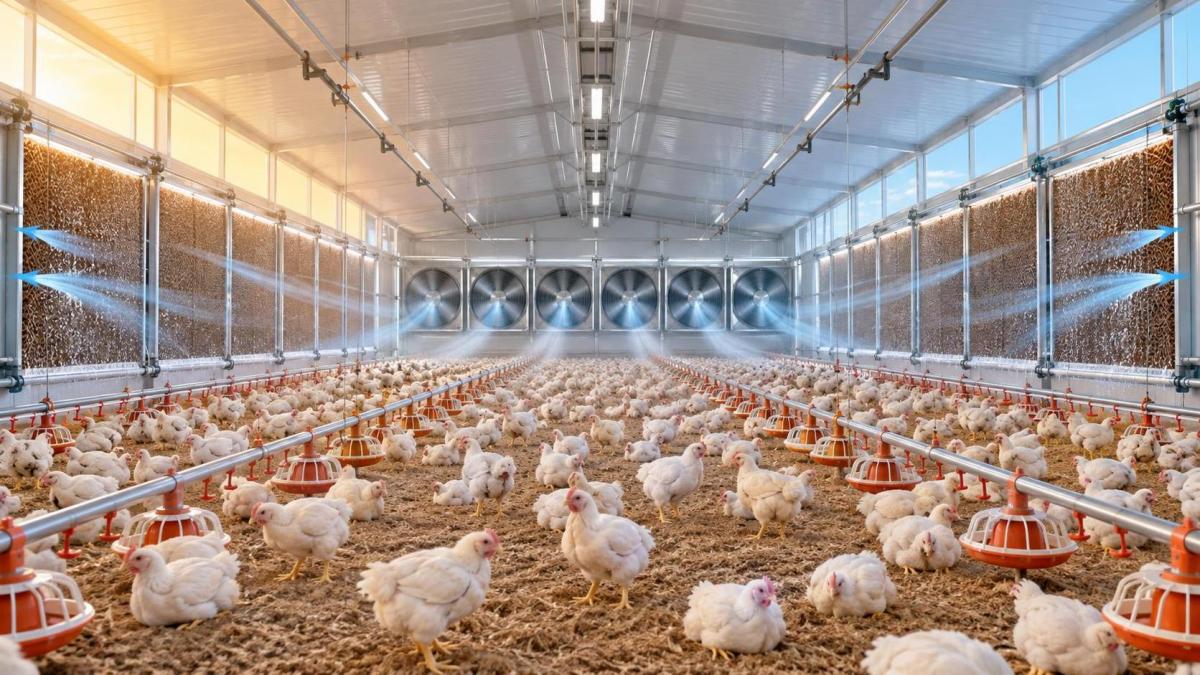
For technical evaluators, the first decision is whether the house needs primarily air exchange, high-speed tunnel ventilation, evaporative cooling, or a combination of these. In warm climates, conventional minimum-ventilation logic cannot protect birds through peak heat. The system must create sufficient air speed across the occupied zone to increase convective heat loss, while also maintaining an airflow path that does not leave stagnant areas near sidewalls, partitions, or the far end of the house.
Summer sizing therefore begins with three questions:
- What is the maximum flock heat load at the intended stocking density and market age?
- What air velocity is needed at bird height under the site's expected hot-weather conditions?
- Can the selected fans still deliver the required airflow at the real operating static pressure?
Those questions should be answered before deciding fan quantity, pad area, inlet configuration, controller stages, or standby generation capacity.
Calculate airflow from the house cross-section and target velocity
For a tunnel-ventilated house, the most useful starting point is the required air velocity through the usable cross-sectional area. This approach aligns the airflow calculation with the outcome that matters during heat stress: air moving over the birds.
The basic relationship is:
Required airflow = effective house cross-sectional area x target air velocity
The effective cross-sectional area is the vertical area through which air can actually travel. It is derived from the internal width and the average clear height of the airflow path, not simply the building's external dimensions. Ceiling obstructions, hanging equipment, baffles, structural members, and lower sidewall geometry can all reduce the useful area or create resistance that changes velocity distribution.
In a simple rectangular approximation:
Cross-sectional area = internal width x average effective ceiling height
A house with a peaked ceiling requires a more careful calculation. Treating the full roof peak as uniformly effective airflow area can overstate capacity because the highest part of the roof may contribute less to useful bird-level velocity. A practical design review should use the actual internal profile and identify the portion of the air stream that reaches the bird zone without short-circuiting above it.
Target velocity should be set according to bird type, bird age, feather cover, stocking density, house length, humidity conditions, and the producer's welfare and performance objectives. Mature, heavy birds have a much narrower heat-stress margin than young birds. A velocity that is adequate for a lighter flock may be insufficient near final weight, particularly when birds are densely stocked and metabolic heat production is high.
Rather than applying one universal air-speed figure, use the flock's management program and local engineering guidance to establish a design target at bird level. Then verify whether the target is intended as an average house velocity, a measured velocity at specific sampling points, or a fan-stage calculation. These are not interchangeable. A system may show a satisfactory average airflow calculation while still producing weak velocities in occupied sections of the house.
Convert the calculated requirement into fan capacity at operating pressure
Once the required airflow is known, fan selection becomes a performance-curve exercise. The relevant value is the airflow each fan delivers at the expected static pressure, not its free-air or zero-pressure rating.
Static pressure is created by every restriction in the air path. Common contributors include:
- Evaporative cooling pads, especially when wet, aged, or partially blocked.
- Pad support structure, screens, shutters, louvers, and light traps.
- Dirty fan guards, damaged shutters, and restrictive outlet conditions.
- Air inlets, curtain systems, partitions, and internal obstructions.
- House leakage patterns that alter designed air entry and distribution.
The engineering sequence is straightforward: estimate the total system pressure at the peak cooling configuration, read each candidate fan's performance at that pressure from its certified curve, and divide the total required airflow by the delivered airflow per fan. Round upward, then assess the result against practical staging and redundancy requirements.
Do not assume that adding another fan automatically corrects a weak design. If the pad wall, tunnel inlet, or outlet arrangement is too restrictive, additional fans can increase pressure, reduce individual fan output, or draw air through unintended leakage paths. The system must be reviewed as a complete air circuit.
Check air speed distribution, not just total cubic capacity
A correctly sized total airflow figure can still conceal poor summer performance. Air must travel from the inlet end to the fan end with reasonable uniformity across the bird area. Long houses, houses with internal rooms, uneven floor levels, suspended equipment, or poorly positioned baffles may develop slow-moving zones where birds experience far less cooling than the design calculation suggests.
This is why a summer ventilation review should include an airflow map. Measure velocity at multiple locations along the house length and across its width, using points at or near bird height. Measurements should be taken with the intended tunnel configuration fully operating: pads or inlets open as designed, relevant shutters open, and normal internal equipment in place.
Look for patterns rather than relying on one central reading. Low readings along sidewalls may indicate that air is concentrated through the centre. A drop in velocity near the middle or downstream end can point to leakage, inadequate inlet area, poor baffle arrangement, or fan performance below the assumed curve. Large variation between fan banks can indicate belt wear, motor issues, shutter losses, blade damage, or unequal discharge conditions.
Air direction matters as well. Tunnel ventilation is designed for longitudinal flow. Cross-drafts from uncontrolled side openings, damaged curtains, or non-coordinated fans can interrupt that flow and reduce predictable cooling. A house can feel windy to a person standing near an inlet while still offering inadequate velocity where birds are clustered.
Size evaporative cooling as a separate system
Evaporative pads are often treated as an accessory to fan selection. They should be evaluated separately because they introduce both cooling potential and pressure loss. Their usefulness depends heavily on outdoor air humidity. Where incoming air has enough evaporative capacity, a properly wet and uniformly supplied pad can reduce the temperature of incoming air before it enters the house. Where humidity is already high, the temperature reduction may be limited and the added moisture can narrow the birds' ability to dissipate heat.
The pad face area must be large enough to keep air velocity through the media within the range recommended by the pad manufacturer and the system designer. Excessive face velocity raises pressure drop, increases water carryover risk, and can create uneven wetting. Too little face velocity may not harm cooling directly, but it can impose unnecessary capital cost and complicate cleaning or water management.
Pad evaluation should consider more than nominal thickness and area:
- Water distribution across the full pad face, including the upper edge and corners.
- Water quality, filtration, scale formation, biological fouling, and seasonal maintenance.
- Drainage and sump design that prevents recirculation problems.
- Sealing around the pad frame so fans do not pull uncooled air through gaps.
- Controller logic that avoids operating pads when humidity or house conditions make them counterproductive.
A useful caution is that evaporative cooling cannot compensate for inadequate tunnel airflow. Pads lower inlet-air temperature under suitable conditions; fans create the air movement that carries heat away from the birds. A design that prioritizes pad area while accepting weak bird-level velocity can leave the flock exposed during the most demanding periods.
Build margin for fouling, wear, and the loss of one operating element
Summer ventilation systems operate in a harsh environment. Fan belts stretch, shutters fail to open fully, guards collect dust, pads accumulate mineral deposits, sensors drift, and electrical supply interruptions occur at precisely the time demand is highest. Sizing to a theoretical minimum leaves little room for these predictable conditions.
The appropriate design margin depends on house scale, climate severity, maintenance capability, and the consequences of flock loss or performance deterioration. Technical evaluators should document the assumed margin rather than treating it as an invisible uplift. The documentation should identify whether the margin covers degraded fan output, a failed fan, pressure growth from dirty pads, future stocking changes, or some combination of these factors.
Fan staging deserves particular attention. The control system should bring capacity online in logical increments as house temperature and humidity rise, while avoiding abrupt pressure changes that destabilize inlets or create uncomfortable drafts at lower heat loads. Variable-speed control can improve staging precision, but it does not remove the need for correctly sized full-load capacity. At peak summer conditions, the design must still be able to sustain the required airflow with the available electrical infrastructure.
Backup power is part of ventilation sizing, not an optional facilities discussion. A generator must support the full emergency ventilation strategy, including the fans required to protect birds, control equipment, alarms, and any water systems essential to cooling operation. The transfer arrangement, fuel autonomy, test procedure, and alarm escalation path should be specified with the same discipline applied to fan curves.
Use a field acceptance test before treating the design as complete
The final judgement should be based on measured performance in the completed house. A useful acceptance test records static pressure, fan status, inlet or pad configuration, air velocity at a defined grid of bird-level points, outdoor temperature and humidity, and controller stage. It should also inspect whether shutters open fully, pads wet evenly, curtains seal, and fans rotate in the correct direction.
These readings establish a baseline for future troubleshooting. When summer performance declines, the operator can compare current pressure and velocity against the original commissioned condition instead of guessing whether the cause is fan wear, pad blockage, air leakage, control settings, or a change in flock loading.
A poultry house ventilation system is adequately sized for summer heat when its design airflow, pressure assumptions, cooling method, electrical resilience, and measured in-house velocity all support the flock at its most demanding condition. The calculation is necessary, but it is only the first layer of the decision. The more durable designs are the ones that continue to deliver their intended air speed after the house is occupied, the pads are wet, the equipment has aged, and outdoor heat has reached the level the system was built to handle.
Deep Dive
Related Intelligence
 Smart Livestock & Poultry TechHow poultry housing systems improve flock health and reduce labor costs in commercial farmsAnalyst:Agri-Tech Strategist
 Smart Livestock & Poultry TechWhat livestock management features matter most when scaling a multi-site poultry operation in 2026Analyst:Agri-Tech Strategist
 Smart Livestock & Poultry TechCan automated farming solutions integrate with existing ventilation and feeding hardware on legacy poultry farmsAnalyst:Agri-Tech Strategist