Can You Switch to Cheaper EV Coolant Without Compatibility Retesting?
Key Takeaways
- The Kyiv Independent Hit by Suspected Russian CyberattackIT & Security Director
- What is editorial exposure and how does it differ from paid advertising?IT & Security Director
- Apple Warns Users in 99 Countries of Spyware; German Lawmakers' Devices SuspectedIT & Security Director
- How to write technical content for exporters selling machinery abroadChief Civil Engineer
- BW ESS Brings Hams Hall, Europe's Largest Operating Battery Storage Project, OnlineAutomotive Tech Analyst
- How to size electric motors for pumpsChief Civil Engineer
- Trump Administration Pledges $15 Billion in Farm Aid Ahead of Midterm ElectionsAgri-Tech Strategist
- When does automated food processing technology pay for itself?Agri-Tech Strategist
Industry Overview
We do not just publish news; we construct a high-fidelity digital footprint for our partners. By aligning with TNE, enterprises build the essential algorithmic "Trust Signals" required by modern search engines, ensuring they stand out to high-net-worth buyers in an increasingly crowded global digital landscape.
Can a lower-cost EV coolant replace the current grade without new compatibility testing? Sometimes—but only when existing qualification evidence covers the proposed product, the cooling system, and the conditions of use, and the responsible approval authority accepts that evidence. A similar datasheet, matching color, or “EV compatible” claim is not enough.
For procurement teams, the appeal is straightforward: lower fluid cost without changing hardware. For thermal management engineers, the concern is what happens after months of circulation through aluminum channels, pumps, seals, and plastic fittings. A substitution that looks harmless at purchase can create corrosion, leakage, or electrical-performance problems later.
The practical question is therefore not whether every cheaper coolant needs a complete qualification program. It is whether the available evidence closes every meaningful gap—or whether targeted validation is needed before approving the switch.
Separate a supplier change from a chemistry change
“Alternative coolant” can describe several very different proposals. A distributor may offer the same approved formulation under another label. A supplier may offer a different product within the same specification. Or procurement may be considering an entirely different inhibitor package because its headline properties look similar.
Those are not equivalent engineering changes.
The key distinction is between avoiding duplicate testing and skipping qualification. Existing evidence can justify the former. A lower purchase price cannot justify the latter.
Start with the cooling architecture, not the product brochure
Before comparing fluids, establish exactly where the coolant will circulate. An EV may have separate battery, power electronics, and drive-unit loops, or interconnected circuits whose operating conditions change with valve position. A fluid approved for one loop is not automatically suitable for another.
In an indirect battery cooling system, coolant normally remains inside cold plates or channels rather than contacting cells or energized components directly. That does not make electrical properties irrelevant: leakage scenarios and system design may still impose conductivity requirements. However, low-conductivity requirements are application-specific, not universal across all EV cooling loops.
Direct-contact immersion systems are a different category. Their dielectric fluids require evidence appropriate to contact with cells, insulation, adhesives, and electrical assemblies. A conventional water-glycol coolant should not be substituted into an immersion system because it carries an EV label.
Build the assessment around a defined operating envelope:
- Normal and peak fluid temperatures, including cold starts and local hot spots.
- Pressure, flow rate, pump speed, and likely cavitation conditions.
- Every wetted metal, elastomer, plastic, coating, adhesive, and joining material.
- Required freeze protection, heat rejection, and electrical characteristics.
- Service interval, top-up practice, and realistic residual-fluid levels after draining.
Without this baseline, even a substantial supplier test report may answer the wrong question.
Why matching datasheets does not establish compatibility
Two coolants can share a glycol base, nominal concentration, freezing point, and similar viscosity while behaving differently in the same system. Datasheets are useful screening tools, but they rarely disclose enough to establish long-term interchangeability.
Inhibitor chemistry changes the corrosion picture
Corrosion protection depends on the complete formulation, not simply whether the base fluid is ethylene glycol or propylene glycol. Organic acids, inorganic inhibitors, buffers, and other additives interact with metal surfaces and influence deposit formation. Products described under the same broad chemistry family may still differ materially.
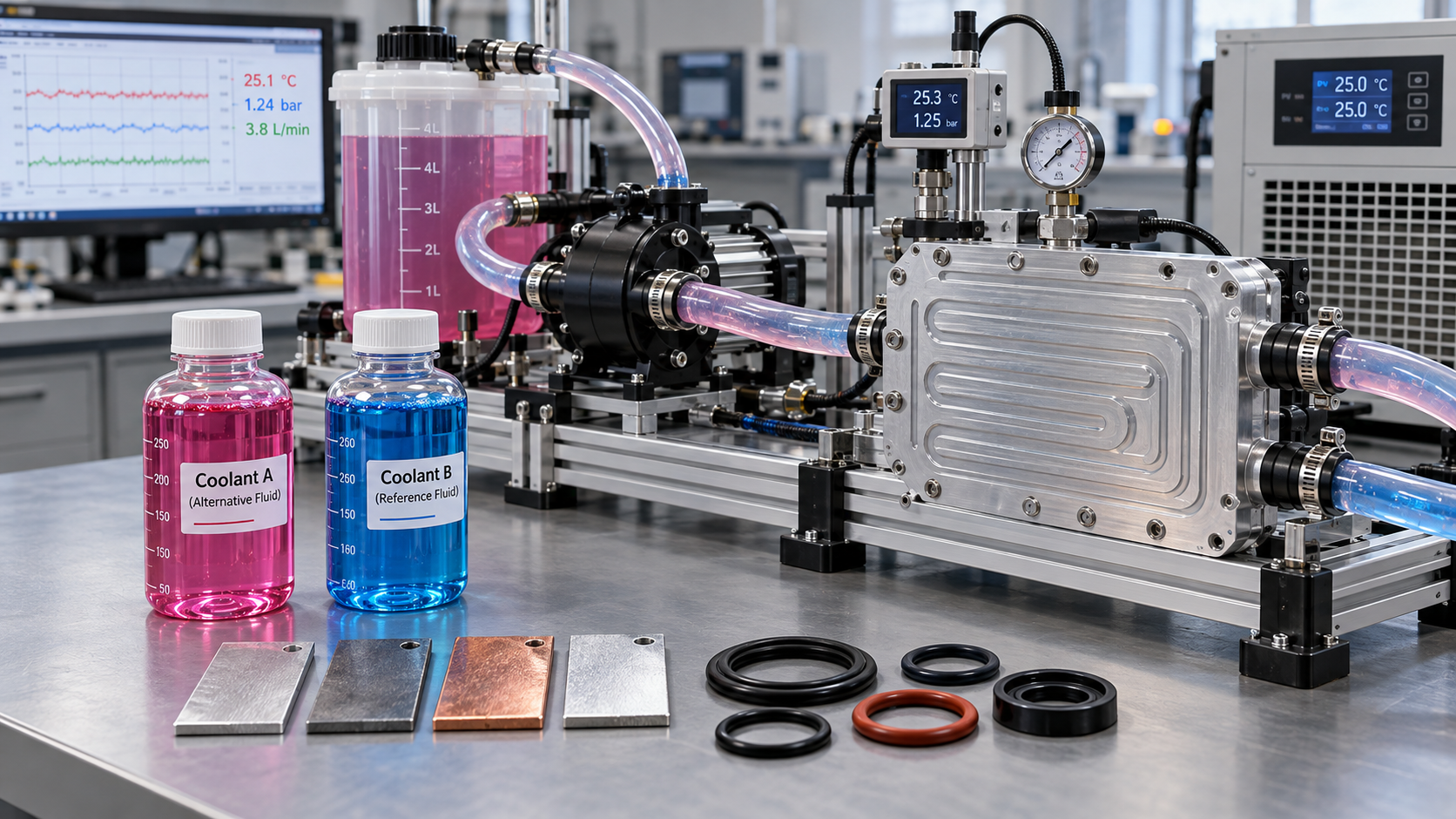
Aluminum cold plates deserve particular attention, but the review must include the whole mixed-material circuit. Copper-containing components, brazed joints, fittings, and manufacturing residues can all affect performance. A corrosion result obtained on a generic metal coupon does not automatically represent a production cooling assembly.
Seals and plastics may respond slowly
A seal can look acceptable after a short soak yet lose strength, swell, shrink, or develop an unacceptable compression-set response during extended exposure. Plastic fittings and reservoirs may also experience changes in dimensions or mechanical properties.
Material names alone are insufficient. “EPDM compatible,” for example, does not identify the exact compound, cure system, temperature exposure, or acceptance criteria. Where consequences are significant, evidence should relate to the actual production material or a justified representative.
Electrical and thermal properties need context
Fresh-fluid conductivity is only a starting point. Temperature, water quality, contamination, corrosion products, and additive aging can change it. Where conductivity matters, compare results using defined methods and temperatures, and consider relevant aged-fluid conditions.
Heat capacity, thermal conductivity, viscosity, and density also matter as a set. A concentration change intended to preserve freeze protection can alter pressure drop and pumping demand. Similar freezing points do not prove equivalent cooling performance.
Build an evidence bridge before commissioning new tests
A useful review begins with a gap matrix: what the system requires, what the current coolant has demonstrated, what the candidate has demonstrated, and what remains unresolved. This makes the decision visible to engineering, purchasing, quality, and warranty teams.
Request more than a safety data sheet and sales declaration. The supplier evidence package should include:
- Exact product identity: formulation designation, supplied concentration, manufacturing source, and traceability.
- Applicable approvals: the actual specification revision, product listing, and application scope—not simply “recommended for” language.
- Supporting test reports: methods, exposure conditions, material grades, fluid condition, and acceptance limits.
- Quality controls: batch acceptance properties, certificates of analysis, and contamination controls.
- Change notification: contractual visibility into relevant formulation, raw-material, or production changes.
- Mixing and service guidance: restrictions, flushing requirements, water quality, and concentration control.
A supplier may protect proprietary formulation details. That is understandable, but confidentiality cannot replace technical assurance. A controlled disclosure under a confidentiality agreement, or an adequately substantiated equivalence statement, may help close the gap.
Recognized coolant standards can support screening. For example, ASTM D3306 addresses glycol-based coolants for automobile and light-duty service, while methods such as ASTM D1384 assess corrosion under specified laboratory conditions. These references do not, by themselves, establish suitability for every EV battery loop, electrical requirement, or production material combination.
Ask what the evidence actually covers—not how many standards appear on the brochure.
Use targeted validation where the evidence stops
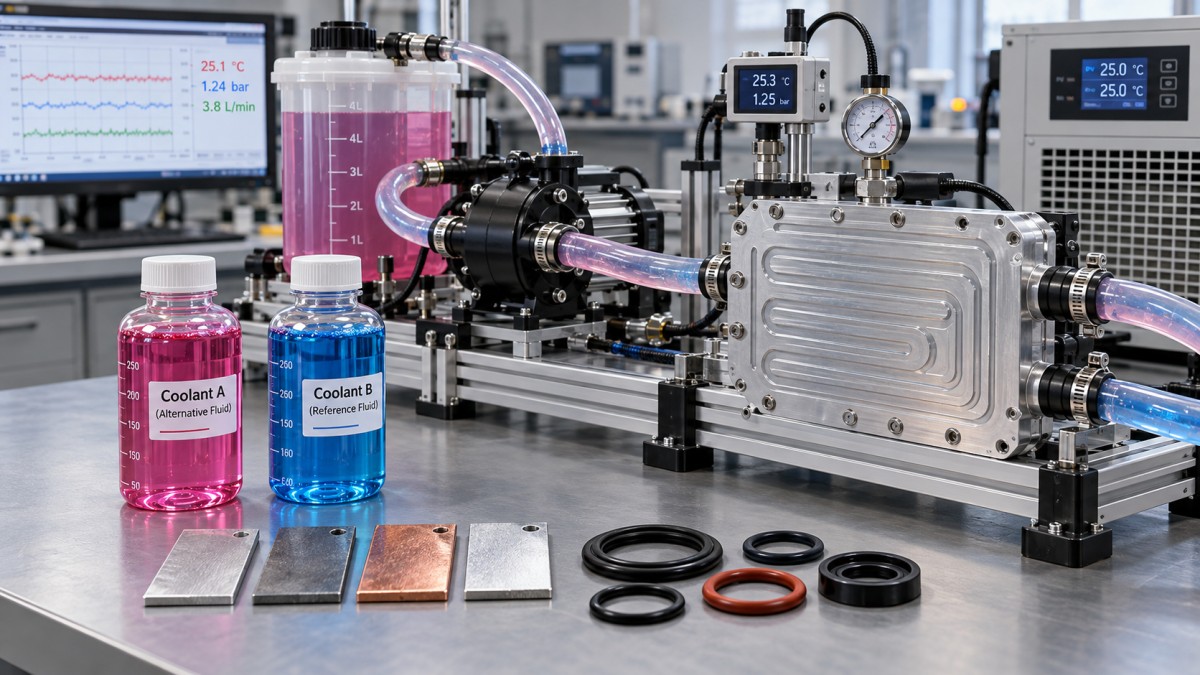
If the candidate is not already covered, testing should follow the identified risks. There is no universal minimum test package or exposure duration that makes every EV coolant substitution safe.
Agree acceptance criteria before testing begins. Otherwise, teams can end up interpreting disappointing results as acceptable because the purchasing deadline is approaching.
Accelerated testing can be valuable, but hotter is not automatically more representative. Excessive temperatures may introduce degradation mechanisms that do not occur in service. Test conditions and their relationship to field life need an engineering rationale.
Where component tests cannot resolve system interactions, a representative loop or vehicle-level evaluation may be necessary. Conversely, a narrowly defined documentation gap does not always justify repeating a complete vehicle qualification program.
Do not overlook the coolant already inside the vehicle
A common substitution mistake is testing only the new fluid. In service, complete removal of the old coolant may be impractical. Residual fluid can remain in cold plates, hoses, pumps, and low points.
Clear appearance after mixing is not proof of compatibility. A blend may remain transparent while its corrosion protection or electrical behavior changes. It may also develop deposits only after thermal cycling or aging.
Define whether the switch applies to factory fill, service replacement, or both. Factory fill generally offers better control over the initial fluid condition, although manufacturing residues still matter. Service replacement introduces greater variation in water quality, contamination, concentration, and residual coolant.
If mixing is not supported, the approval needs an achievable flushing and refill procedure—not merely an instruction to “drain completely.” Confirm how technicians will verify concentration, remove trapped air, and identify the correct replacement fluid.
Who can approve a switch without new compatibility testing?
The answer depends on ownership of the design and contractual requirements. A fleet operator, component supplier, vehicle manufacturer, and maintenance provider may have very different authority to approve a fluid change.
Where an OEM specification or warranty condition names approved products, obtain confirmation that the candidate is covered. Meeting a general industry standard does not override a product-specific requirement. For suppliers working under customer-controlled designs, a material change may require customer approval even when internal engineering considers it low risk.
A defensible no-new-testing decision should record:
- The exact candidate product and intended application.
- The existing qualification evidence and why it remains applicable.
- Any differences in formulation, source, concentration, materials, or operating conditions.
- The rationale for accepting those differences without additional testing.
- Required engineering, quality, customer, or OEM authorization.
“No new testing required” should be the conclusion of that review, not its starting assumption.
Calculate savings after the change is made safe
The commercial comparison should include qualification costs, flushing, downtime, inventory segregation, service training, disposal, and any change in replacement interval. A lower unit price may still deliver worthwhile savings—but the relevant figure is the lifecycle benefit after implementation costs.
Once approved, release the change through controlled documentation. Update the bill of materials and service instructions where applicable, preserve batch traceability, and consider monitoring early deployments for fluid condition, leaks, deposits, or abnormal pump behavior. Monitoring complements qualification; it does not replace unresolved safety-critical evidence.
Ultimately, a cheaper EV coolant can replace the current grade without new compatibility testing when documented equivalence or existing approval genuinely covers the application and the authorized decision-maker accepts it. When that bridge is incomplete, targeted validation is usually the more rational choice than either repeating everything or testing nothing. The objective is not to protect the incumbent fluid—it is to secure the savings without quietly transferring risk into the cooling system.
Deep Dive
Related Intelligence
 EV ComponentsHow Technological Breakthroughs in EV Components Are Inspiring Battery-Swapping Designs for Agri-DronesAnalyst:Automotive Tech Analyst
 EV ComponentsHow much do EV charging stations cost to install for commercial fleets in 2026?Analyst:Automotive Tech Analyst
 EV ComponentsDo electric scooters qualify as compliant last-mile delivery tools under 2026 urban logistics regulations?Analyst:Automotive Tech Analyst