DOT Approved LED Headlights: Compliance Checks Before You Upgrade
Key Takeaways
- How to size DC fast EV charging stations for peak charging demandIT & Security Director
- When does modular construction reduce a project's total cost?Chief Civil Engineer
- What cloud infrastructure analysis reveals about Singapore latency risksIT & Security Director
- How to verify recycled green building materials meet project standardsChief Civil Engineer
- What to evaluate when comparing cybersecurity analysis providersIT & Security Director
- When does agricultural automation equipment pay off for mid-size farms?Agri-Tech Strategist
- How Tank Design Helps Reduce Oxidation Risks in Edible Oil StorageAgri-Tech Strategist
- How to match heavy duty earthmoving equipment to site conditionsChief Civil Engineer
Industry Overview
We do not just publish news; we construct a high-fidelity digital footprint for our partners. By aligning with TNE, enterprises build the essential algorithmic "Trust Signals" required by modern search engines, ensuring they stand out to high-net-worth buyers in an increasingly crowded global digital landscape.
Why do DOT approved LED headlights need more than a packaging claim?
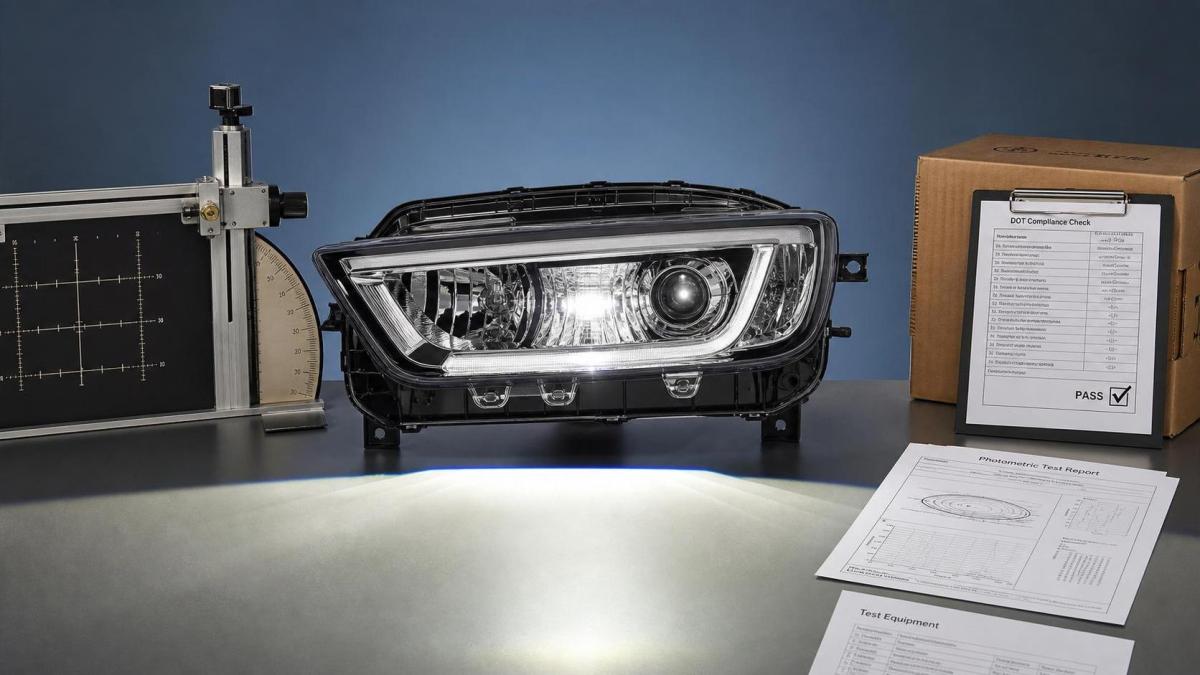
Upgrading to DOT approved LED headlights looks simple on paper. In practice, compliance depends on testable details, not just a label printed on the box.
That matters because headlamp performance affects road safety, liability exposure, inspection results, and product acceptance across fleets, workshops, and distribution channels.
A compliant unit should align with applicable U.S. lighting requirements, maintain a controlled beam pattern, and carry correct markings that can be verified.
The problem is that many LED retrofit products use the phrase DOT approved LED headlights loosely. Some are well engineered. Others only borrow compliance language for marketing.
In sectors tracked closely by TradeNexus Edge, this distinction is not minor. Digital sourcing has made technical comparison faster, but it has also increased the risk of buying around incomplete evidence.
A stronger review starts with one question: can the supplier prove that the complete headlamp system, not just the LED chip, meets the claimed standard?
What does “DOT approved” actually mean for an LED headlight assembly?
This is where many evaluations go off track. DOT itself does not hand out a simple consumer-style approval sticker for every aftermarket lighting product.
More accurately, road-legal lighting products sold for U.S. use are expected to comply with Federal Motor Vehicle Safety Standard 108, often called FMVSS 108.
For DOT approved LED headlights, the practical review should focus on whether the lamp assembly is designed, tested, and marked for compliant on-road use.
An LED bulb alone is not the whole story. Housing geometry, reflector or projector optics, thermal management, driver electronics, and mounting tolerance all influence compliance.
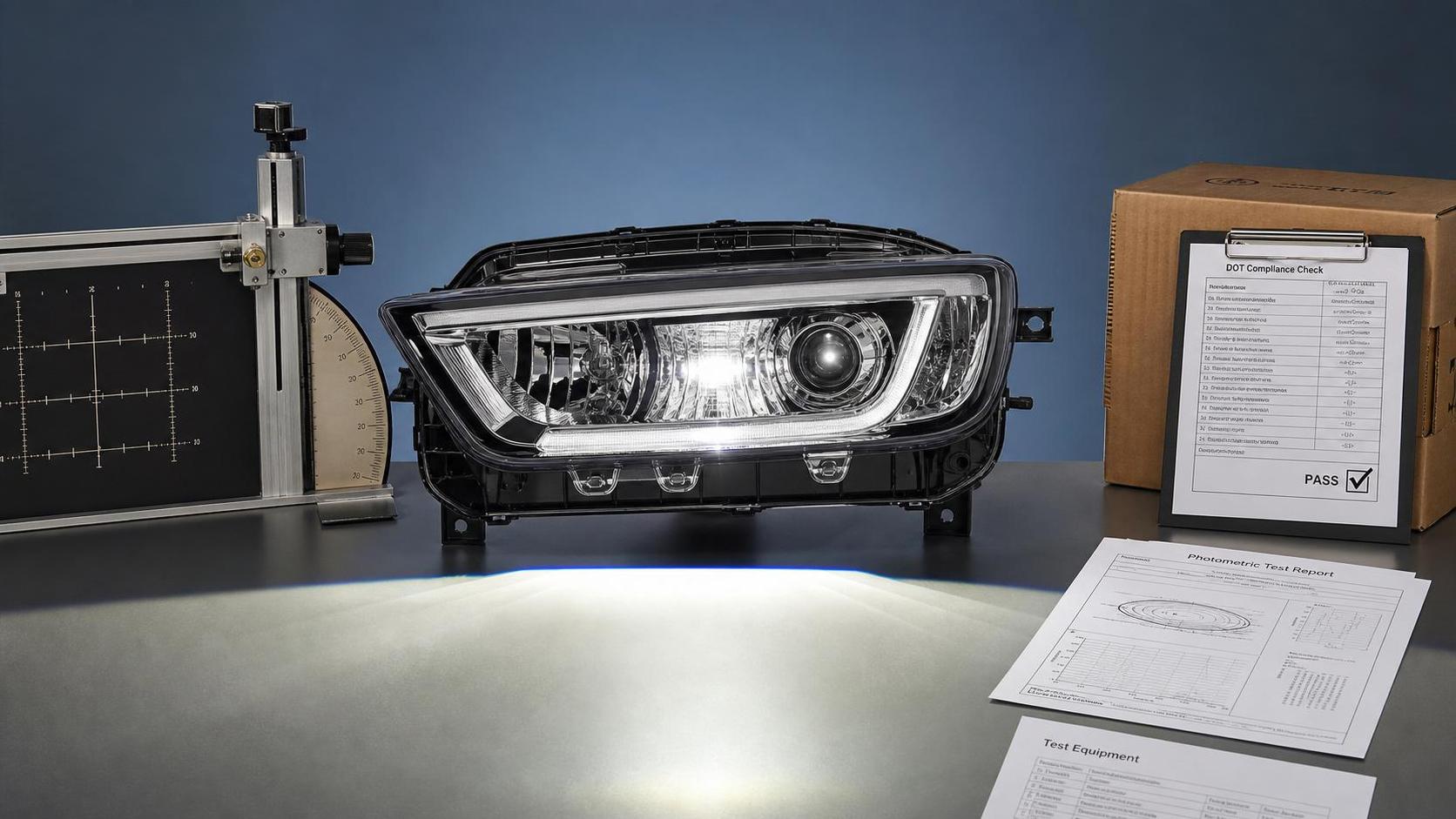
A supplier should be able to provide traceable technical files. These usually include photometric data, marking information, test references, and model-specific fitment details.
If those records are vague, outdated, or disconnected from the exact SKU being purchased, the “DOT approved” claim should be treated as unconfirmed.
A quick reality check helps
In real sourcing cycles, the safest approach is to separate three ideas: legal marketing language, documented technical compliance, and reliable field performance.
The best DOT approved LED headlights usually perform well in all three areas. Lower-grade products often manage only the first one.
Which compliance checks matter most before a retrofit program moves forward?
The most common mistake is overvaluing brightness. High lumen output does not guarantee safer lighting or legal road performance.
A better evaluation sequence looks at optical control first, then electrical and mechanical compatibility, and only then purchasing efficiency.
- Beam pattern accuracy: confirm low-beam cutoff sharpness, vertical aim stability, and glare control under the intended mounting condition.
- Housing compatibility: verify whether the LED geometry matches the reflector or projector design of the target headlamp.
- Thermal stability: review heat sink design, fan reliability if present, and lumen maintenance under prolonged operating temperature.
- Electrical behavior: check driver quality, voltage range, electromagnetic interference risk, and interaction with vehicle monitoring systems.
- Labeling and traceability: confirm permanent markings, batch identification, and supplier records that support post-market review.
In actual use, beam pattern data deserves the closest attention. A headlight can appear bright during bench review and still create excessive foreground light or dangerous glare.
That is why serious evaluations ask for photometric evidence, not only color temperature, wattage, or promotional before-and-after photos.
How can you tell whether a supplier’s test evidence is credible?
This question matters as much as the lamp itself. Even genuine DOT approved LED headlights can become a sourcing problem when documentation is incomplete or disconnected from production.
The first step is consistency. The model number on the report, carton, housing, and purchase specification should match exactly.
The second step is relevance. Test documents should reflect the actual configuration, including optical system, driver type, and intended installation orientation.
The third step is traceability. It should be possible to follow the product from sample testing to production batches without a documentation gap.
TradeNexus Edge often emphasizes this kind of contextual validation across industrial categories. A certificate without supply chain clarity rarely supports confident risk control.
When a supplier is credible, responses are specific. They can explain test conditions, optical design assumptions, and what changes would require retesting.
When credibility is weak, answers turn generic. The conversation shifts toward brand claims, price advantages, or unsupported references to “global standards.”
Questions worth asking during technical review
- Was the tested unit a complete lamp assembly or only a replaceable bulb?
- Do the reported beam measurements reflect the final production optics?
- What production controls keep thermal and optical output consistent?
- Which changes in materials or electronics trigger revalidation?
Where do compliant-looking LED headlight projects usually fail?
Most failures do not start with an obvious defect. They start with small assumptions that were never checked early enough.
One frequent issue is treating retrofit bulbs as equal to purpose-built assemblies. If the original housing was designed for halogen output geometry, the beam can degrade badly.
Another issue is relying on visual brightness tests in a warehouse or yard. Human impression is not a substitute for controlled photometric verification.
Labeling errors also create avoidable problems. If the housing lacks durable and accurate markings, downstream inspections and warranty handling become harder.
Thermal stress is often underestimated. Some DOT approved LED headlights perform well for short demonstrations, then lose stability after sustained operation in enclosed housings.
There is also a supply chain angle. A validated pilot sample can differ from mass production if driver components, LEDs, or molding tolerances are changed without notice.
A practical safeguard is to define an incoming inspection checklist before volume ordering. That keeps compliance from becoming a one-time pre-purchase exercise.
Is the lowest-cost option ever worth it when DOT approved LED headlights are compared?
Sometimes a lower price is justified by simpler packaging or larger scale. More often, the cheapest option shifts cost into rework, returns, failed inspections, or safety exposure.
That does not mean the highest price is automatically the best. The goal is to compare compliance depth, production control, and field consistency against total operating risk.
A useful comparison includes more than unit cost:
- validation lead time and document quality;
- sample-to-production consistency;
- failure rate under heat and vibration;
- ease of traceability during claims or audits;
- fitment accuracy across the intended vehicle range.
In other words, the better question is not “Which DOT approved LED headlights are cheapest?” It is “Which option remains compliant and controllable after installation and over time?”
What should the final approval checklist include before purchase or rollout?
By the last stage, the decision should be evidence-based and easy to repeat. That is especially important when multiple sites or service teams will use the same specification.
A workable final checklist usually includes documented compliance claims, beam test review, fitment confirmation, traceable labeling, and pilot installation feedback.
It also helps to record rejection criteria in advance. That may include unstable cutoff lines, inconsistent markings, excessive driver temperature, or mismatch between sample and batch data.
For organizations comparing suppliers through digital B2B channels, this discipline reduces the noise created by aggressive claims and incomplete technical files.
DOT approved LED headlights can be a strong upgrade when the compliance path is clear. They become risky when optical, mechanical, and documentary checks are compressed into a price decision.
The next sensible move is to build a short validation matrix for every candidate model. Compare evidence, not slogans, and confirm that the tested product is the one that will actually ship.
That approach takes more effort upfront, but it usually saves more time than it costs once installation, inspection, and liability are part of the equation.
Deep Dive
Related Intelligence
 Aftermarket PartsWhat Strategic Link Gaps Are Slowing Down Aftermarket Parts Distribution in Agri-Drones Service Networks?Analyst:Automotive Tech Analyst
 Aftermarket PartsCan aftermarket auto parts meet OEM durability standards without voiding vehicle warranties in 2026?Analyst:Automotive Tech Analyst
 Aftermarket PartsHow do aftermarket auto parts impact fleet maintenance costs for construction equipment operators?Analyst:Automotive Tech Analyst