Agricultural Supply Chain Traceability: What Data Matters Most on the Farm
Key Takeaways
- How to evaluate precision livestock farming companies for grazing herdsAgri-Tech Strategist
- How to assess an agricultural machinery manufacturer's parts supportAgri-Tech Strategist
- What drives industrial automation cost in a new production line?Chief Civil Engineer
- What makes Ethiopia poultry farming profitable for small-scale producers?Agri-Tech Strategist
- Are Cloud Procurement Platforms Worth It for Chemical Sourcing?IT & Security Director
- How to Verify a New Materials Supplier’s Technical DocumentationLead Materials Scientist
- Should Buyers Switch from Petrochemical Plastics to Bio-Based Polymers?Lead Materials Scientist
- What Causes Frequent Customs Delays for Specialty Chemical Imports?Lead Materials Scientist
Industry Overview
We do not just publish news; we construct a high-fidelity digital footprint for our partners. By aligning with TNE, enterprises build the essential algorithmic "Trust Signals" required by modern search engines, ensuring they stand out to high-net-worth buyers in an increasingly crowded global digital landscape.
Agricultural supply chain traceability becomes useful only when farm records are specific, timely, and tied to real operational decisions.
That is why the question is not whether to collect data, but which data actually protects compliance, supports buyer trust, and improves execution.
In agri-tech and food systems, traceability now sits at the intersection of regulation, trade risk, sustainability claims, and digital procurement.
For businesses following markets through TradeNexus Edge, the pattern is clear: stronger chains are built on cleaner farm-level evidence, not broader reporting volume.
Why farm data now carries more strategic weight
Agricultural supply chain traceability used to be treated as a downstream documentation task.
Today, it starts much earlier, often before planting, because market access increasingly depends on verifiable origin, production methods, and chain-of-custody consistency.
Retailers, processors, exporters, and insurers want more than a farm name and shipment date.
They want to know what happened in a field, when it happened, who recorded it, and whether each event can be linked to a physical lot.
This matters across a broad industrial context.
Food safety teams need faster recalls.
Sourcing teams need defensible claims around residue limits, sustainability, or regenerative practices.
Digital platforms need structured records that can move between farm systems, logistics systems, and customer portals.
What traceability means at the farm level
At its core, agricultural supply chain traceability is the ability to connect a marketed product to a documented production history.
That history should be searchable, auditable, and precise enough to answer practical questions.
Which field produced this lot?
What seed or planting material was used?
Which inputs were applied?
What weather or field conditions affected the crop?
How was the harvest separated, stored, and transported?
Good traceability is not a giant archive of disconnected files.
It is a chain of linked events.
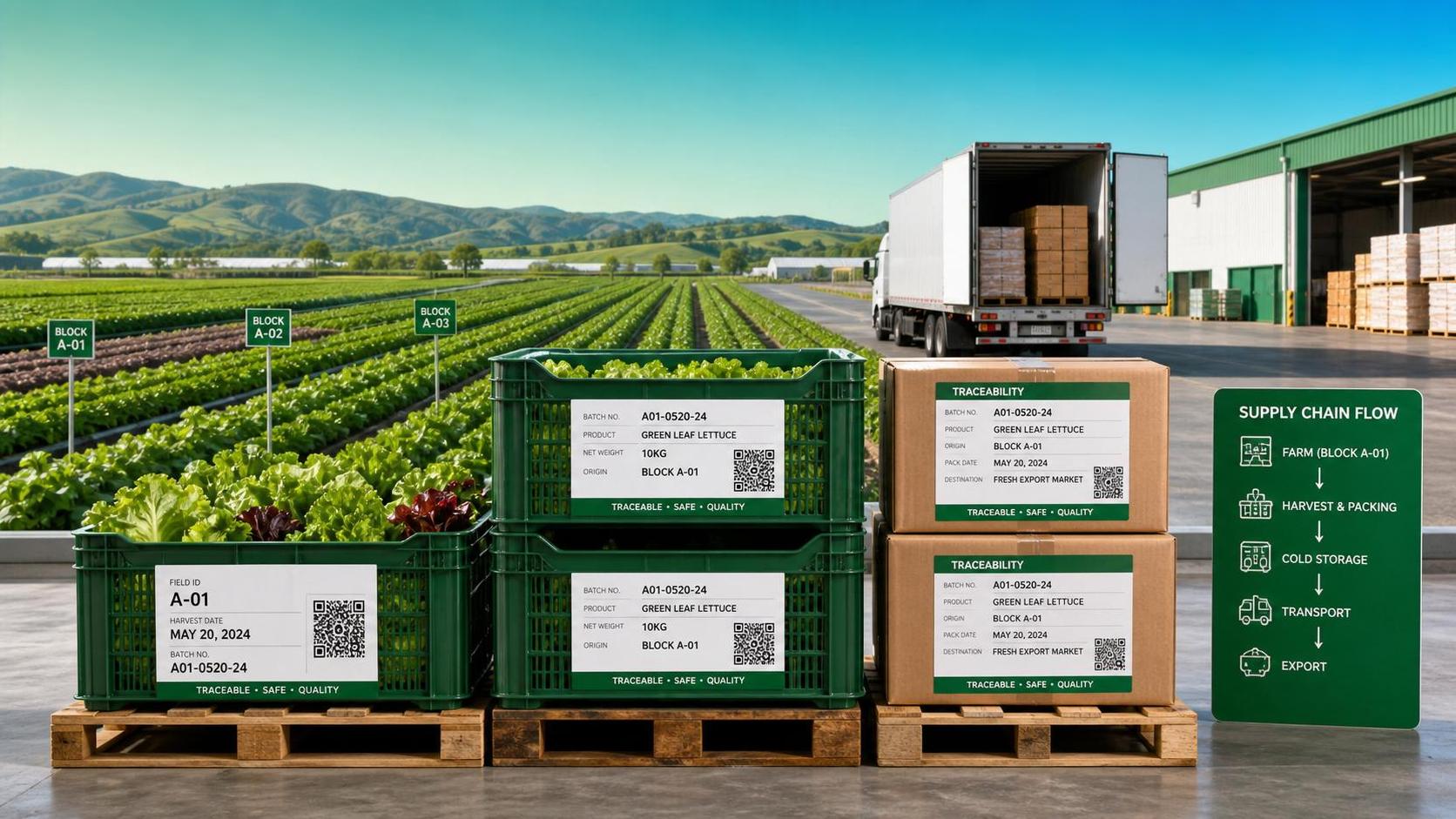
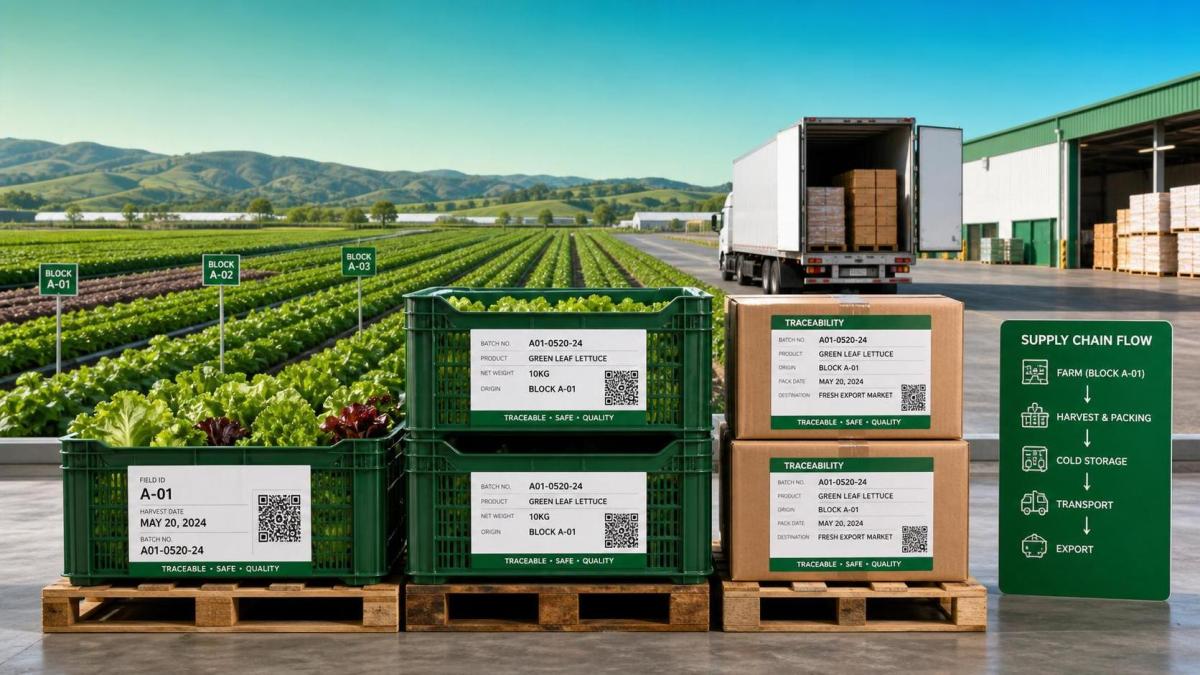
Each event should carry a date, location, responsible party, and lot reference.
Without that structure, agricultural supply chain traceability turns into manual reconstruction during audits or incidents.
The data categories that matter most
Not every record has equal value.
The most useful farm data usually falls into a few operational categories.
Field and site identity
Every traceable process starts with a stable field identifier.
That may include farm name, block code, GPS boundary, acreage, crop type, and ownership or management status.
If fields are renamed each season, data integrity weakens immediately.
Planting and genetic material
Seed lot, variety, supplier, planting date, and treatment status can all become critical later.
These records support performance review, claims verification, and targeted issue isolation.
Input application records
This is often the most scrutinized data set in agricultural supply chain traceability.
Fertilizers, crop protection chemicals, biologicals, irrigation additives, and soil amendments should be recorded with product name, batch, rate, operator, and timing.
Pre-harvest intervals and restricted-entry intervals must also be visible.
Field conditions and crop events
Pest pressure, disease observations, water stress, extreme weather, and scouting notes create context that static compliance forms often miss.
These records help explain why certain interventions happened and whether downstream quality issues were predictable.
Harvest, lot creation, and segregation
Harvest date alone is not enough.
Teams need to know which field sections were harvested together, how lots were formed, whether equipment was cleaned, and where product moved next.
This is the bridge between farm activity and commercial inventory.
Storage and transfer records
Once product leaves the field, agricultural supply chain traceability depends on continuity.
Bin assignment, cold-chain conditions, loading time, carrier information, and destination references keep lots connected through handoffs.
What buyers, auditors, and operators actually look for
Many traceability programs fail because they optimize for record collection, not record usability.
In practice, stakeholders usually test three things.
- Can a lot be traced back to a specific field and production window?
- Can key claims be validated with source records rather than summary spreadsheets?
- Can an exception be isolated quickly without freezing unnecessary inventory?
This is where agricultural supply chain traceability creates measurable business value.
A precise lot genealogy shortens root-cause analysis.
A complete input history supports export documentation.
A reliable chain of custody reduces friction with premium buyers and certification bodies.
Where implementation usually breaks down
The hardest part is rarely software selection alone.
The real challenge is converting field activity into consistent digital records without slowing operations.
Several gaps appear repeatedly across agricultural supply chain traceability programs.
- Field codes do not match harvest or warehouse codes.
- Input logs are captured, but product batches are omitted.
- Harvest crews combine product before lot rules are defined.
- Paper records are digitized too late to support live decisions.
- Data ownership is unclear across farm, packhouse, and logistics partners.
These failures matter because traceability is only as strong as the weakest handoff.
A sophisticated dashboard cannot repair broken source logic.
A practical way to prioritize farm data
A useful starting point is to rank records by decision impact, not by how easy they are to collect.
That usually leads to a focused first phase.
Start with the minimum traceability spine
Define field ID, crop variety, input applications, harvest event, lot number, storage location, and outbound shipment reference.
If these elements link cleanly, the rest of the model becomes easier to expand.
Add contextual data where claims require it
Sustainability metrics, water-use records, labor declarations, and soil-health indicators matter when contracts or certifications depend on them.
They should be tied to commercial purpose, not collected as generic extras.
Test retrieval, not just entry
A traceability design should be judged by how quickly it answers a buyer query or incident investigation.
If retrieval takes hours, the data model is still incomplete.
The wider digital commerce angle
Agricultural supply chain traceability is no longer isolated within agriculture.
It now connects with enterprise systems, cross-border trade workflows, supplier qualification, and digital trust architecture.
That is why platforms such as TradeNexus Edge pay close attention to traceability maturity across agri-food networks.
The signal extends beyond farm operations.
It affects how businesses are evaluated in global B2B ecosystems, how claims survive scrutiny, and how supply risk is priced.
In other words, farm data is becoming part of commercial credibility.
What to assess next
A sensible next step is to map the current farm-to-lot data path and identify where records lose identity, timing, or accountability.
From there, compare required claims against actual source evidence.
That exercise usually shows whether agricultural supply chain traceability is being managed as paperwork or as operational infrastructure.
The difference matters.
When the right farm-level data is defined early and linked cleanly, traceability supports compliance, protects market access, and makes the wider supply chain easier to trust.
Deep Dive
Related Intelligence
 Precision FarmingHow Global Commerce Data Helps Precision Farming Equipment Managers Forecast Spare Part Demand AccuratelyAnalyst:Agri-Tech Strategist
 Precision FarmingHow much does deploying automated farming solutions manufacturer hardware increase labor efficiency on layer farms?Analyst:Agri-Tech Strategist
 Precision FarmingWhy automated farming solutions manufacturers prioritize modular design over full-stack integrationAnalyst:Agri-Tech Strategist