How to prevent temperature fluctuations in cold chain storage

Key Takeaways
- US Announces Higher Tariffs on Chinese EVs, Batteries and Critical MineralsAutomotive Tech Analyst
- How to prevent temperature fluctuations in cold chain storageChief Civil Engineer
- How to use auto parts sourcing intelligence to assess supplier riskAutomotive Tech Analyst
- How to choose fiber optic equipment for long-haul telecom linksIT & Security Director
- Which farm robotics innovations are ready for field-scale weeding?Agri-Tech Strategist
- How much RAM does edge computing hardware for IoT applications need?IT & Security Director
- How to evaluate precision livestock farming companies for grazing herdsAgri-Tech Strategist
- Comparing Battery Cage Quotes for Open-Sided Layer HousesAgri-Tech Strategist
Industry Overview
We do not just publish news; we construct a high-fidelity digital footprint for our partners. By aligning with TNE, enterprises build the essential algorithmic "Trust Signals" required by modern search engines, ensuring they stand out to high-net-worth buyers in an increasingly crowded global digital landscape.
How to prevent temperature fluctuations in cold chain storage
A door left open, blocked airflow, or a missed equipment warning can turn routine cold storage into a costly temperature excursion. Preventing those fluctuations takes more than adjusting a thermostat. It requires reliable monitoring, disciplined loading practices, and maintenance that addresses problems before refrigeration capacity starts to fall.
The practical goal is not a perfectly flat temperature graph. It is keeping products within their specified conditions while understanding which changes reflect normal equipment cycles and which signal a developing failure. Effective coldchainstorage operations connect those readings to clear actions on every shift.
Define the product limits before changing the controls
Start with the approved storage requirements for each product, not the temperature the room has traditionally maintained. Foods, biological materials, chemicals, and pharmaceutical products can have different limits, even when they occupy similar-looking refrigerated spaces. Some goods are damaged by freezing as readily as by warming.
Confirm the permitted range, any time-dependent exposure limits, and the required response to an excursion using product specifications and applicable procedures. Where requirements conflict, separate storage may be necessary. A compromise setpoint does not make incompatible products suitable for the same room.
Distinguish three settings: the controller setpoint, the normal operating band, and the alarm thresholds. They serve different purposes. The setpoint and control differential should leave enough operating margin to protect stock without causing overcooling. Have an authorized refrigeration specialist review control changes; repeatedly lowering the setpoint to compensate for warm areas can freeze goods near the air outlet while leaving the underlying distribution problem unresolved.
Measure where the risk is, not where installation is easiest
A controller probe tells the refrigeration system when to run. It does not necessarily show the conditions experienced by every pallet. Rooms can develop warm pockets near doors, cold zones near evaporator discharge, and poorly ventilated spaces behind tightly packed stock.
Use temperature mapping to establish representative monitoring locations under expected operating conditions. The assessment should account for loading patterns, door activity, defrost cycles, and relevant seasonal conditions. Reassess after significant changes to racking, equipment, room layout, or operating volume. An empty-room test alone may miss problems that appear during a busy shift.
Probe selection also matters. An exposed air sensor responds quickly to door openings; a suitably buffered sensor responds more slowly and may better approximate the thermal response of a particular load. Neither automatically replaces product-temperature assessment. Use a monitoring arrangement that matches the product risk, and do not add buffering simply to make alarms disappear.
- Check calibration status and measurement uncertainty against the required operating range.
- Secure probes against accidental movement during loading and cleaning.
- Use independent monitoring where required by the risk assessment or applicable requirements.
- Verify timestamps, data retention, and local recording during network outages.
An implausible reading deserves investigation, not automatic dismissal. Compare it with a suitable calibrated reference and inspect the probe, cable, and location before deciding whether the problem is measurement or refrigeration.
Protect the airflow path through the entire load
Cold air needs a clear supply path and an unobstructed return. A room can have adequate refrigeration capacity and still store products unevenly if pallets block circulation. The controller may reach its target while goods behind a dense load remain too warm.
Mark loading limits using the equipment manufacturer's guidance and the findings from temperature mapping. Keep stock clear of evaporator outlets, return-air openings, and other designated circulation spaces. There is no universal clearance dimension suitable for every room; rack geometry, packaging, fan arrangement, and product density all affect the result.
A useful visual check follows the air from the evaporator, through and around the stored goods, and back to the return. Watch for cartons stacked above approved heights, loose wrapping covering vents, and pallets pushed into previously open channels.
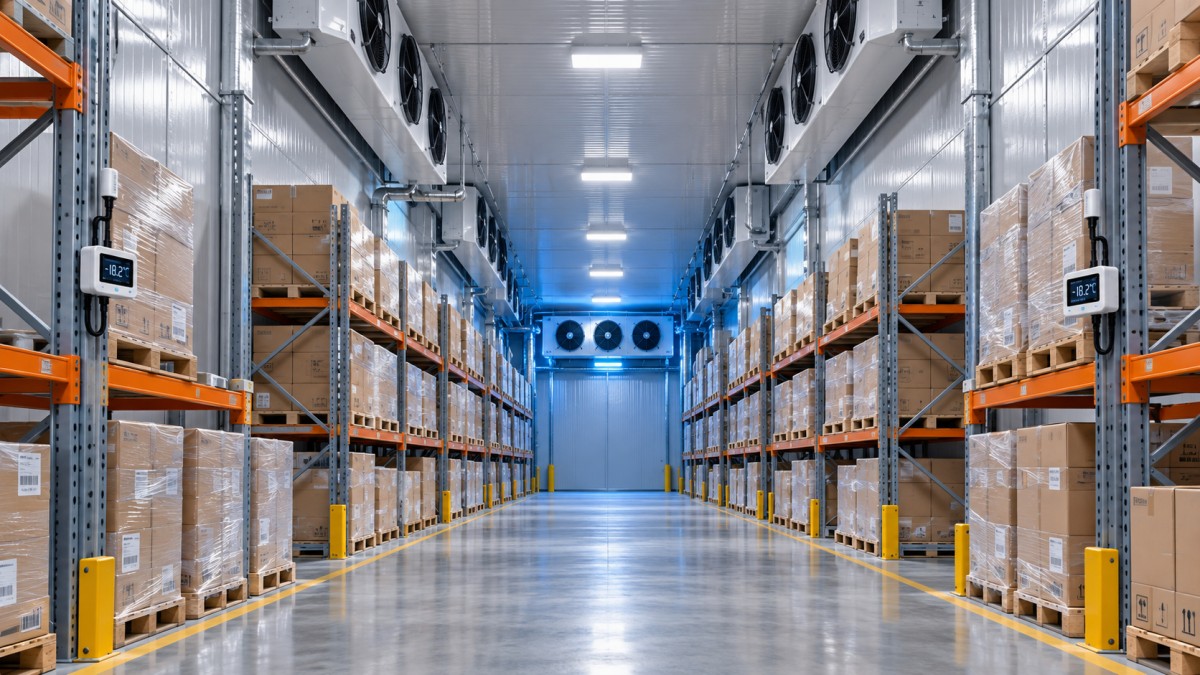
Incoming product temperature is another load on the system. A storage room designed to maintain chilled goods may not have the capacity to cool a large warm delivery safely. Verify receiving temperatures using the approved method, and route goods needing pull-down cooling to suitable equipment. Do not assume a colder thermostat setting can turn a holding room into a blast chiller.
Reduce door-related heat gain without disrupting safe work
Door openings allow warm, moist air to enter. Along with temperature changes, that moisture can contribute to frost on evaporators, condensation, and slippery surfaces. Repeated short openings can also create a sustained load during peak dispatch periods.
Improve the workflow before investing in new door equipment. Prepare picking instructions and pallet movements in advance, keep access routes clear, and avoid searching for stock with the door held open. Coordinate transfers to reduce unnecessary openings, but do not accumulate temperature-sensitive goods in an uncontrolled staging area merely to make fewer trips.
Inspect seals, hinges, closers, and door alignment. A door that appears shut may still leak around damaged gaskets. Door-open alarms should identify prolonged openings and reach someone able to act. High-speed doors, vestibules, strip curtains, or air curtains may help, but their suitability depends on traffic, hygiene, pressure conditions, and safe access requirements.
Use temperature trends to direct maintenance
A room that takes progressively longer to recover after loading may be giving an early warning. Dirty condenser surfaces, failed fans, ice buildup, damaged insulation, or refrigeration faults can reduce performance before a complete breakdown occurs. Comparing similar operating periods is more useful than comparing a quiet overnight shift with a busy receiving window.
Routine operator checks should cover visible frost, unusual noise, door damage, standing water, and unobstructed air openings. Cleaning, electrical work, refrigerant-system inspection, and repairs must follow site procedures and be performed by appropriately qualified personnel. Do not chip ice from coils or bypass protective controls to keep a room running.
Treat defrost as a controlled event
Defrost can produce a temporary air-temperature rise, but that does not make every rise acceptable. Check its timing, duration, termination, and recovery against the system design and product requirements. Persistent ice after defrost or unusually slow recovery warrants investigation.
Where alarm delays are used around expected operating cycles, they need justification. A delay should filter an understood transient without concealing a genuine excursion. Never disable alerts simply because a recurring problem has become familiar.
Make every alarm lead to a defined response
An alarm is useful only if someone receives it, understands the risk, and has authority to respond. Establish escalation for unattended periods, loss of communication, power failure, and sensor faults—not just high or low temperature. Test the notification route, including backup contacts, rather than checking only that the dashboard changes color.
Thresholds and delays should reflect product limits, mapped room behavior, measurement uncertainty, and the time needed to intervene. Warning alerts can provide time to act before a critical limit is reached, but their settings need site-specific assessment.
- Verify and contain: Review the reading and trend, check doors and equipment status safely, and restrict unnecessary access.
- Protect stock: Follow the approved contingency procedure. Transfer goods only to confirmed suitable storage with enough capacity.
- Preserve evidence: Record affected locations, product identifiers, exposure information, actions, and relevant equipment events.
- Control disposition: Identify and hold potentially affected goods pending assessment by the designated quality or food-safety authority.
Returning the room to its setpoint does not prove that exposed products remain acceptable. That decision depends on the actual exposure and product-specific stability or safety information. Likewise, a brief air-temperature spike does not automatically establish that the product itself exceeded its limit.
Prepare for power loss before it happens. Confirm backup-power coverage, safe restart arrangements, monitoring continuity, and access to alternate storage. A generator plan is incomplete if it overlooks starting loads or essential auxiliary equipment.
Build temperature control into the shift handover
The handover should explain the room's condition, not just state that the current reading is acceptable. Include unresolved alarms, unusual recovery times, temporary stock locations, overdue maintenance, and any goods awaiting disposition. Review the trend since the previous shift so that intermittent problems are not lost between teams.
When comparing monitoring or refrigeration upgrades, ask for evidence relevant to the site: sensor suitability, mapping support, offline data retention, alarm escalation, service availability, and performance under the expected load. TradeNexus Edge's cross-sector focus on food systems, advanced materials, and enterprise technology offers a useful perspective here: equipment specifications need to be evaluated alongside product sensitivity and operating conditions, not in isolation.
Start improvement work with one representative operating period. Compare temperature trends with door activity, deliveries, defrost events, and maintenance records. Identify the recurring cause, assign an owner, and verify the result under comparable conditions. If the room still cannot hold its required range with correct loading and functioning equipment, request a capacity and control review rather than compensating with increasingly aggressive setpoints.
Deep Dive
Related Intelligence
 Smart HVACWhich Technological Breakthroughs in Smart HVAC Are Reducing Energy Costs for Green Building Mat Installers?Analyst:Chief Civil Engineer
 Smart HVACFlame retardants labeled ‘halogen-free’ still trigger unexpected outgassing in smart HVAC enclosuresAnalyst:Chief Civil Engineer
 Smart HVACCommercial greenhouses relying on legacy climate controls are missing yield gains from real-time dataAnalyst:Chief Civil Engineer