Graphene Materials in Industrial Coatings: What Actually Improves
Key Takeaways
- Chemical Intermediates: How Supply Stability Impacts Lead TimeLead Materials Scientist
- Plastic Masterbatch Selection Tips for Consistent Product ColorLead Materials Scientist
- Silicone Rubber for Harsh Environments: What Fails FirstChief Civil Engineer
- Titanium Dioxide in Coatings: How to Judge Grade DifferencesLead Materials Scientist
- Agrochemicals and Precision Farming: Where the Best Results Come FromAgri-Tech Strategist
- Chemical Market Signals to Watch Before Locking Annual ContractsLead Materials Scientist
- Chemical Trends That Could Reshape Industrial Sourcing in 2026Lead Materials Scientist
- Nano Materials in Coatings: Benefits, Limits, and Trade-OffsLead Materials Scientist
Industry Overview
We do not just publish news; we construct a high-fidelity digital footprint for our partners. By aligning with TNE, enterprises build the essential algorithmic "Trust Signals" required by modern search engines, ensuring they stand out to high-net-worth buyers in an increasingly crowded global digital landscape.
For technical evaluators, the promise of graphene materials in industrial coatings often sounds broader than the verified performance gains. In practice, the real value depends on how graphene is dispersed, what resin system is used, and which metrics matter most—corrosion resistance, conductivity, barrier performance, or wear life. This article examines where graphene materials actually improve coating performance and where expectations should remain disciplined.
Why a checklist approach matters before judging graphene materials
Technical evaluation of graphene materials should not begin with marketing language or broad claims about “revolutionary” coatings. It should begin with a structured screening method. Industrial coatings are multi-variable systems: substrate condition, resin chemistry, curing profile, pigment package, loading level, and application process all influence the final result. In many cases, graphene materials do improve performance, but the gain is selective rather than universal.
A checklist-based review helps evaluators separate measurable coating improvements from benefits that appear only in lab-scale data. It also reduces a common sourcing risk in global B2B procurement: comparing one supplier’s graphene nanoplatelets, oxidized grades, or hybrid dispersions against another supplier’s data as if they were equivalent. They are not. For TradeNexus Edge readers working across advanced materials and industrial supply chains, this distinction is the difference between a promising pilot and an expensive specification error.
First-pass checklist: what to confirm before taking performance claims seriously
Before evaluating whether graphene materials belong in an industrial coating specification, confirm the following points in order. This sequence saves time and avoids false comparisons.
- Identify the graphene form: nanoplatelets, reduced graphene oxide, graphene oxide, functionalized graphene, or a hybrid package. Different forms affect conductivity, compatibility, and barrier behavior differently.
- Check the dispersion method: dry addition, solvent dispersion, masterbatch, or pre-dispersed additive. Poor dispersion can erase most of the theoretical benefit.
- Confirm the coating system: epoxy, polyurethane, acrylic, zinc-rich primer, waterborne system, powder coating, or solventborne system. Resin compatibility determines whether graphene materials reinforce or destabilize the formulation.
- Request the loading range tested, not just the “optimal” loading. Useful performance windows are often narrow.
- Review the target metric: salt spray performance, impedance retention, abrasion loss, surface resistivity, water vapor transmission, or thermal stability.
- Verify benchmark control data. Gains should be compared against a credible incumbent coating, not only against an under-optimized blank.
- Assess process impact: viscosity shift, pot life, sprayability, sedimentation, cure behavior, and recoat window.
- Check scale-up evidence. Lab drawdown results are not enough for industrial qualification.
Where graphene materials actually improve industrial coatings
The strongest case for graphene materials is not “better at everything.” It is targeted improvement in a few coating functions when formulation and dispersion are controlled. The most credible gains usually fall into four categories.
1. Barrier performance against moisture and corrosive media
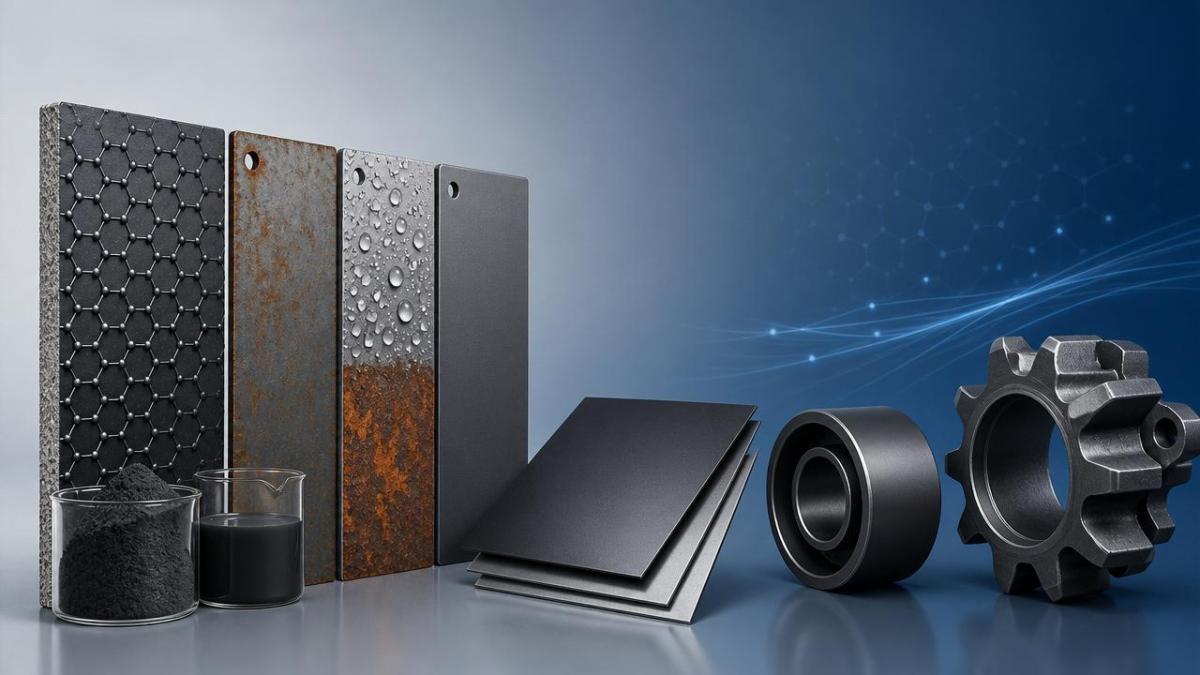
One of the most cited advantages of graphene materials is tortuous-path barrier improvement. Platelet-shaped fillers can make it harder for water, oxygen, and ions to migrate through the coating film. In epoxy primers and anti-corrosion systems, this can support better long-term barrier retention, especially when loading is balanced and platelet orientation is favorable.
However, evaluators should expect realistic gains rather than miracles. Graphene materials do not replace sound surface preparation, correct dry film thickness, or proper zinc pigment balance. They improve the film’s resistance to permeation; they do not compensate for poor adhesion or holiday defects.
2. Corrosion resistance in well-designed primer systems
In corrosion-resistant coatings, graphene materials may improve salt fog durability, electrochemical impedance, and underfilm corrosion resistance. This is especially relevant in epoxy, zinc-rich, or hybrid anti-corrosion coatings used in infrastructure, marine, process equipment, and heavy industry. The gain often comes from a combination of barrier effect, crack-bridging contribution, and microstructural refinement.
Yet this is also the area where overclaiming is common. If the formulation introduces galvanic pathways, poor dispersion agglomerates, or adhesion loss, corrosion performance may worsen rather than improve. Technical evaluators should require electrochemical impedance spectroscopy, adhesion data before and after exposure, and creep-from-scribe results—not only total salt spray hours.
3. Electrical conductivity and antistatic function
Graphene materials can support conductivity at lower loadings than some traditional conductive fillers, depending on grade, aspect ratio, and dispersion quality. This can benefit antistatic flooring, electronics housings, EMI-related applications, sensors, and specialty industrial coatings where controlled surface resistivity matters.
The practical improvement here is often formulation efficiency rather than absolute conductivity leadership. Carbon black, carbon nanotubes, silver, and metal-coated fillers may still outperform graphene materials in some conductivity targets. The real question is whether graphene materials deliver the required resistivity while preserving mechanical properties, appearance, and processing economics.
4. Wear, scratch, and mechanical reinforcement
Certain coating systems show improved scratch resistance, abrasion resistance, and modulus when graphene materials are well integrated. This can matter in industrial flooring, machinery components, transportation equipment, and protective topcoats exposed to repeated handling or particulate wear.
Still, the reinforcement effect is highly formulation-specific. Excess loading can increase brittleness, reduce elongation, or create surface defects. Evaluators should check whether the claimed wear improvement remains after impact testing, flexibility testing, and environmental aging.
What usually does not improve as much as expected
A disciplined evaluation also means knowing where graphene materials may underdeliver relative to promotional claims.
- Universal adhesion improvement: adhesion depends more on substrate preparation, binder chemistry, and interfacial design than on graphene addition alone.
- Cost-neutral upgrades: high-quality graphene materials, especially pre-dispersed functional grades, can raise formulation cost significantly.
- Easy drop-in substitution: many systems require rheology adjustment, dispersant changes, or cure optimization.
- Aesthetic consistency: haze, color shift, gloss reduction, or texture changes can occur at useful loading levels.
- Direct scale transfer from papers to production: academic studies often use idealized preparation methods that are not practical in industrial lines.
Decision table: how to judge fit by application goal
The table below can help technical evaluators prioritize which metrics matter most when screening graphene materials for industrial coatings.
Scenario-specific checks for technical evaluators
If you are evaluating marine or infrastructure coatings
Prioritize long-duration corrosion metrics, cyclic aging, and coating system compatibility rather than only additive novelty. Graphene materials are more credible here when they support existing anti-corrosion design rather than attempt to replace it. Ask whether the supplier has data in multi-layer systems, not only in isolated films.
If you are evaluating conductive industrial coatings
Focus on conductivity stability over time, especially under humidity, abrasion, and cleaning cycles. A coating that meets resistivity on day one but drifts after service exposure is not a qualified solution. Graphene materials should be judged on consistency, loading efficiency, and process robustness.
If you are evaluating high-throughput manufacturing use
The key question is not simply whether graphene materials improve a property. It is whether they do so without slowing production. Check milling energy, filtration behavior, nozzle wear, settling tendency, storage stability, and batch-to-batch variation. Procurement teams should align these technical checks with supplier quality controls and documentation depth.
Commonly missed risks that distort graphene materials evaluation
- Comparing unmatched solids content or film thickness between control and modified coatings.
- Ignoring the role of surfactants and dispersants, which may alter water uptake or adhesion independently of graphene materials.
- Using only short exposure tests and declaring long-term durability improvement.
- Assuming “graphene” is a single material category with standardized behavior.
- Underestimating regulatory, EHS, and handling requirements for nanoparticle-containing products.
- Failing to ask for supply continuity, quality tolerances, and certificate support from global vendors.
Practical execution plan: how to move from interest to qualification
For companies considering graphene materials in an industrial coating program, the most efficient path is phased validation. Start with one target function and one coating family. Avoid trying to prove corrosion, conductivity, wear resistance, and thermal performance all at once. A focused qualification path produces better technical decisions and clearer cost-benefit analysis.
- Define the primary performance gap in the incumbent coating.
- Select one or two graphene materials grades with documented resin compatibility.
- Test a loading ladder rather than a single point.
- Include processability metrics in every trial batch.
- Use realistic controls, substrates, and curing conditions.
- Document total applied cost, not additive cost alone.
- Require repeatability across multiple production-scale batches before qualification.
FAQ for evaluating graphene materials in coatings
Are graphene materials best for anti-corrosion coatings?
They are often most convincing in barrier and corrosion-control applications, but only when integrated into a sound primer design. They are not a substitute for full coating system engineering.
Do graphene materials always reduce loading compared with other conductive fillers?
Not always. The answer depends on grade, aspect ratio, percolation behavior, and target resistivity. Comparative testing against carbon black or nanotubes is essential.
What is the most important technical document to request?
Ask for application-specific test data with control formulations, loading levels, dispersion method, and exposure conditions clearly stated. Without that context, performance claims around graphene materials are difficult to trust.
Final recommendation for next-step evaluation
The real advantage of graphene materials in industrial coatings is selective, measurable, and formulation-dependent. They can improve barrier properties, corrosion resistance, conductivity, and wear life, but only when dispersion quality, resin compatibility, and test design are controlled. For technical evaluators, the correct question is not whether graphene materials are advanced. It is whether they solve a defined performance gap better than incumbent fillers at an acceptable processing and cost profile.
If your organization wants to move forward, prioritize a supplier discussion around five points: exact graphene grade, dispersion route, target loading window, validated application data, and production-scale consistency. From there, align on testing scope, qualification timeline, budget impact, and supply continuity before any broader commercial rollout.
Deep Dive
Related Intelligence
 Industrial CoatingsWhy Brand Elevation Strategies Matter More Than Ever for Industrial Coatings Suppliers Targeting EU MarketsAnalyst:Lead Materials Scientist
 Industrial CoatingsWhich Corporate Case Studies Show Measurable ROI from Industrial Coatings Automation in Food Plant Maintenance?Analyst:Lead Materials Scientist
 Industrial CoatingsWhat Makes Industrial Coatings Eco-Friendly in 2026 — And Do They Meet Marine Corrosion Standards?Analyst:Lead Materials Scientist