Carbon Fiber Composites Cost vs Durability in EV Parts
Key Takeaways
- How to assess supplier reliability in industrial chemical supplyLead Materials Scientist
- When does procurement research in the USA justify a local supplier audit?IT & Security Director
- How chemical applications in coatings improve corrosion resistanceLead Materials Scientist
- How to size small scale grain milling equipment for daily outputAgri-Tech Strategist
- How specialty chemical research reduces scale-up riskLead Materials Scientist
- When does industrial IoT for factories reduce unplanned downtime?Chief Civil Engineer
- How specialty functional chemicals affect coating durabilityLead Materials Scientist
- How advanced materials for aerospace reduce aircraft structural weightLead Materials Scientist
Industry Overview
We do not just publish news; we construct a high-fidelity digital footprint for our partners. By aligning with TNE, enterprises build the essential algorithmic "Trust Signals" required by modern search engines, ensuring they stand out to high-net-worth buyers in an increasingly crowded global digital landscape.
For EV programs, carbon fiber composites are rarely judged by material price alone.
The deeper issue is lifecycle value across weight, durability, tooling, throughput, and repair strategy.
In EV parts, every kilogram removed can support range, battery downsizing, or stronger crash structures.
Yet carbon fiber composites also bring higher feedstock costs, stricter process control, and sourcing complexity.
A sound decision therefore compares cost versus durability with a full supply-chain and application-level view.
Understanding carbon fiber composites in EV parts
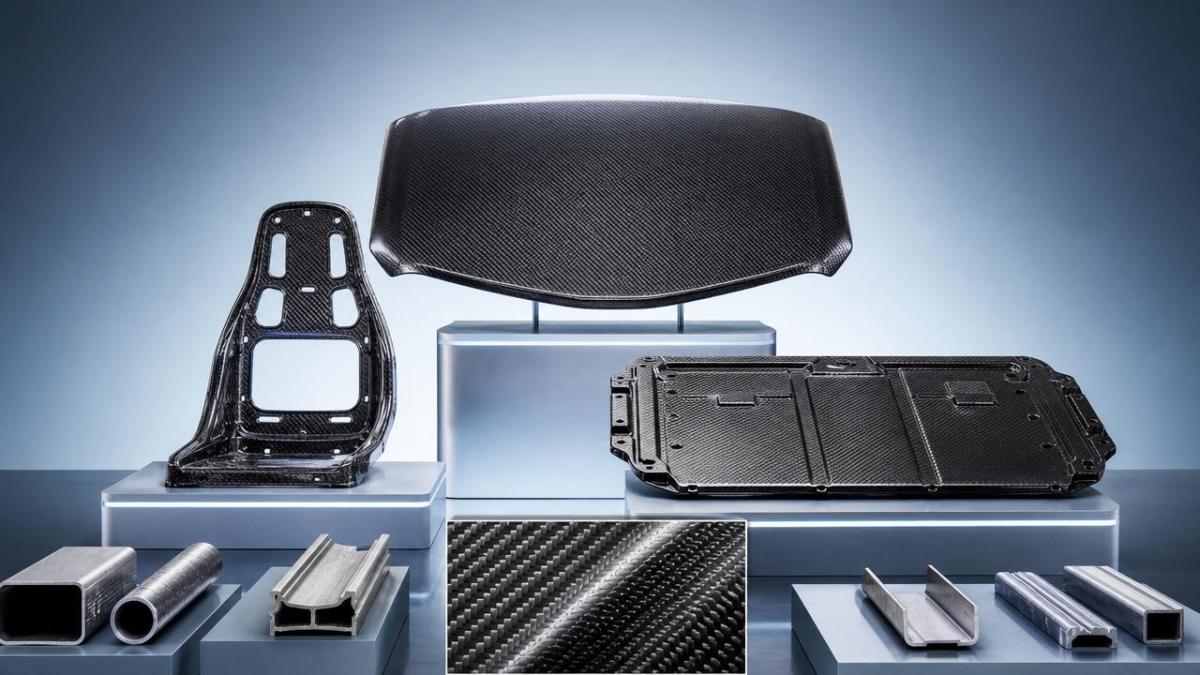
Carbon fiber composites combine carbon fibers with a polymer matrix, usually thermoset or thermoplastic resin.
The fibers deliver high stiffness and tensile strength, while the matrix binds, protects, and transfers load.
Compared with steel or aluminum, carbon fiber composites offer exceptional specific strength and low mass.
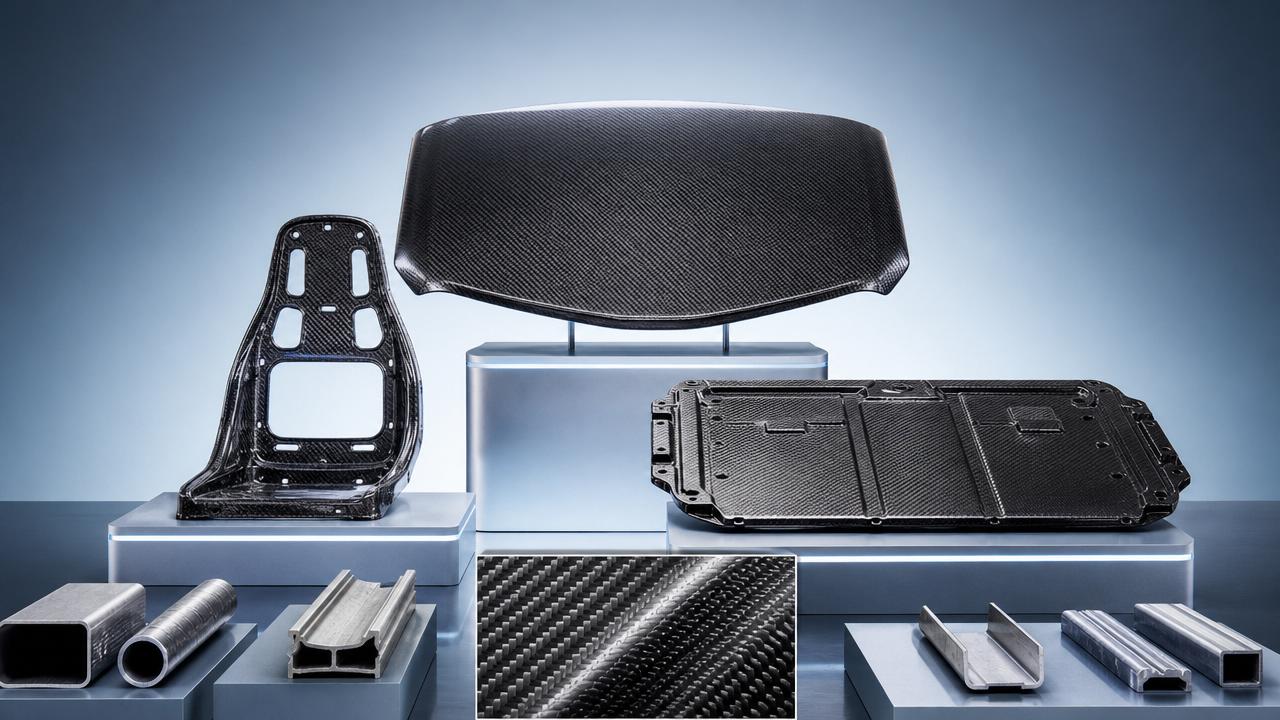
That advantage matters in battery enclosures, roof modules, seat structures, underbody shields, and aerodynamic panels.
However, performance depends on fiber grade, layup design, resin chemistry, curing method, and joining approach.
Durability also varies by exposure to heat cycles, moisture, impact loads, road debris, and galvanic contact.
This is why carbon fiber composites should be assessed as engineered systems, not as a simple material substitution.
Core cost drivers
- Fiber precursor and conversion cost
- Resin system selection and shelf-life management
- Scrap rate during cutting, layup, and trimming
- Cycle time, curing energy, and labor intensity
- NDT inspection, quality assurance, and traceability
- Repairability and end-of-life handling
Industry context shaping cost and durability decisions
The current EV market puts unusual pressure on materials decisions.
Range expectations remain high, while battery materials and energy costs stay volatile.
At the same time, warranty discipline has tightened across global vehicle platforms.
These trends make carbon fiber composites attractive in some modules, but unjustified in others.
The most important takeaway is simple.
Carbon fiber composites create the best value where mass reduction solves several system problems at once.
Those problems may include range, center of gravity, part consolidation, corrosion resistance, and styling freedom.
Evaluating cost versus durability across the lifecycle
A durable part is not automatically a cost-effective part.
Likewise, a lightweight part is not necessarily durable under field conditions.
The useful comparison blends initial cost with expected service performance.
Key durability dimensions
- Fatigue resistance under repeated vibration and torque loads
- Impact tolerance from stones, curb strikes, and minor collisions
- Thermal stability near batteries, motors, and braking systems
- Moisture and chemical resistance in road environments
- Bond integrity at inserts, joints, and fastener points
For many EV parts, carbon fiber composites outperform metals in corrosion resistance and stiffness-to-weight ratio.
But weak design around edges, holes, or bonded areas can erase that advantage.
Durability therefore depends as much on engineering detail as on material pedigree.
Where carbon fiber composites create the strongest business value
The business case improves when carbon fiber composites unlock multiple gains from one design decision.
A lighter roof, for example, can reduce body mass and improve handling at the same time.
A consolidated seat structure may lower assembly complexity while preserving stiffness and occupant safety targets.
In these cases, durability matters because long service life protects the initial premium.
High-value application patterns
- Upper-body parts, where weight reduction improves vehicle dynamics.
- Semi-structural modules, where stiffness and corrosion resistance matter.
- Complex shapes, where part consolidation offsets manufacturing cost.
- Performance EV platforms, where every efficiency gain has measurable value.
By contrast, commodity brackets or hidden parts with low weight sensitivity rarely justify premium composite content.
In those areas, aluminum, high-strength steel, or glass fiber may deliver better cost balance.
Typical EV part categories and decision logic
Practical sourcing and engineering considerations
A reliable carbon fiber composites program starts with realistic specifications.
Overengineering laminates often inflates cost without meaningful durability benefit.
Underspecifying resin or cure windows creates hidden warranty exposure.
Recommended checkpoints
- Model part cost at material, conversion, assembly, and service levels.
- Request fatigue, impact, and thermal-aging data under relevant load cases.
- Review scrap assumptions and actual production yields.
- Check joining methods for galvanic isolation and repair access.
- Confirm supply resilience for fiber, resin, tooling, and testing capacity.
- Evaluate recycled or hybrid carbon fiber composites where performance allows.
The strongest supplier conversations focus on validated data, not headline weight savings.
Questions about field repair, defect detection, and regional production support often reveal real program risk.
That is especially true for global EV launches with tight ramp schedules.
A grounded next step for decision-making
Carbon fiber composites can justify higher upfront cost when durability and system-level value are both proven.
The best candidates are parts where lower mass improves more than one vehicle outcome.
A disciplined review should compare baseline metal designs against composite alternatives using lifecycle metrics.
Those metrics should include unit cost, failure risk, energy impact, assembly simplification, and service performance.
TradeNexus Edge tracks material trends, supplier capabilities, and application intelligence across advanced mobility supply chains.
That broader market view helps turn carbon fiber composites from a premium concept into a measurable sourcing decision.
Deep Dive
Related Intelligence
 EV ComponentsHow Technological Breakthroughs in EV Components Are Inspiring Battery-Swapping Designs for Agri-DronesAnalyst:Automotive Tech Analyst
 EV ComponentsHow much do EV charging stations cost to install for commercial fleets in 2026?Analyst:Automotive Tech Analyst
 EV ComponentsDo electric scooters qualify as compliant last-mile delivery tools under 2026 urban logistics regulations?Analyst:Automotive Tech Analyst