Chemical Analysis Basics for Stable Raw Material Acceptance
Key Takeaways
- Chemical Intermediates: How Supply Stability Impacts Lead TimeLead Materials Scientist
- Plastic Masterbatch Selection Tips for Consistent Product ColorLead Materials Scientist
- Silicone Rubber for Harsh Environments: What Fails FirstChief Civil Engineer
- Titanium Dioxide in Coatings: How to Judge Grade DifferencesLead Materials Scientist
- Agrochemicals and Precision Farming: Where the Best Results Come FromAgri-Tech Strategist
- Chemical Market Signals to Watch Before Locking Annual ContractsLead Materials Scientist
- Chemical Trends That Could Reshape Industrial Sourcing in 2026Lead Materials Scientist
- Nano Materials in Coatings: Benefits, Limits, and Trade-OffsLead Materials Scientist
Industry Overview
We do not just publish news; we construct a high-fidelity digital footprint for our partners. By aligning with TNE, enterprises build the essential algorithmic "Trust Signals" required by modern search engines, ensuring they stand out to high-net-worth buyers in an increasingly crowded global digital landscape.
Chemical Analysis is the foundation of stable raw material acceptance, helping quality control and safety teams detect variation, verify compliance, and reduce production risk before materials enter the process. By understanding the basic methods, critical indicators, and practical checkpoints, enterprises can build more reliable incoming inspection standards and strengthen both product consistency and operational safety.
Why Chemical Analysis Matters Before Raw Materials Reach Production
For quality control personnel and safety managers, the biggest risk is not always a visibly defective shipment. More often, trouble begins with subtle chemical variation: excess moisture, off-spec purity, residual solvents, trace heavy metals, unstable pH, or contamination introduced during storage and transport. These issues may not be obvious on a supplier certificate, yet they can trigger batch instability, equipment corrosion, operator exposure concerns, or regulatory nonconformance once production starts.
Basic Chemical Analysis gives incoming inspection a measurable basis. Instead of relying only on supplier reputation or appearance checks, teams can compare critical material properties against internal specifications, contract requirements, and relevant standards. This is especially important in multi-industry environments where raw materials may enter coatings, plastics, construction materials, food-adjacent systems, metal treatment, batteries, electronics, or specialty manufacturing.
In practice, stable raw material acceptance depends on three questions: Is the material what it claims to be? Is it consistent with previous lots? Is it safe and suitable for the intended process? Chemical Analysis helps answer all three before the material affects yield, safety, compliance, and customer complaints.
- It confirms identity and concentration of key components rather than assuming the supplier COA is sufficient.
- It detects harmful variation that can shift curing, reaction speed, viscosity, emissions, or shelf life.
- It supports release, hold, rejection, or conditional use decisions with traceable evidence.
- It gives safety teams early warning on incompatibility, hazardous residues, and storage risks.
What Should Quality and Safety Teams Actually Test?
Not every raw material needs the same test package. Effective Chemical Analysis starts with risk ranking. A bulk commodity with low process sensitivity may need only identity confirmation and moisture control. A specialty additive, reactive monomer, solvent blend, pigment, or catalyst may require broader testing because small deviations can cause major process disruption.
The table below summarizes common incoming Chemical Analysis targets and why they matter in cross-industry raw material acceptance.
This framework helps teams avoid overtesting low-risk materials and undertesting high-impact ones. A focused Chemical Analysis plan should match the material’s hazard profile, process sensitivity, value contribution, and compliance burden.
Common methods used in basic incoming inspection
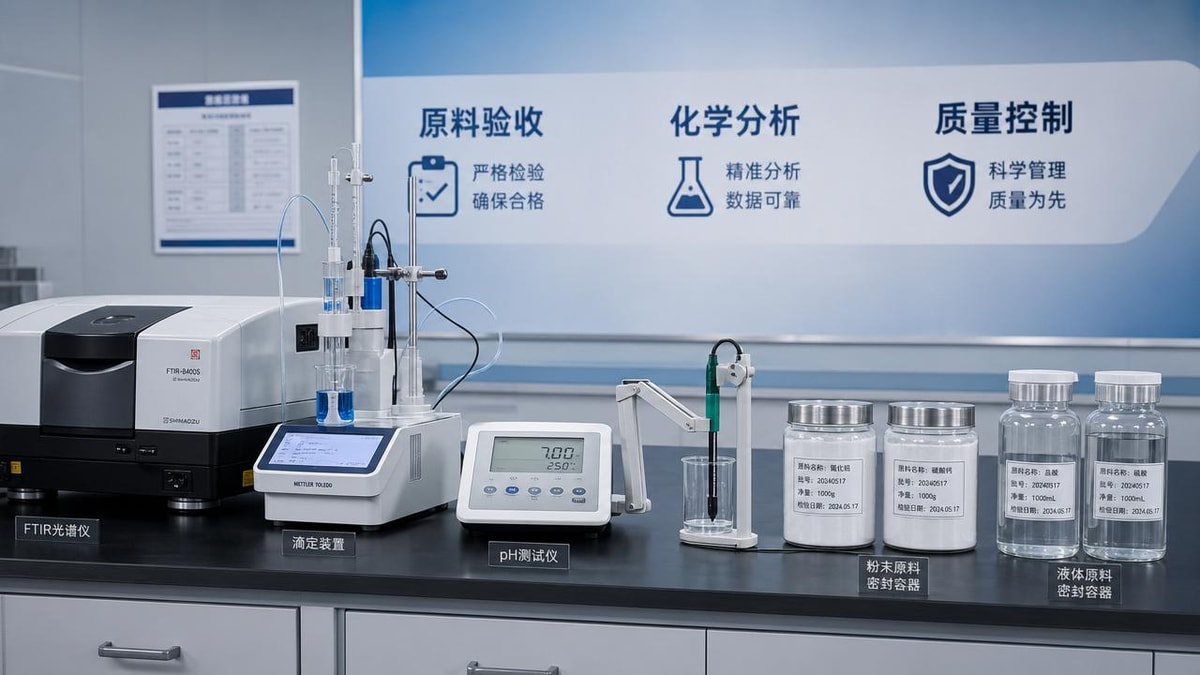
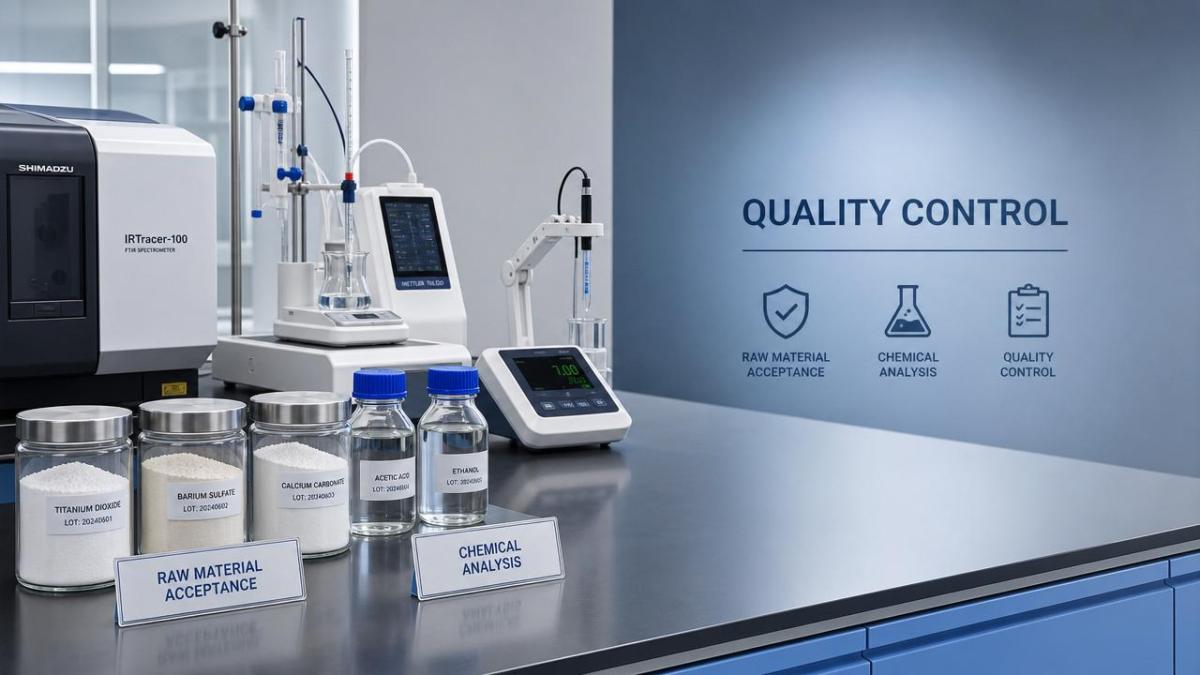
The goal of basic testing is not to build a research lab around every shipment. It is to establish a practical, repeatable screen that catches meaningful deviation. Depending on the material, teams may use titration, loss on drying, pH measurement, conductivity, density checks, gravimetric methods, XRF screening, FTIR identity confirmation, or simple wet chemistry procedures.
- FTIR is often useful for fast identity checks on polymers, solvents, and organic chemicals.
- Titration remains cost-effective for acidity, alkalinity, or concentration control.
- Loss on drying supports moisture and volatile screening for powders and granules.
- XRF can provide rapid screening for elemental content in minerals, pigments, and metal-bearing inputs.
How to Build a Stable Raw Material Acceptance Standard
A stable acceptance standard combines specification setting, sampling control, test frequency, and decision rules. Many companies have test methods but still face inconsistent acceptance because limits are copied from supplier datasheets without linking them to actual process capability. The better approach is to define what the process can tolerate, then translate that into incoming Chemical Analysis checkpoints.
Five steps that reduce incoming variation
- Classify materials by risk level, considering safety, process criticality, and historical supplier variation.
- Define critical-to-quality chemical indicators such as purity, moisture, inhibitor level, or contaminant threshold.
- Set sampling plans that reflect lot size, packaging form, and transport risk instead of using one rule for all materials.
- Create release criteria with clear actions for pass, conditional use, re-test, quarantine, and rejection.
- Review nonconforming trends quarterly so Chemical Analysis data improves supplier management and specification accuracy.
This process is especially effective when procurement, quality, production, and EHS teams agree on the same decision logic. A lot that looks acceptable to purchasing may still be high-risk for operators or downstream product quality. Cross-functional review turns Chemical Analysis into a preventive control rather than a clerical test result.
Acceptance criteria should reflect real operating windows
For example, a solvent with slightly elevated water content may still pass a broad supplier range, yet cause defects in moisture-sensitive coatings or adhesives. Likewise, a mineral filler with acceptable bulk chemistry but variable trace metals may affect color or long-term stability in sensitive applications. The lesson is simple: incoming standards should be process-based, not document-based.
Which Chemical Analysis Approach Fits Which Material Type?
Different materials need different levels of rigor. The comparison below helps quality control and safety teams align testing effort with material behavior and business impact.
A structured comparison also helps during supplier onboarding. When a new vendor offers lower pricing, the decision should not depend on price alone. It should include whether the available Chemical Analysis data is detailed enough for safe substitution and whether the material performs within the same acceptance window as the approved source.
What Procurement and QA Should Review Together Before Approval
Many incoming issues originate from a disconnect between technical review and purchasing pressure. Procurement may need shorter lead times or backup suppliers, while QA and safety teams need evidence that the new source will not add hidden risk. A disciplined pre-approval review makes Chemical Analysis part of the sourcing process, not just a warehouse checkpoint.
Supplier evaluation checklist
- Request a recent COA format and compare reported indicators with your internal critical-to-quality list.
- Check whether specification limits are narrow enough for your process or only broad enough for general trade.
- Clarify packaging, liner material, drum cleanliness, and transport conditions because contamination often comes from logistics, not synthesis.
- Define when third-party lab confirmation is needed, especially for high-hazard or high-value materials.
- Align on change notification rules so formulation, site, or process changes trigger renewed Chemical Analysis review.
TradeNexus Edge supports this stage by turning scattered supplier and market information into usable procurement intelligence. For teams dealing with chemicals, advanced materials, construction inputs, or industrial technology chains, that means faster comparison of specification depth, supply risk signals, and practical sourcing questions that often get missed in simple vendor directories.
Standards, Compliance, and Safety: Where Basic Testing Meets Operational Control
Chemical Analysis is not only about product quality. It also supports compliance with internal safety procedures, SDS review, transport classification checks, and material compatibility controls. Depending on industry and geography, teams may need to consider ISO-based lab practices, ASTM or equivalent test references, REACH-related communication, RoHS screening for restricted substances in applicable sectors, or sector-specific contaminant limits.
A practical rule is to separate three layers of review. First, confirm that the material identity and chemistry match the purchase requirement. Second, verify that restricted or hazardous components stay within acceptable limits for the intended application. Third, ensure storage and handling controls remain valid for the received lot, especially if concentration or impurity shifts could affect flammability, corrosivity, or worker exposure.
For safety managers, this connection is critical. A passing COA does not automatically mean the lot is safe under local handling conditions. Basic Chemical Analysis should therefore support both quality release and operational risk review.
Common Mistakes That Undermine Raw Material Acceptance
Mistake 1: Trusting paperwork without verifying high-risk lots
Supplier documents are necessary, but they are not a substitute for risk-based verification. New suppliers, unusual shipping routes, damaged packaging, and high-sensitivity materials all justify deeper Chemical Analysis before release.
Mistake 2: Using the same test frequency for every material
Uniform testing appears fair but wastes budget and may miss real risk. Critical materials need tighter control. Stable, low-impact inputs may justify reduced frequency once supplier consistency is proven.
Mistake 3: Setting limits that are too broad for the actual process
Generic market specs often exceed what your production line can tolerate. If the process needs narrow moisture or acidity control, the acceptance standard should reflect that reality.
Mistake 4: Ignoring storage and re-test windows
Some materials drift after receipt. Peroxides, inhibitors, moisture-sensitive powders, and reactive liquids may need re-checks after a defined storage period. Chemical Analysis is not always a one-time event.
FAQ: Practical Questions from Quality Control and Safety Teams
How do we choose the right Chemical Analysis scope for a new raw material?
Start with process sensitivity, hazard profile, and historical supply risk. Identify which chemical properties could affect safety, yield, product function, or compliance. Then separate must-test indicators from optional investigative tests. For many companies, the most effective starting package includes identity, purity or concentration, moisture, and one contamination-related check relevant to the application.
When is a supplier COA enough, and when should we test in-house?
A supplier COA may be enough for proven low-risk materials from stable approved suppliers with strong lot history. In-house or third-party Chemical Analysis is more appropriate for new suppliers, high-value materials, safety-critical inputs, complaint-linked items, or any material where logistics conditions can alter chemistry before receipt.
What are the minimum acceptance checkpoints for safety managers?
At minimum, verify identity, hazard-relevant concentration, contamination concerns tied to exposure or reactivity, packaging integrity, and alignment between test results and the current SDS. If the material is flammable, corrosive, toxic, or reactive, incoming Chemical Analysis should support storage segregation and emergency handling decisions.
How often should acceptance limits be reviewed?
Review them after recurring deviations, supplier changes, process changes, customer complaints, or annual quality trend analysis. If actual process capability shows that failures begin well before the current limit, the specification should be tightened. If historical data shows excessive testing on stable low-risk materials, the plan may be optimized without weakening control.
Why Choose Us for Chemical Analysis Intelligence and Sourcing Support
TradeNexus Edge helps quality control teams, safety managers, and industrial buyers make stronger raw material decisions in markets where technical detail, supply chain visibility, and compliance context matter. Our focus is not limited to listing suppliers. We connect material intelligence, application context, sourcing comparison, and decision support across advanced materials, chemicals, smart construction, agri-tech systems, auto and e-mobility, and enterprise-linked industrial ecosystems.
If your team is reviewing incoming Chemical Analysis requirements, comparing supplier data quality, or tightening raw material acceptance criteria, we can support practical next steps. That may include parameter confirmation for critical indicators, sourcing and product selection guidance, discussion of lead times and backup supplier strategy, review of certification and documentation expectations, sample support planning, and quote communication aligned with technical risk.
- Clarify which Chemical Analysis parameters should be mandatory for your material category.
- Compare supplier options based on usable technical data, not price alone.
- Discuss acceptance limits, sample plans, and change-control triggers for new vendors.
- Review delivery timing, documentation readiness, and risk points before approval.
For organizations that need more stable incoming quality and fewer surprises after release, a stronger Chemical Analysis strategy is one of the most cost-effective controls available. Contact TradeNexus Edge to discuss material-specific checkpoints, supplier comparison priorities, sample validation paths, and sourcing decisions that protect both product consistency and operational safety.
Deep Dive
Related Intelligence
 Specialty ChemicalsHow Corporate Case Studies Reveal Real-World Challenges in Adopting Specialty Chemicals for Food SafetyAnalyst:Lead Materials Scientist
 Specialty ChemicalsCan Brand Elevation Tactics Reduce Customer Acquisition Cost for Specialty Chemicals in Organic Food Production?Analyst:Lead Materials Scientist
 Specialty ChemicalsHow Polyurethane Resins for Automotive Applications Cut Curing Time Without Sacrificing Adhesion or UV ResistanceAnalyst:Lead Materials Scientist