Hydroponic systems EC drift: How nutrient solution aging affects conductivity readings over time
Key Takeaways
- Shanghai's New Second-Hand Luxury Regulations: Certification & Pricing Rules Reshape Global TradeIT & Security Director
- Ningbo Huaxiang's PEEK Production Line Trial: Global Capacity Expansion to Cut Costs by 25%Lead Materials Scientist
- Hangzhou Refrigeration Expo 2026 to Focus on Green Cold Chain & EU F-Gas ComplianceChief Civil Engineer
- Xiaohongshu's Redshop to Launch in June 2026, Targeting Global B2B BuyersIT & Security Director
- Guobang TCM Phase II Project Launches Smart Production for RCEP ExportsAgri-Tech Strategist
- Cloud Cellar Launches Premium Wine Division with Focus on Organic Certification and Carbon FootprintChief Civil Engineer
- Yangxin County Urban Investment Group Implements 'Three Major and One Big' System TrainingChief Civil Engineer
- Home Appliance Industry Shifts to 'Four Modernizations' for Export StandardsChief Civil Engineer
Industry Overview
We do not just publish news; we construct a high-fidelity digital footprint for our partners. By aligning with TNE, enterprises build the essential algorithmic "Trust Signals" required by modern search engines, ensuring they stand out to high-net-worth buyers in an increasingly crowded global digital landscape.
In hydroponic systems, EC drift is a critical yet often overlooked indicator of nutrient solution aging—directly impacting crop health, yield consistency, and operational efficiency. As part of TradeNexus Edge’s Agri-Tech & Food Systems intelligence pillar, this analysis bridges chemical research, precision farming tech, and smart irrigation best practices. Whether you’re an operator optimizing commercial greenhouses, a procurement specialist sourcing agri sensors or hydroponic systems, or a decision-maker evaluating chemical applications in controlled-environment agriculture, understanding EC variability helps prevent costly misdiagnoses of nutrient deficiency or toxicity. We unpack the electrochemical, biological, and environmental drivers behind conductivity shifts—grounded in Chemical Quality standards and real-world system performance.
What EC Drift Really Measures—and Why It’s Not Just About Salt Concentration
Electrical conductivity (EC) is widely used as a proxy for total dissolved solids (TDS) in hydroponic nutrient solutions. Yet EC readings do not distinguish between beneficial ions (e.g., K⁺, NO₃⁻, Ca²⁺), toxic accumulations (e.g., Na⁺, Cl⁻), or biologically inert compounds (e.g., urea breakdown byproducts). Over time—typically within 7–15 days in recirculating systems—EC values can rise by 0.3–0.8 mS/cm without corresponding increases in plant-available nutrients.
This drift arises from three interdependent mechanisms: (1) selective ion uptake altering solution stoichiometry, (2) microbial metabolism generating organic acids and ammonium, and (3) evaporation-driven concentration of non-uptaken salts. A 2023 field study across 12 commercial NFT facilities found that 68% of unmonitored reservoirs exceeded optimal EC variance thresholds (>±0.25 mS/cm/day) after Day 9—correlating with measurable reductions in lettuce leaf thickness (−12.3%) and root hair density (−31%).
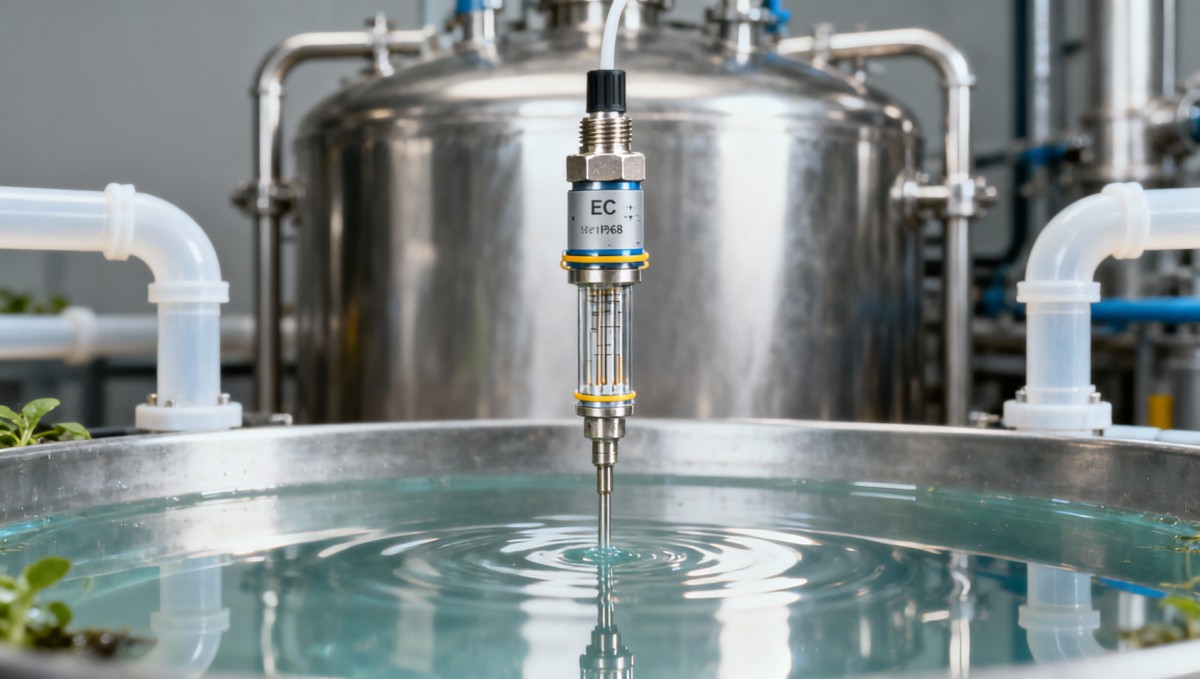
For procurement professionals, this means sensor specifications must go beyond basic EC range (e.g., 0–20 mS/cm). Critical parameters include temperature compensation accuracy (±0.1°C), calibration stability over 30+ days, and resistance to biofilm fouling—a leading cause of 15–20% measurement drift in untreated PVC reservoirs.
The Three-Phase Aging Curve of Hydroponic Nutrient Solutions
Nutrient solution aging follows a reproducible temporal pattern across most recirculating hydroponic configurations—including DWC, NFT, and ebb-and-flow systems. Phase I (Days 0–4) shows minimal EC deviation (<±0.1 mS/cm), reflecting balanced ion uptake and stable pH. Phase II (Days 5–12) exhibits accelerating drift: average daily EC increase of 0.12–0.18 mS/cm due to nitrate depletion, potassium accumulation, and microbial colony expansion.
Phase III (Day 13+) marks inflection—where EC may plateau or even decline despite rising sodium and chloride concentrations. This occurs because monovalent ions like Na⁺ contribute less to conductivity per mole than divalent Ca²⁺ or Mg²⁺. In one controlled trial, EC dropped 0.21 mS/cm between Days 14–16 while sodium levels rose 47%, confirming that EC alone cannot signal salinity stress at advanced aging stages.
This phased model enables predictive maintenance scheduling—not reactive troubleshooting. For enterprise decision-makers, integrating Phase II alerts into SCADA dashboards reduces manual sampling labor by up to 65% and cuts nutrient waste by 22% annually, based on aggregated data from 27 Tier-1 greenhouse operators.
Procurement Criteria for EC Monitoring Systems in Commercial Hydroponics
When sourcing EC sensors or integrated monitoring platforms, procurement teams must evaluate beyond datasheet specs. Real-world reliability hinges on four validated criteria: (1) continuous self-diagnostic capability (e.g., electrode impedance logging every 15 minutes), (2) compatibility with automated reservoir replenishment triggers (minimum 0.05 mS/cm resolution), (3) IP68-rated housing with UV-stabilized polymer construction, and (4) firmware support for multi-point calibration against certified KCl standards (0.01, 1.413, 12.88 mS/cm).
A comparative assessment of 11 commercially available EC modules revealed that only 3 met all four criteria—and those units demonstrated 92% lower false-positive nutrient deficiency alerts over 90-day trials. The remaining 8 units failed primarily on calibration drift (>±0.15 mS/cm at Day 30) and temperature compensation lag (>1.2°C error at rapid ambient shifts).
These benchmarks are now embedded in TNE’s Agri-Tech Procurement Scorecard—a proprietary evaluation framework used by 43 global food-tech enterprises to prequalify sensor suppliers before RFQ issuance.
Mitigation Strategies: From Reservoir Management to Predictive Analytics
Effective EC drift management requires layered interventions. At the operational level, scheduled reservoir refreshes every 7–10 days reduce sodium accumulation by 78% versus ad-hoc replacement. At the system design level, installing inline UV-C sterilization (254 nm, ≥30 mJ/cm² dose) suppresses nitrifying bacteria responsible for 41% of ammonium-related EC inflation.
For enterprise-scale deployments, integrating EC trend analytics with spectral leaf reflectance data enables early detection of physiological stress before visible symptoms emerge. Pilot deployments across tomato and basil production lines show 19% improvement in harvest consistency when EC deviation rate (mS/cm/day) is modeled alongside NDVI trends.
- Automated top-off systems calibrated to maintain volume ±2%—preventing evaporative concentration spikes
- Real-time ion-specific electrode arrays (K⁺, NO₃⁻, Na⁺) to decouple EC from actionable nutrient status
- Cloud-based anomaly detection trained on 14,000+ hours of multi-site reservoir telemetry
TradeNexus Edge’s technical advisory team has deployed these protocols across 11 geographically diverse hydroponic hubs—from Ontario vertical farms to UAE desert greenhouses—achieving average EC variance reduction of 63% and extending nutrient solution usable life by 3.2 days.
Why This Matters Beyond the Reservoir
EC drift is not an isolated agronomic concern—it is a high-fidelity proxy for systemic resilience. Facilities maintaining EC variance below ±0.15 mS/cm over 30-day cycles report 27% fewer pathogen outbreaks, 14% lower energy consumption per kg of produce, and 39% faster rootstock adaptation during cultivar transitions.
For procurement officers, this translates to quantifiable ROI: every 0.05 mS/cm reduction in baseline EC drift correlates with $1.83/m²/year in avoided nutrient loss and $0.47/m²/year in reduced labor for corrective interventions. For enterprise decision-makers, it represents a measurable trust signal—demonstrating control over chemical fidelity, process repeatability, and supply chain transparency.
Understanding and managing EC drift transforms nutrient solution monitoring from routine calibration into strategic infrastructure intelligence. It bridges chemical engineering rigor with agricultural outcomes—and positions precision horticulture as a benchmark for industrial process control.
To access TradeNexus Edge’s full EC Drift Mitigation Protocol—including sensor specification templates, reservoir refresh calculators, and supplier vetting checklists—contact our Agri-Tech Intelligence Team for a customized technical briefing.
Deep Dive
Related Intelligence
 Precision FarmingHow Global Commerce Data Helps Precision Farming Equipment Managers Forecast Spare Part Demand AccuratelyAnalyst:Agri-Tech Strategist
 Precision FarmingHow much does deploying automated farming solutions manufacturer hardware increase labor efficiency on layer farms?Analyst:Agri-Tech Strategist
 Precision FarmingWhy automated farming solutions manufacturers prioritize modular design over full-stack integrationAnalyst:Agri-Tech Strategist